
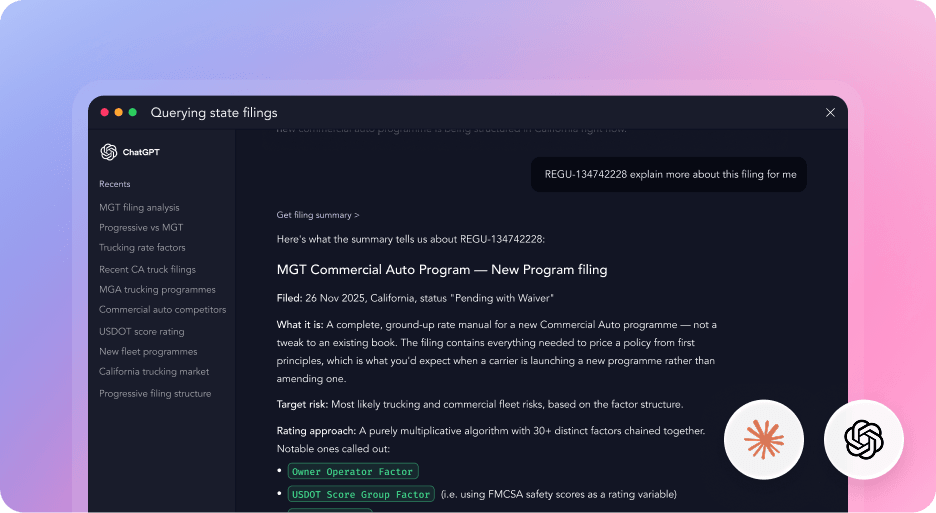
Learn how to conenct both ChatGPT and Claude to the State Filings MCP server in under 5 minutes
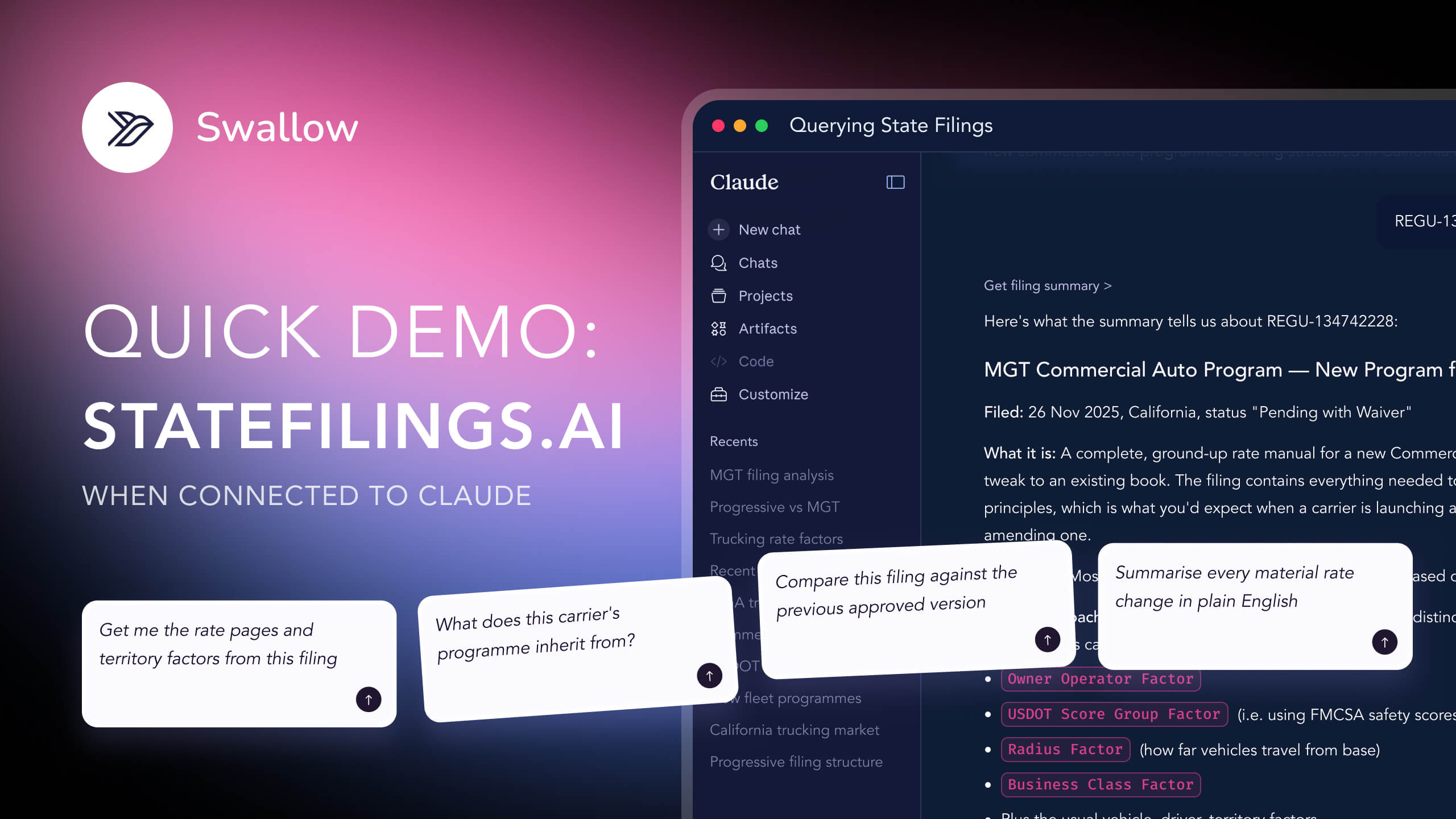
Ask questions in plain English and get cited answers from millions of State Filings thanks to our API
The Swallow State Filings MCP server is a Model Context Protocol endpoint that turns the indexed State filings filings corpus into a conversational research surface for LLM clients including Anthropic Claude Desktop, Claude.ai, OpenAI ChatGPT, Cursor, and Claude Code.
In one line: paste one URL into your LLM, sign in, and ask actuarial questions in plain English. The model searches filings, reads summaries, walks predecessor chains, and pulls structured rate tables on your behalf with no SQL, downloading PDFs, portal trawling, or additonal code dependency.
Model Context Protocol is an open standard originally published by Anthropic that lets LLM clients call external tools through a single JSON RPC interface. The major LLM vendors have converged on MCP, including Claude, ChatGPT, Cursor, and Gemini. An MCP is like a plugin or connector to you existing LLM client experience.
Anyone whose job already involves reading, analyzing and submitting state filings.
Typical users include:
• US admitted P&C carriers running competitive and pricing intelligence
• MGAs and programme managers diligencing incumbent rating plans
• Reinsurers tracking direct and fronted programme behaviour
• Captives and risk retention groups benchmarking against the marketInsur
• Tech new entrants researching state by state competitive landscapes
• Actuarial consultancies pulling filing precedent for client deliverables
• Compliance and state filings teams researching DOI objection patterns
Typical roles inside carriers include:
• Pricing actuaries
• Product managers
• State filings analysts
• Underwriting leadership
• Competitive intelligence teams
The portal is effectively a search box attached to a document repository. Finding a filing usually means downloading large PDFs, manually reading them, repeating the process across carriers, and trying to track changes by memory. The MCP server collapses that process into a single conversational workflow.
Examples include:
• “List every California auto filing in 2025 that added a telematics surcharge”
• “Walk this Progressive programme back to its ISO bureau root”
• “Pull the rates out of REGU-134742228”
• Competitive rate scans that previously took a day become a single prompt
• Programme lineage walks reduce hours of manual cross referencing
• Filing triage becomes near instant
• Every LLM claim remains traceable to State Filings ids and page references
• Conversations themselves become reusable and sharable workpapers
The platform indexes the full state filings record, including:
• Rate filings
• Rule filings
• Programme filings
• Form filings
• Correspondence documents
Coverage today includes California from 2005 onward, alongside bureau and predecessor chains including ISO, NCCI, AAIS, and MSO. Additional states are onboarding through 2026.
If it has been filed in state filings, it is included.
The Free tier includes:
• Full structured filing search
• Semantic summary search
• Filing summaries
Every filing is embedded into vector representations. Natural language queries are enabled against the filing index.,
Benefits include:
• Millisecond search times
• Low compute cost
• Discovery beyond keyword matching
Yes. For Free you get summaries of filing content which augmenets LLM conversational logic.
Yes. Create a free account here
Most LLM clients support MCP server plugins or connections, it can usually integrate successfully.
The MCP server is plain JSON RPC 2.0 over HTTPS. It is stateless rather than SSE.
Yes. The same surfaces powering internal tooling are available externally:
• Structured search
• Semantic search
• Structured extracts
Paste one MCP server URL (https://api.statefilings.ai/mcp) into a LLM client of your choice - Claude, ChatGPT, Cursor, Gemini etc. Sign in, and the indexed state filings corpus becomes conversational.
Search, summaries, lineage and structured rate tables all become accessible through natural language.
Yes. No mutations are possible through the MCP surface.
No. The server is deterministic. It only returns filed values. The MCP server will not invent anything. If the corpus lacks a value, the model points users back to the source documents instead.
Current indexed coverage includes California from 2005 onward. Additional states are onboarding throughout 2026.
No. StateFilings is an independent product built by Swallow (Llow Group Ltd). We are not affiliated with, endorsed by, or connected to the National Association of Insurance Commissioners (NAIC) or any state insurance department. The filings in our corpus are public regulatory records, filed by insurers with state regulators and available to the public. We index, summarise, and structure those public documents; the underlying filings remain exactly as their filers submitted them.
No