
SERFF filings come with their own vocabulary, and a lot of it is unfamiliar even to people who work in insurance every day. Terms like disposition, rating factor and objection letter mean something specific and consistent across states, even though usage can vary at the margins. Knowing them turns a dense filing into something you can navigate quickly.
This is a working glossary of the terms that come up most often, grouped by where they sit in a filing's life. Each one links to a fuller guide if you want the whole picture.
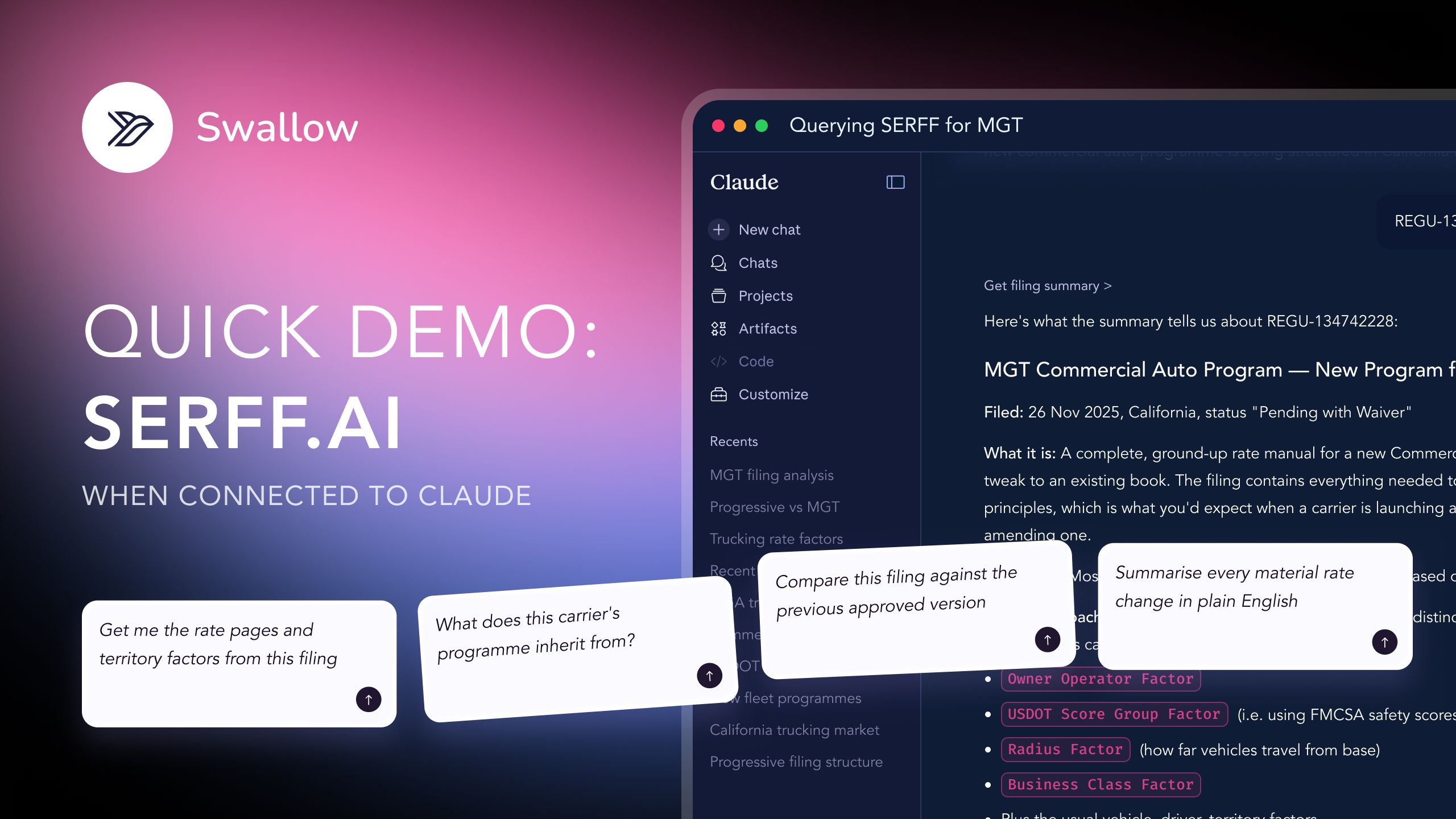
serff.ai is built to do that for you: it indexes millions of SERFF filings and lets you ask questions in plain English, even within the context of that specific filing, instead of opening documents one by one. You can connect it to the AI assistant you already use: Claude or ChatGPT, via the serff.ai MCP server, or work directly in the web platform.
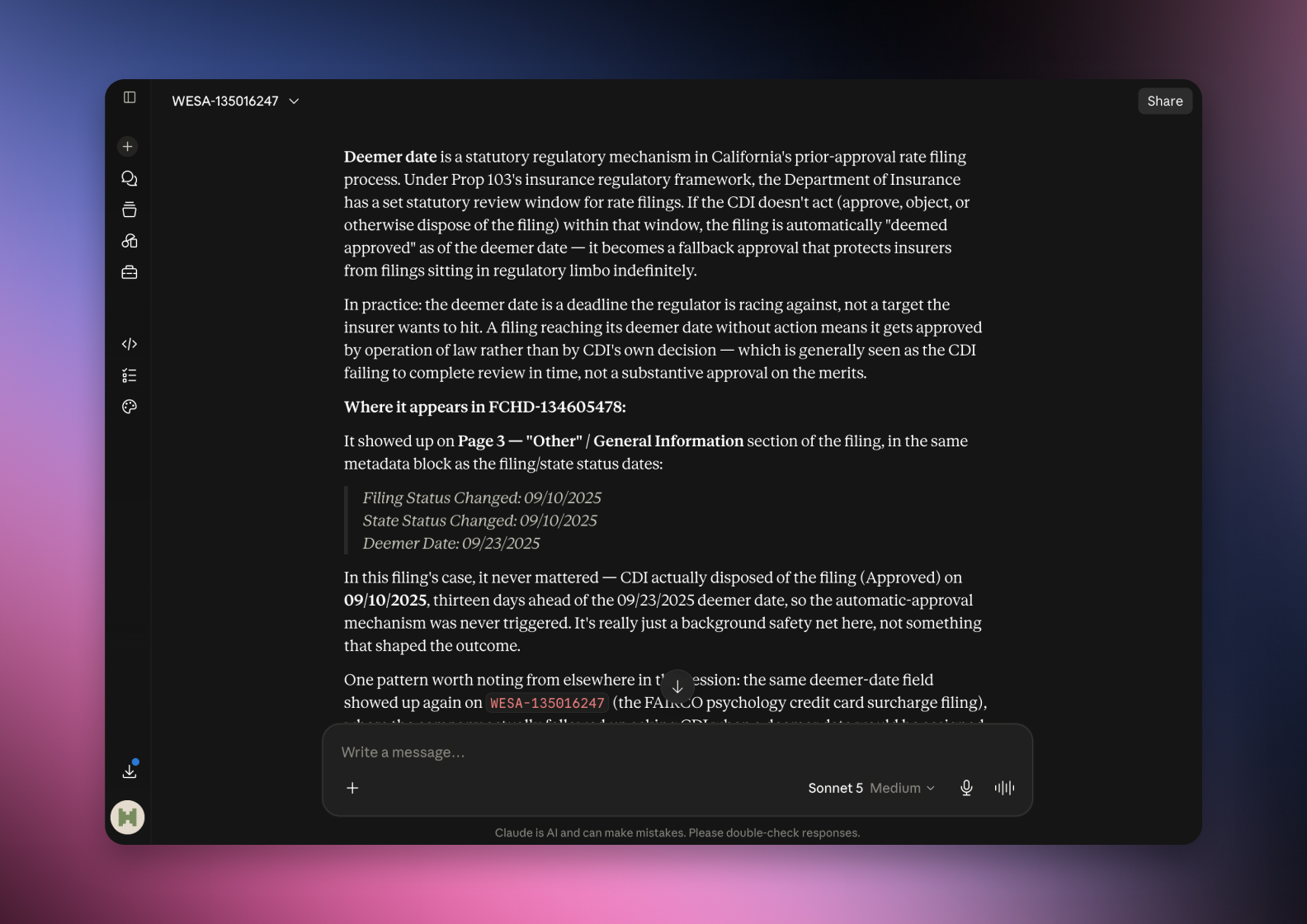

Connected via MCP to the AI you already use, Claude or ChatGPT, or through our dedicated platform, serff.ai makes searching and analysing SERFF filings effortless. An unfamiliar term becomes a single question: ask what it means, where it appears, or how it affects the filing, and get a grounded, cited answer in seconds.
The manual way
Look up an unfamiliar term, then hunt for it in the filing.
With serff.ai, just ask
“What does this term mean, and where does it appear in this filing?”
The manual way
Guess whether a term applies to rates, forms or both.
With serff.ai, just ask
“Does this term apply to the rate filing, the form filing, or both?”
The manual way
Cross-reference jargon against a general glossary.
With serff.ai, just ask
“Explain this term the way it is used in this specific filing.”
The manual way
Keep a personal glossary updated as new terms come up.
With serff.ai, just ask
“List every filing-specific term used in this document.”
Every answer is cited back to the exact page of the source PDF and grounded only in filed values, with no invented numbers, so you can trust it the way this audience needs to. Research that took weeks takes a prompt.
No credit card required. Simply sign up and connect to Claude or ChatGPT or use Swallow’s SERFF.ai platform.
SERFF standardises how filings are structured across almost every state, and a shared vocabulary comes with that structure. The terms below are the ones you will run into in nearly any filing, regardless of product or state.
Bookmark this page. Most filings only use a handful of these terms at once, so you rarely need the whole list, just the two or three that are unfamiliar in the filing in front of you.
Most SERFF filings draw on the same core vocabulary: lifecycle terms like status and disposition, pricing terms like rate and rating factor, and document terms like form and endorsement. Once you recognise these, a filing from any state or product reads the same way.
TOI stands for Type of Insurance and Sub-TOI for Sub-Type of Insurance, the fields SERFF uses to classify a filing by the product line it covers.
Filing status is where the filing currently stands in review; disposition is the final decision once review is complete.
A rate filing changes the price; a rule filing changes the logic that decides how that price and coverage apply to a given risk.
It is the document in a rate filing that explains the reasoning behind a rate change, including loss experience, trend and methodology.
Each term above links to its own dedicated guide with a fuller explanation and worked examples.





 ChatGPT
 Claude
.png)
.png)
.png)