
Researching policy forms means finding the specific contract documents behind a product and working out how they fit together: which form is the base, which endorsements attach to it, and which edition is currently in force. A single product can involve a base form plus a dozen endorsements, filed across several states and editions, so the research task is really an assembly job as much as a search.
This is how to approach it: where forms are catalogued, how to confirm you have the current edition, and how to build a complete picture of what a product covers from its component forms.
serff.ai is built to do that for you: it indexes millions of SERFF filings and lets you ask questions in plain English instead of opening documents one by one. You can connect it to the AI assistant you already use: Claude or ChatGPT, via the serff.ai MCP server, or work directly in the web platform.
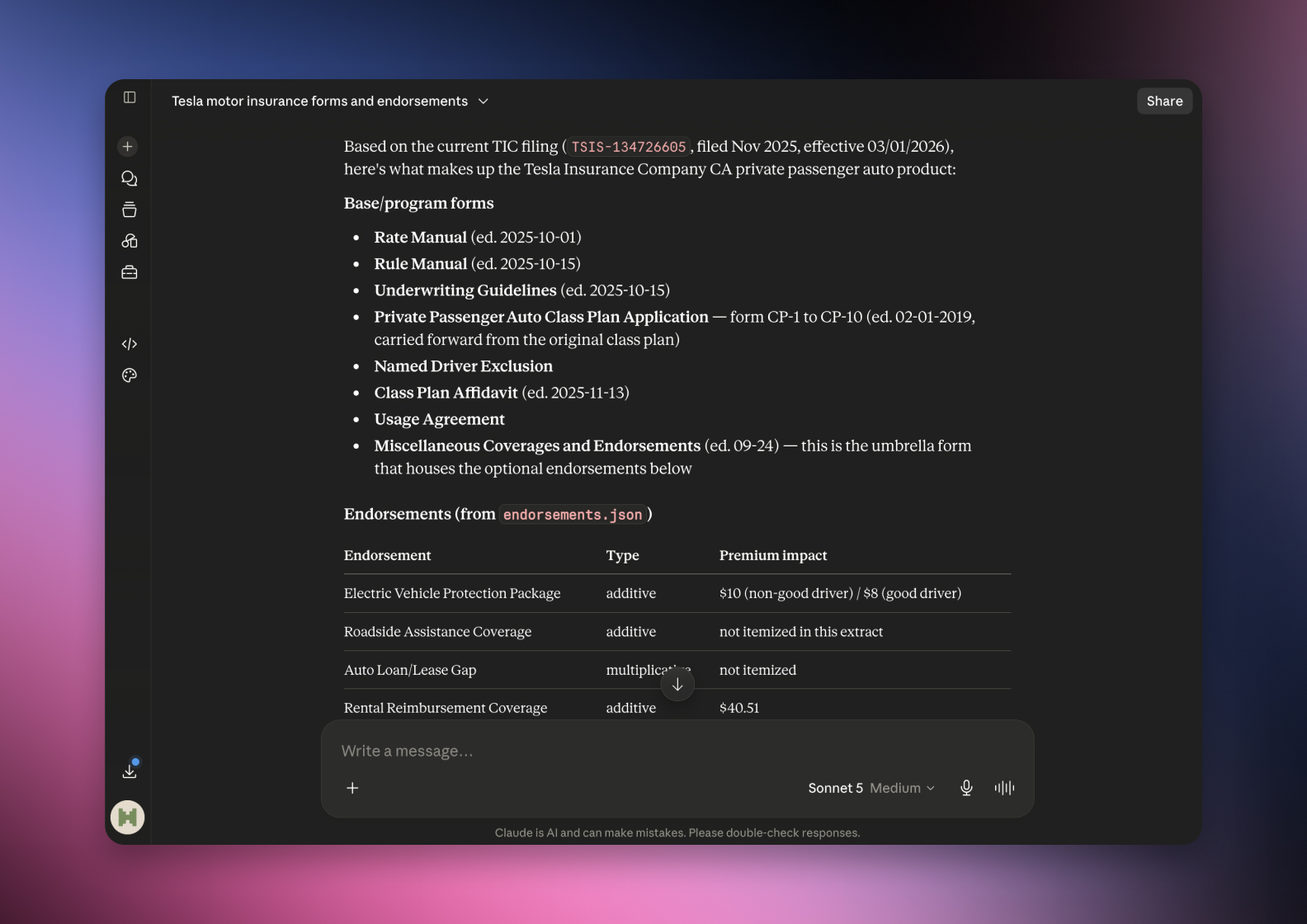

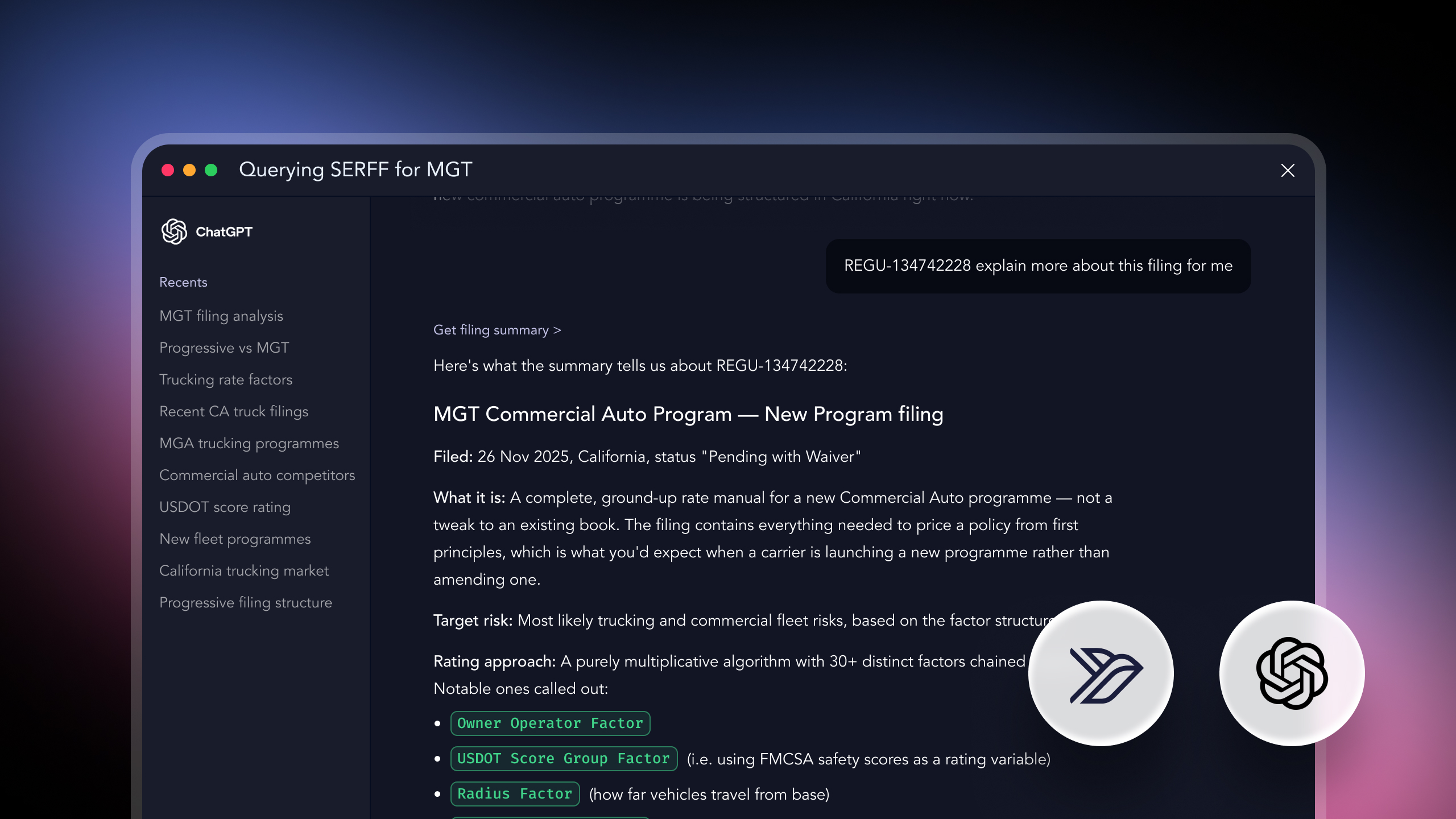
Connected via MCP to the AI you already use, Claude or ChatGPT, or through our dedicated platform, serff.ai makes searching and analysing SERFF filings effortless. Form research becomes a single question: ask which forms make up a product, which edition is current, or what an endorsement changes, and get a grounded, cited answer in seconds.
The manual way
Piece together a product's base form and endorsements by hand.
With serff.ai, just ask
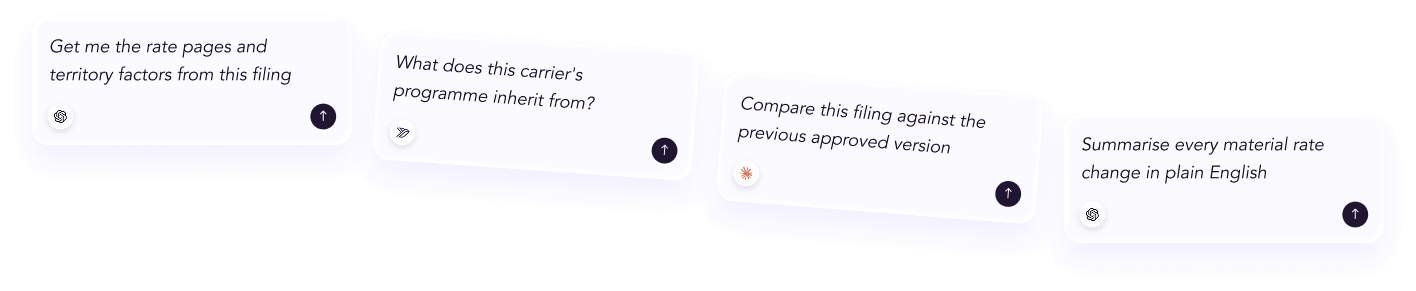
“What forms make up this product, base and endorsements?”
The manual way
Check whether a form is the current edition or superseded.
With serff.ai, just ask
“Is this the current edition of this form?”
The manual way
Read every endorsement to see what each one actually does.
With serff.ai, just ask
“What does each endorsement attached to this product change?”
The manual way
Search separately for a form across every state it's filed in.
With serff.ai, just ask
“Which states is this form filed in, and does it vary?”
Every answer is cited back to the exact page of the source PDF and grounded only in filed values, with no invented numbers, so you can trust it the way this audience needs to. Research that took weeks takes a prompt.
No credit card required. Simply sign up and connect to Claude or ChatGPT or use Swallow’s SERFF.ai platform.
Begin from the form filing itself, which lists every form and endorsement in the submission with its number, edition date and action. That schedule is the map for everything else in the research.
A form's identity does not change across editions, but its content can. Before relying on any specific wording, confirm the edition date matches what is currently in force, since an older edition may still appear in search results even after a replacement has superseded it.
If a search returns more than one edition of the same form number, sort by edition date and treat the most recent one as current, but double check the filing's action field to confirm it wasn't withdrawn rather than replaced.
A product's actual coverage is the base form as modified by every attached endorsement currently in force. Reading the base form alone can be misleading if a significant endorsement narrows or broadens what it says. Build the picture by reading them together, in the order they attach.
Forms can vary slightly by state even for what looks like the same product. Don't assume a form researched in one state applies identically elsewhere; confirm the specific state filing before relying on the wording.
Researching policy forms means starting from the form schedule, confirming you have the current edition of each document, and reading the base form together with every attached endorsement rather than in isolation. Coverage lives in the combination, not any single document.
Start with the form schedule in the relevant form filing, which lists every form and endorsement with its number, edition date and action.
Check the edition date and the action field; a form marked replaced or withdrawn is no longer current even if it still appears in search results.
Yes, often. Forms can differ slightly by state even for what appears to be the same underlying product, so confirm the specific state filing.
Because an endorsement can meaningfully narrow or broaden the coverage the base form describes; reading either alone can be misleading.
Start from the form schedule of the relevant filing, which lists every associated form and endorsement in one place.





 ChatGPT
 Claude
.png)
.png)
.png)