
A SERFF filing is the complete regulatory submission an insurer sends to a state insurance department through the System for Electronic Rates & Forms Filing (SERFF) to introduce or change its rates, rules or policy forms. A single filing can hold dozens of documents: rate pages, actuarial exhibits, policy forms and back-and-forth with the regulator, so reading one by hand means working through them all in a deliberate order.
serff.ai is built to do that for you: it indexes millions of SERFF filings and lets you ask questions in plain English instead of opening documents one by one. You can connect it to the AI assistant you already use: Claude or ChatGPT, via the serff.ai MCP server, or work directly in the web platform.
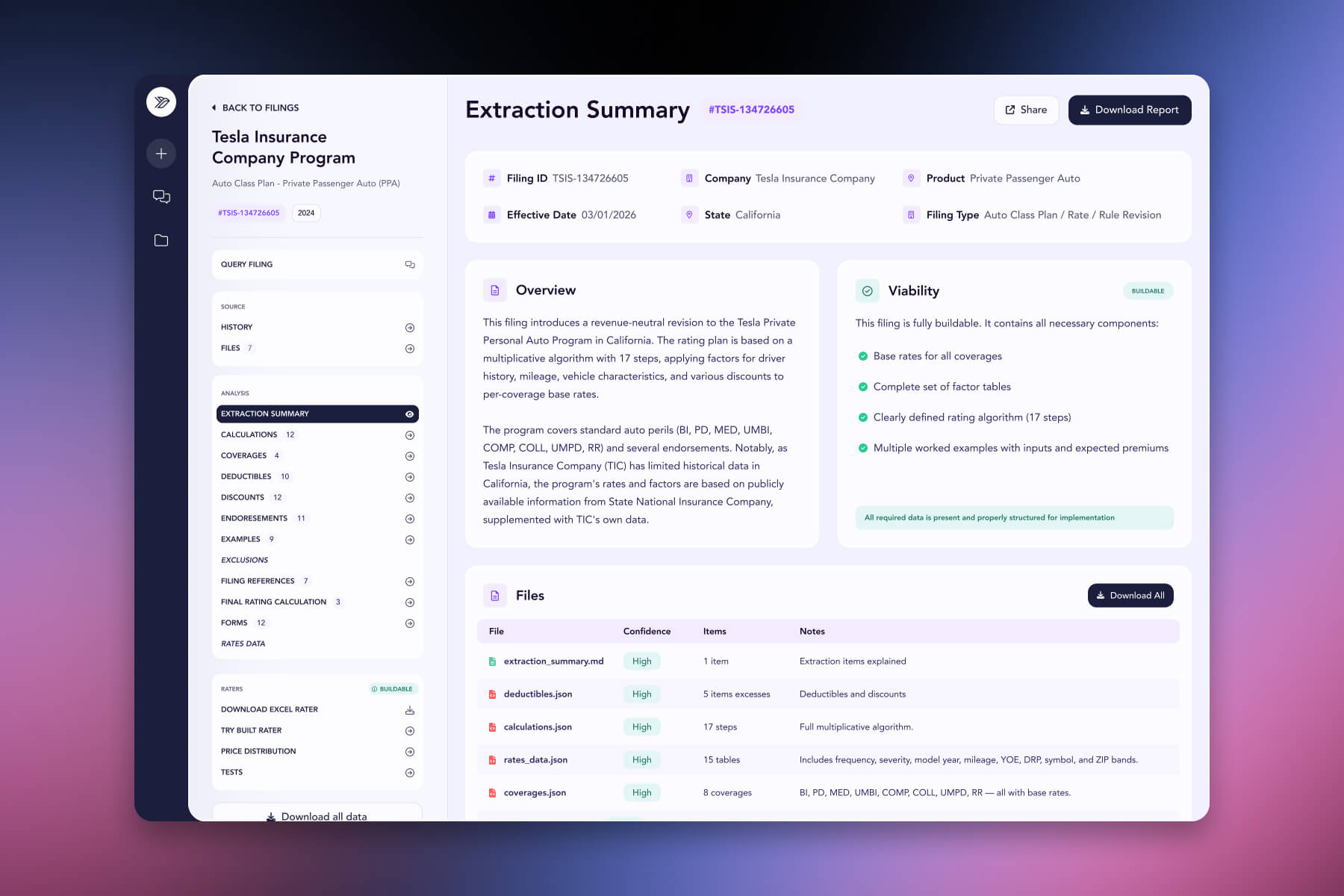

Connected via MCP to the AI you already use, Claude or ChatGPT, or through our dedicated platform, serff.ai makes searching and analysing SERFF filings effortless. Reading a filing becomes a single question: ask what changed, why it changed, or what the regulator pushed back on, and get a grounded, cited answer in seconds instead of opening document after document.
The manual way
Read all 200+ pages to understand what the filing does.
With serff.ai, just ask
“Summarise this filing.”
The manual way
Diff the new rate pages against the old ones by hand.
With serff.ai, just ask
“What changed from the previous version?”
The manual way
Hunt through the correspondence thread for objections.
With serff.ai, just ask
“Show every regulator objection and how the insurer responded.”
The manual way
Cross-check a number you are not sure about.
With serff.ai, just ask
“Where in the filing does this figure come from?”
Every answer is cited back to the exact page of the source PDF and grounded only in filed values, with no invented numbers, so you can trust it the way this audience needs to. Research that took weeks takes a prompt.
No credit card required. Simply sign up and connect to Claude or ChatGPT or use Swallow’s SERFF.ai platform.
This part is the manual method. It walks through each section of a filing and flags what actuaries, pricing, underwriting and product teams should pull out: the signals that tell you what changed, why it changed, and whether it was actually approved.
Read a filing in this order: (1) Filing at a Glance → (2) General Information → (3) the schedule that carries the change (Rate/Rule or Form) → (4) supporting documentation and the actuarial memorandum → (5) rate information → (6) correspondence and objection letters → (7) amendments → (8) disposition. Summary first, outcome last.
Almost every filing is organised into the same handful of sections. Knowing what each one holds is half the battle. Once you can name the parts, you can jump straight to whatever your question needs.
This is the summary screen, and it's the quickest way to understand a submission before you open anything. It typically shows the insurer, state, filing type and sub-type of insurance (TOI / Sub-TOI), current status, the date submitted, requested and effective dates, and the tracking numbers that identify the filing.
Those tracking numbers matter more than they look. The SERFF tracking number is unique across the whole system and is how you'll cite or re-find the filing. The state tracking number is assigned by the regulator, and the company tracking number is the insurer's own internal reference, useful when you're trying to connect a filing to its predecessors from the same company.
Read the filing type first. It tells you which schedule actually carries the change: a Rate filing sends you to the Rate/Rule schedule, a Form filing to the Form schedule, and a combined Rate/Rule/Form filing to both. It stops you hunting for a rate change in a filing that only touches policy wording.
The general information section is where the insurer explains, in plain language, what the filing does and why. This is the single most useful narrative in the whole submission: it usually states the purpose, the business rationale, the market type, and, for a rate filing, the overall rate impact being requested.
Read this before the technical exhibits. It frames everything that follows, so by the time you reach the rate pages or the actuarial memorandum you already know what the insurer says it is trying to achieve.
This is where the substance lives, and it's the section pricing and product teams should spend the most time in.
In the Rate / Rule Schedule, you're looking at the rate pages and rule changes themselves: base rates, the rating factors and tables being changed, territory or tier definitions, and any change to the rating algorithm. Compare the new pages against what they replace. The story is in the deltas, not the absolute values.
In the Form Schedule, each row is a policy form or endorsement with a form number, an edition date, a form type and an action: new, replacement or withdrawn. A replacement action is your cue to compare the new wording against the prior edition to see exactly what coverage moved.
Supporting documentation is the evidence behind the ask. The most important item is usually the actuarial memorandum, which sets out the reasoning for a rate change: the loss experience, trend and development assumptions, credibility, expense provisions and the methodology used to arrive at the indicated rate.
Other supporting items can include actuarial exhibits, certifications, compliance documents and cover letters. Read the memorandum for the why, and treat the exhibits as the workings that support it.
Some supporting documents, certain actuarial exhibits in particular, can be marked confidential and withheld from public view. If the logic of a filing seems to have a gap, a confidential exhibit is often the missing piece, not an error in your reading.
For rate filings, the rate information section carries the headline numbers: the overall indicated change (what the data supports), the overall requested change (what the insurer actually asked for), the number of policyholders affected and the change in written premium. Later, the disposition tells you the approved figure.
Don't treat the requested change as the change that happened. Indicated, requested and approved are three different numbers, and the gaps between them are often the most interesting part of the filing: they show where the insurer held back and where the regulator pushed.
Many filings include a thread of correspondence between the insurer and the regulator. Objection letters raise questions, request clarification or challenge assumptions; the insurer's responses answer them, often with revised exhibits or supporting data.
This is the most under-read section and often the most revealing. Objection letters show you exactly which assumptions a regulator considers weak, and the responses show how the insurer defends them. That is intelligence you can't get from the final approved documents alone.
Filings are frequently updated before a decision is reached. Reviewing amendments tells you what changed after submission, which documents were replaced, and how the insurer responded to regulator feedback. If you only read the final approved documents, you miss the trail that explains how the filing got there.
Finally, check the disposition, the regulator's final decision. Common outcomes include approved, approved with conditions, filed, withdrawn or disapproved. The disposition report usually lists the status of each schedule item, so you can see not just the overall result but which specific forms or rate pages were accepted.
Close the loop by comparing the disposition against what you read in step 5: the difference between the requested and the approved change is what actually reached the market.
Put together, one pass looks like this. You open Filing at a Glance and see a personal auto rate filing, currently approved. General Information tells you it's a mid-single-digit rate increase driven by claims trend. You go to the Rate/Rule schedule and find the increase is concentrated in a handful of territories and a revised model-year factor. The actuarial memorandum explains the trend selection; an objection letter questions it; the response narrows the increase. The disposition confirms an approved change a point or two below what was requested. In ten minutes you know what changed, why, and what the market will actually see, without reading all 200 pages front to back.
A few habits quietly cost people accuracy:
Many states publish filings through SERFF Filing Access, a public portal where you can search by state, company and filing type. Participation and the exact documents made public vary by state, and some supporting exhibits may be marked confidential.
It depends on your question, but most professionals start with Filing at a Glance for orientation, then read the General Information description. For a rate change, the actuarial memorandum and the rate information carry the substance; for a form change, the form schedule does.
The indicated change is what the insurer’s data supports, the requested change is what the insurer asked the regulator to approve, and the approved change is what the regulator ultimately allowed. They are often different numbers, and the gaps reveal how the filing was negotiated.
No. While much of a filing is publicly viewable through Filing Access, certain items, particularly some actuarial exhibits, can be filed as confidential and withheld from public view.
Anywhere from a handful to several dozen. A simple form filing may include only a couple of documents, while a complex rate filing can carry rate pages, multiple exhibits, an actuarial memorandum and a long correspondence thread.






 ChatGPT
 Claude
.png)
.png)
.png)
.png)