
An insurance endorsement is a document that modifies a base policy form, adding, removing or changing coverage without rewriting the entire contract. Instead of issuing a new form for every small change, insurers attach endorsements that adjust specific provisions while the base form stays largely intact.
Because endorsements can quietly reshape what a policy actually covers, they deserve as much attention as the base form itself, and in a filing they are easy to skim past if you are not looking for them.
serff.ai is built to do that for you: it indexes millions of SERFF filings and lets you ask questions in plain English instead of opening documents one by one. You can connect it to the AI assistant you already use: Claude or ChatGPT, via the serff.ai MCP server, or work directly in the web platform.
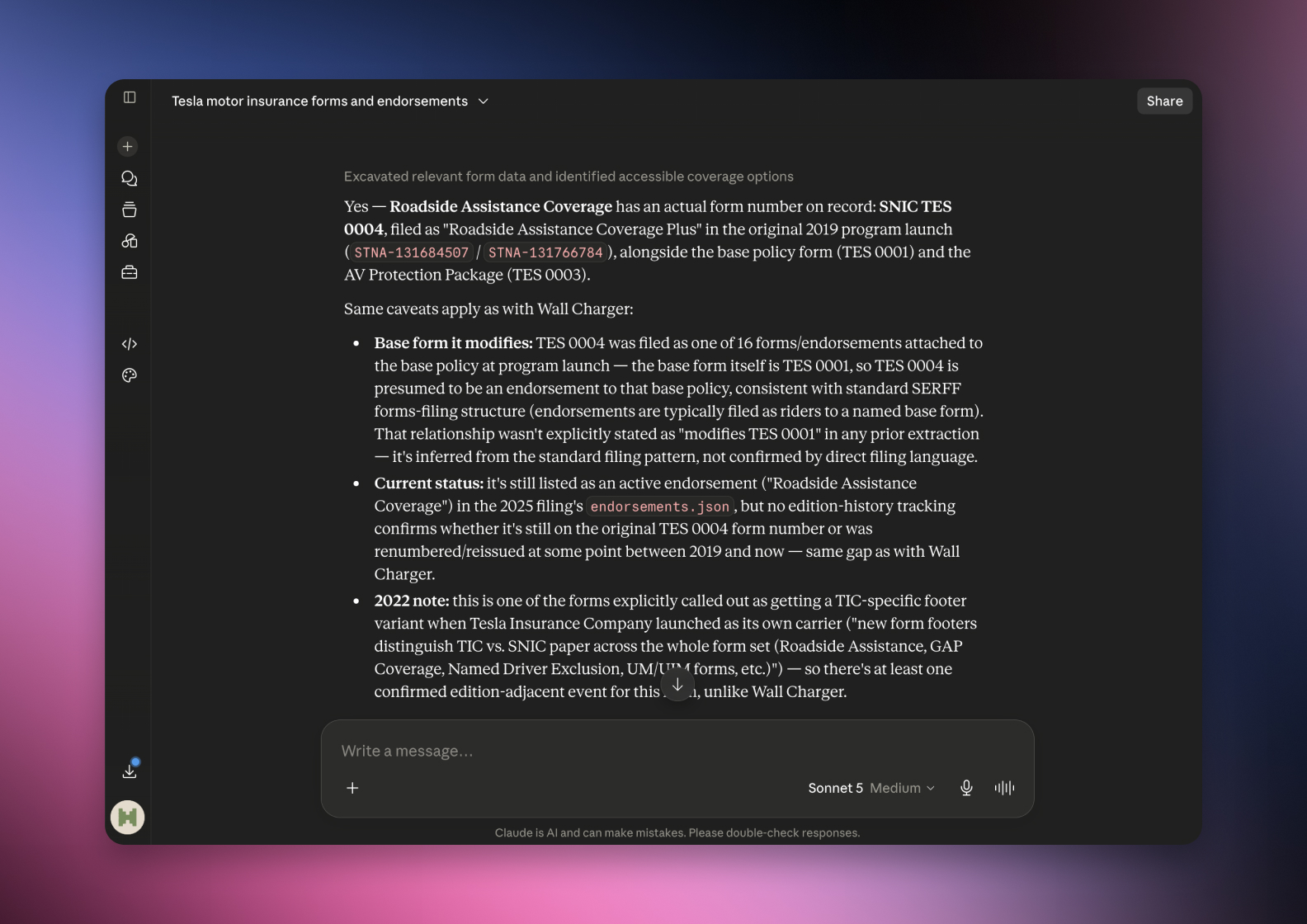

Connected via MCP to the AI you already use, Claude or ChatGPT, or through our dedicated platform, serff.ai makes searching and analysing SERFF filings effortless. An endorsement becomes a single question: ask what it changes, which form it attaches to, or whether it broadens or restricts coverage, and get a grounded, cited answer in seconds.
The manual way
Read an endorsement against its base form line by line.
With serff.ai, just ask
“What does this endorsement change about the base form?”
The manual way
Work out which base form an endorsement attaches to.
With serff.ai, just ask
“Which policy form does this endorsement modify?”
The manual way
Determine whether an endorsement adds or restricts coverage.
With serff.ai, just ask
“Does this endorsement broaden or restrict coverage?”
The manual way
Track how many endorsements apply to one product.
With serff.ai, just ask
“How many endorsements are filed for this product?”
Every answer is cited back to the exact page of the source PDF and grounded only in filed values, with no invented numbers, so you can trust it the way this audience needs to. Research that took weeks takes a prompt.
No credit card required. Simply sign up and connect to Claude or ChatGPT or use Swallow’s SERFF.ai platform.
Like a base form, an endorsement is tracked with its own identifying detail, even though it modifies rather than replaces the form it attaches to.
A policy form is the base contract: the insuring agreement, definitions, conditions and exclusions. An endorsement attaches to that base and changes a specific piece of it. You read the form to understand the contract as a whole, and the endorsement to see what has been layered on top.
A base form can stay completely unchanged in a filing while an endorsement quietly narrows or broadens what it covers. That makes endorsements one of the more consequential parts of a form filing to read carefully, since the coverage story often lives there rather than in the base form.
Always read an endorsement alongside the form it attaches to, not in isolation. The same endorsement wording can have a different practical effect depending on what the base form already says.
New editions of an endorsement can replace an older one silently within a filing. Check the edition date and action (new, replacement or withdrawn) so you know whether you are looking at a change or the status quo.
An endorsement modifies a base policy form to add, remove or change coverage, without a full contract rewrite. It carries its own form number and edition date, and its effect only makes sense read against the base form it attaches to.
It is a document that modifies a base policy form, adding, removing or changing specific coverage without rewriting the entire contract.
A policy form is the base contract; an endorsement attaches to it and modifies a specific piece of coverage.
They appear in the form schedule of a form filing, each with its own form number, edition date and the base form it attaches to.
Yes. Endorsements can either broaden or restrict coverage, so each one needs to be read for its specific effect.
The filing typically identifies the base form an endorsement attaches to, either directly on the endorsement or in the form schedule.





 ChatGPT
 Claude
.png)
.png)
.png)
.png)