
A form filing is a submission an insurer makes to a state insurance department to introduce or change the policy wording of a product: the contract language, coverage grants, exclusions and endorsements that define what a policy actually covers. Where a rate filing is about price, a form filing is about the words.
Because those words decide what is and is not covered when a claim is made, regulators review form filings closely for readability, required provisions and compliance with state law. Reading one means working through form schedules and comparing new wording against the editions it replaces.
serff.ai is built to do that for you: it indexes millions of SERFF filings and lets you ask questions in plain English instead of opening documents one by one. You can connect it to the AI assistant you already use: Claude or ChatGPT, via the serff.ai MCP server, or work directly in the web platform.
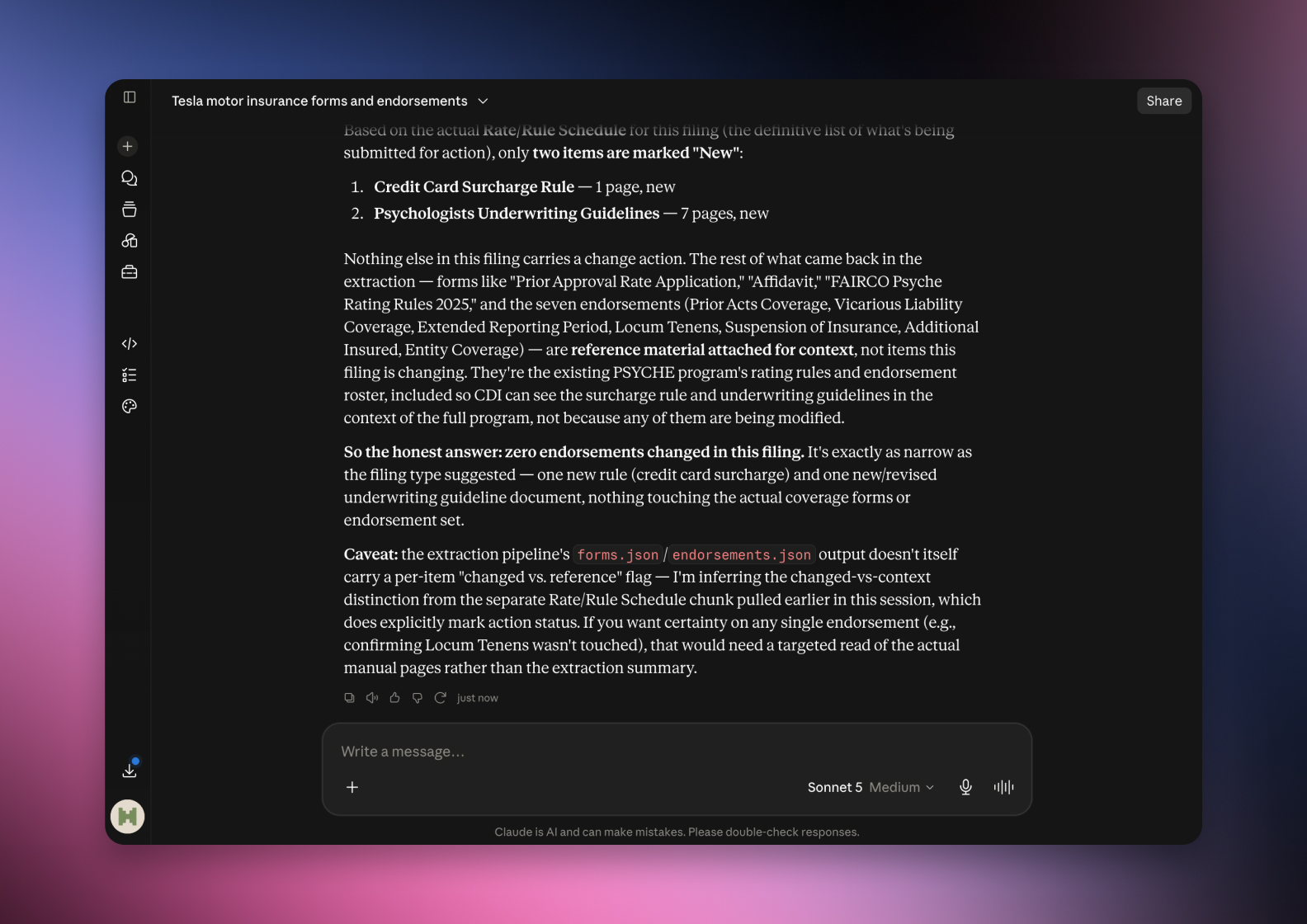

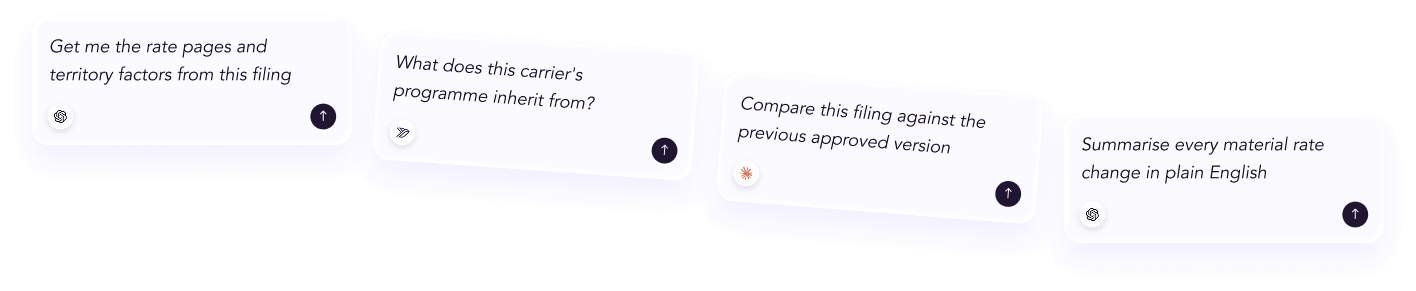
Connected via MCP to the AI you already use, Claude or ChatGPT, or through our dedicated platform, serff.ai makes searching and analysing SERFF filings effortless. A form filing becomes a single question: ask which forms changed, what an endorsement does, or how the wording differs from the last edition, and get a grounded, cited answer in seconds.
The manual way
Read every form to work out which ones actually changed.
With serff.ai, just ask
“Which forms and endorsements changed in this filing?”
The manual way
Diff the new policy wording against the prior edition by hand.
With serff.ai, just ask
“What wording changed from the previous edition?”
The manual way
Decode form numbers and edition dates one by one.
With serff.ai, just ask
“List the forms with their form numbers, edition dates and actions.”
The manual way
Work out whether a change adds or removes coverage.
With serff.ai, just ask
“Does this endorsement add or restrict coverage?”
Every answer is cited back to the exact page of the source PDF and grounded only in filed values, with no invented numbers, so you can trust it the way this audience needs to. Research that took weeks takes a prompt.
No credit card required. Simply sign up and connect to Claude or ChatGPT or use Swallow’s SERFF.ai platform.
A form filing is organised around the form schedule, which lists each policy form and endorsement being introduced or changed. Each row carries the identifying detail and the action being taken.
For the wider structure a form schedule sits inside, see how to read a SERFF filing.
The three filing types change different things. A form filing changes the policy wording and coverage. A rate filing changes the price. A rule filing changes the underwriting or rating rules that decide how coverage and price apply. A single submission can combine more than one, so the filing type tells you which schedules to open.
The action column is the fastest signal. A new action introduces coverage that did not exist before; a replacement action swaps an existing form for a new edition, which is your cue to compare wording; a withdrawn action removes a form entirely. When you see a replacement, the coverage story lives in the delta between the old and new editions, not in the new form alone.
Endorsements are where coverage quietly moves. A base policy form can stay untouched while an endorsement narrows or broadens what it covers. Always read the endorsements against the form they attach to, not in isolation.
Start with the general information description to learn the purpose, then work through the form schedule row by row, comparing each replacement against its prior edition. An insurance endorsement and an insurance policy form are worth understanding in their own right before you go deep.
Do not assume a form filing has no pricing impact. A wording change that alters coverage can change the exposure an insurer takes on, which is sometimes paired with a separate rate or rule filing. Check whether the submission is form-only or combined.
A form filing changes what a policy covers, not what it costs. The form schedule is the heart of it: read the action on each row, and for every replacement, compare the new edition against the old to see exactly which coverage moved.
A form filing changes the policy wording and coverage; a rate filing changes the price. They are often submitted together but reviewed as separate schedules.
A policy form is the standardised contract language that defines a coverage, including the insuring agreement, definitions, conditions and exclusions.
An endorsement is an add-on that modifies the base policy form, adding, removing or changing coverage without rewriting the whole contract.
The action shows what is happening to each form: new introduces it, replacement swaps it for a new edition, and withdrawn removes it.
It depends on the state. Some require prior approval of forms before use, while others allow file-and-use, where forms take effect around the time of filing.





 ChatGPT
 Claude
.png)
.png)
.png)
.png)