
An insurance policy form is the standardised contract document that defines a coverage: the insuring agreement, definitions, conditions and exclusions that decide what is covered, what is not, and under what circumstances a claim is paid. It is the base document that everything else in a product, endorsements, rates and rules, is built around.
Reading a policy form well means reading it as a contract, tracing how the insuring agreement is shaped and narrowed by the definitions and exclusions that follow it.
serff.ai is built to do that for you: it indexes millions of SERFF filings and lets you ask questions in plain English instead of opening documents one by one. You can connect it to the AI assistant you already use: Claude or ChatGPT, via the serff.ai MCP server, or work directly in the web platform.
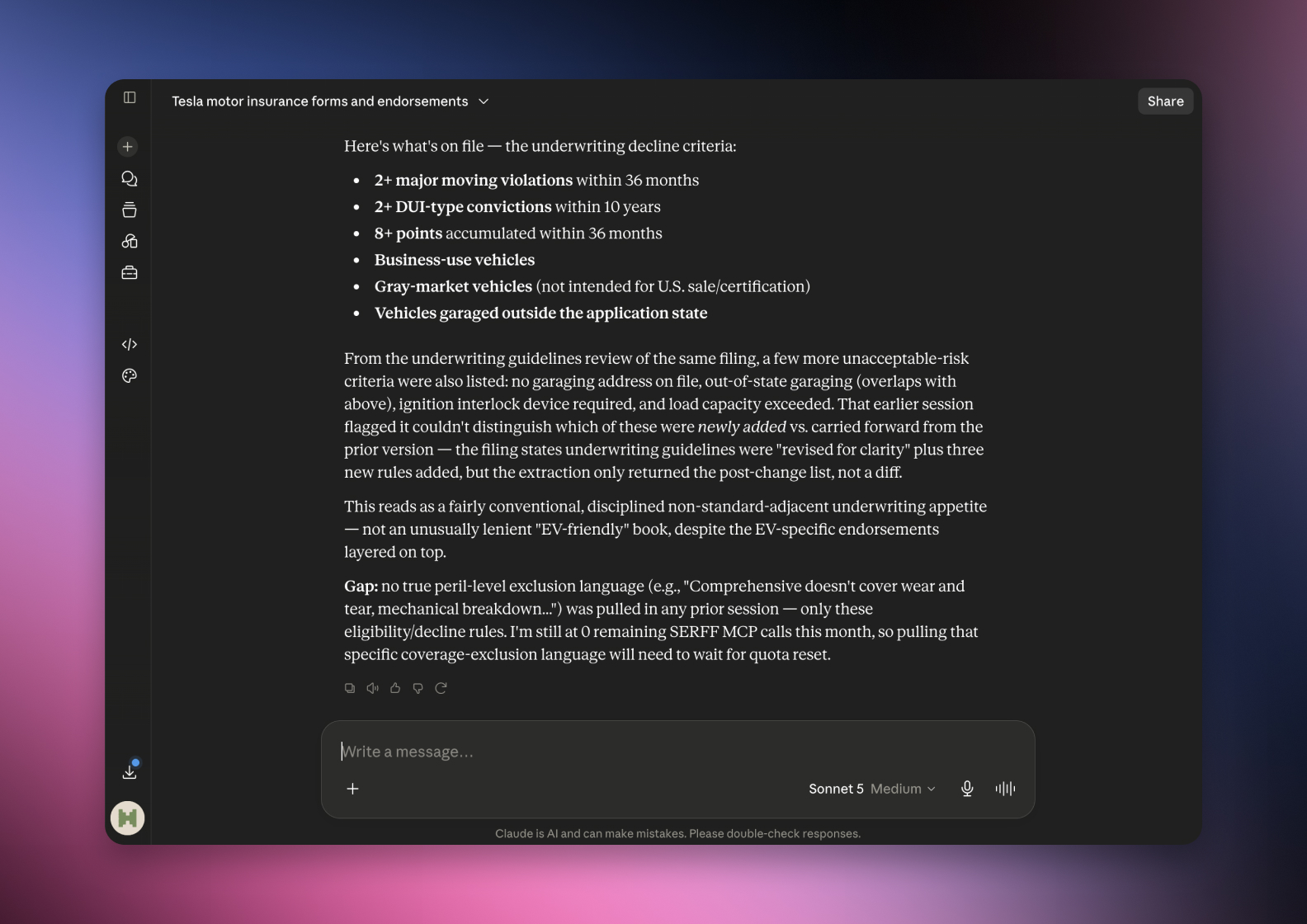

Connected via MCP to the AI you already use, Claude or ChatGPT, or through our dedicated platform, serff.ai makes searching and analysing SERFF filings effortless. A policy form becomes a single question: ask what is covered, what is excluded, or how a definition affects coverage, and get a grounded, cited answer in seconds.
The manual way
Read dense contract language to find what is covered.
With serff.ai, just ask
“What does this policy form cover?”
The manual way
Hunt through exclusions to see what is not covered.
With serff.ai, just ask
“What exclusions apply to this coverage?”
The manual way
Trace how a definition changes the scope of coverage.
With serff.ai, just ask
“How does this definition affect what's covered?”
The manual way
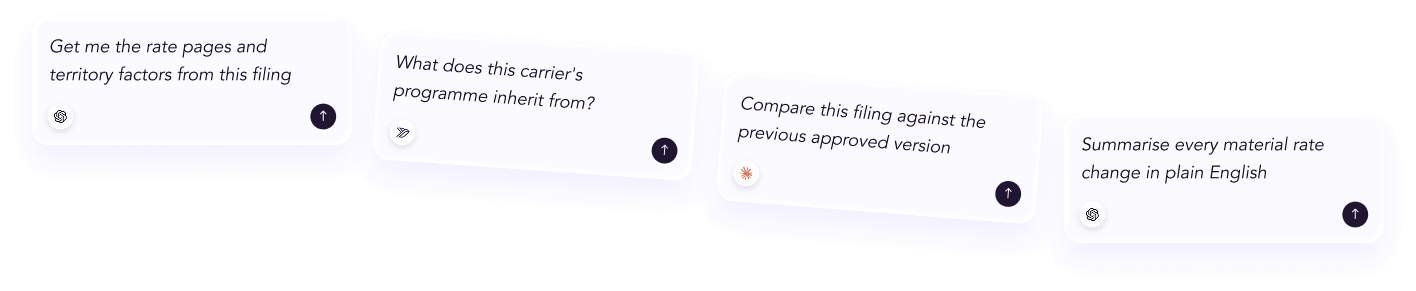
Compare a form against the endorsements attached to it.
With serff.ai, just ask
“How do the attached endorsements modify this form?”
Every answer is cited back to the exact page of the source PDF and grounded only in filed values, with no invented numbers, so you can trust it the way this audience needs to. Research that took weeks takes a prompt.
No credit card required. Simply sign up and connect to Claude or ChatGPT or use Swallow’s SERFF.ai platform.
Most policy forms share a consistent structure, even though the specific language varies by product and insurer.
The policy form is the base contract. An endorsement attaches to it and modifies a specific piece, without rewriting the whole document. You read the form to understand the coverage as designed, and the endorsements to see what has been layered on since.
Each form carries a form number and edition date, and a form filing records the action taken on it: new, replacement or withdrawn. A replacement is your cue to compare the new form against the edition it replaces, since that is where the coverage story lives.
Read the exclusions before the insuring agreement if you are trying to understand what is actually covered in practice. The insuring agreement tells you the promise; the exclusions tell you the real boundary of it.
A definition tucked away mid-form can quietly narrow coverage that the insuring agreement appears to grant broadly. Always check how key terms are defined before concluding what is or is not covered.
A policy form is the base contract: the insuring agreement, definitions, conditions and exclusions that define a coverage. Read it as a whole, since definitions and exclusions routinely narrow what the insuring agreement appears to promise.
It is the standardised contract document that defines a coverage, including the insuring agreement, definitions, conditions and exclusions.
A policy form is the base contract; an endorsement attaches to it and modifies a specific piece of coverage.
It is the core promise in a policy form: what the insurer agrees to pay or do, and under what trigger.
Because exclusions define the real boundary of coverage, often narrowing what the insuring agreement appears to grant broadly.
Check its form number, edition date and the action recorded in the filing: new, replacement or withdrawn, and compare replacements against the prior edition.





 ChatGPT
 Claude
.png)
.png)
.png)
.png)