
Market trends are broader than pricing alone. They include which companies are entering or leaving a segment, how the product mix within a category is shifting, and how the regulatory environment itself is changing. Regulatory filings are a rich, underused source for all of it, since nearly every meaningful move a company makes eventually shows up in a filing somewhere.
This is how to research that wider picture: what to track beyond price, and how to read the signals that indicate a genuine market-level shift.
serff.ai is built to do that for you: it indexes millions of SERFF filings and lets you ask questions in plain English instead of opening documents one by one. You can connect it to the AI assistant you already use: Claude or ChatGPT, via the serff.ai MCP server, or work directly in the web platform.
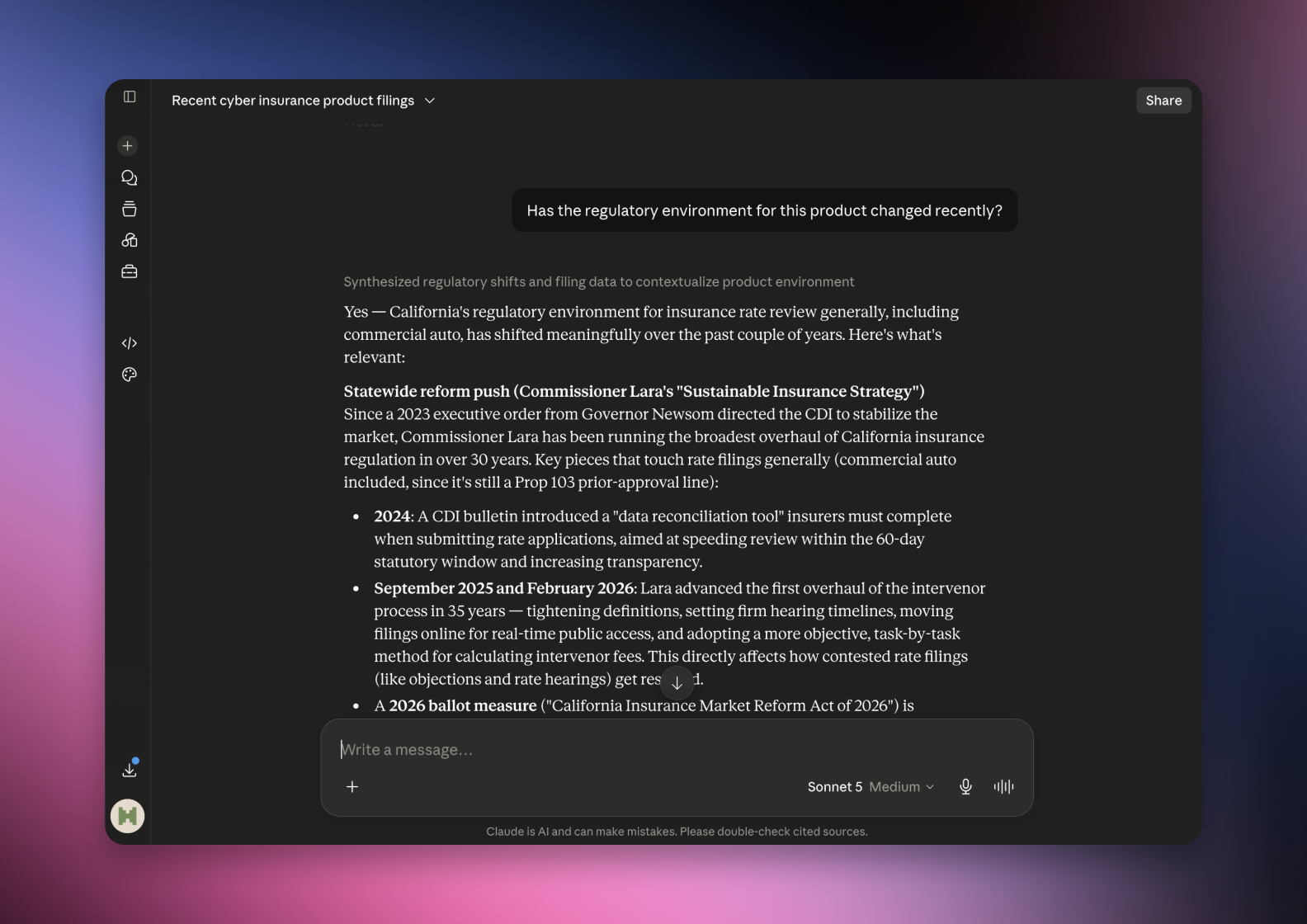

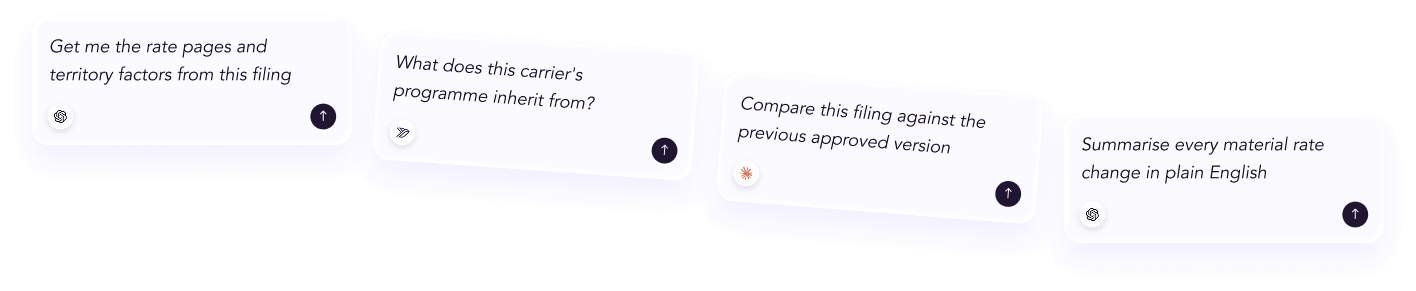
Connected via MCP to the AI you already use, Claude or ChatGPT, or through our dedicated platform, serff.ai makes searching and analysing SERFF filings effortless. Market trend research becomes a single question: ask what's shifting in a market, entrants, exits, or product mix, and get a grounded, cited answer in seconds.
The manual way
Track which companies are entering or leaving a market by hand.
With serff.ai, just ask
“Which companies have entered or exited this market recently?”
The manual way
Piece together a shifting product mix from many filings.
With serff.ai, just ask
“How has the product mix in this market shifted recently?”
The manual way
Watch for regulatory environment changes across states.
With serff.ai, just ask
“Has the regulatory environment for this product changed recently?”
The manual way
Synthesise many signals into one market-level view.
With serff.ai, just ask
“What's the overall trend in this market right now?”
Every answer is cited back to the exact page of the source PDF and grounded only in filed values, with no invented numbers, so you can trust it the way this audience needs to. Research that took weeks takes a prompt.
No credit card required. Simply sign up and connect to Claude or ChatGPT or use Swallow’s SERFF.ai platform.
A company filing in a state or product for the first time is a visible signal of market entry; a long absence of new filings from a previously active company can signal exit or retreat. Both are useful indicators of where a market is headed, well before broader coverage catches up.
Looking at filing activity by product type over time shows whether a category is growing, shrinking, or shifting toward a particular sub-segment, a pattern that individual filings alone would never reveal.
Compare filing volume by product type year over year rather than looking at a single snapshot. A category can look stable in any given month while still trending clearly up or down over a longer window.
Regulators occasionally shift how they review filings, tightening scrutiny on a specific rating factor, for instance, and that shift shows up as a pattern of increased objections on that topic across multiple companies' filings before it's ever formally announced.
A single company's exit from a state doesn't necessarily signal a market-wide trend. Confirm the pattern across multiple companies before concluding the whole market is shifting rather than one insurer's specific decision.
Market trends extend beyond pricing to entrants, exits, product mix and regulatory shifts, all visible in the pattern of filings over time. Track changes across multiple companies and a meaningful time window before treating any single signal as a broader market-wide trend.
Company entrants and exits, shifts in product mix within a category, and changes in the regulatory environment itself are all market trends visible through filings.
A company filing in a state or product for the first time signals entry; a long absence of activity from a previously active company can signal exit.
An increase in objections targeting a specific issue across multiple companies' filings can signal a regulator tightening scrutiny before any formal policy change is announced.
Not on its own. Confirm the pattern holds across multiple companies before treating a single company's decision as evidence of a broader market shift.
Compare activity over a meaningful window, such as year over year, rather than a single snapshot, since short-term stability can mask a longer trend.





 ChatGPT
 Claude
.png)
.png)
.png)
.png)