
AI and manual research are not simply faster and slower versions of the same task. Each has genuine strengths the other lacks, and the honest comparison is less about which one wins and more about which parts of a research task each is actually suited to.
This is a fair look at both: where manual research still earns its place, where AI clearly outperforms it, and what a sensible combination of the two looks like in practice.
serff.ai is built to do that for you: it indexes millions of SERFF filings and lets you ask questions in plain English instead of opening documents one by one. You can connect it to the AI assistant you already use: Claude or ChatGPT, via the serff.ai MCP server, or work directly in the web platform.
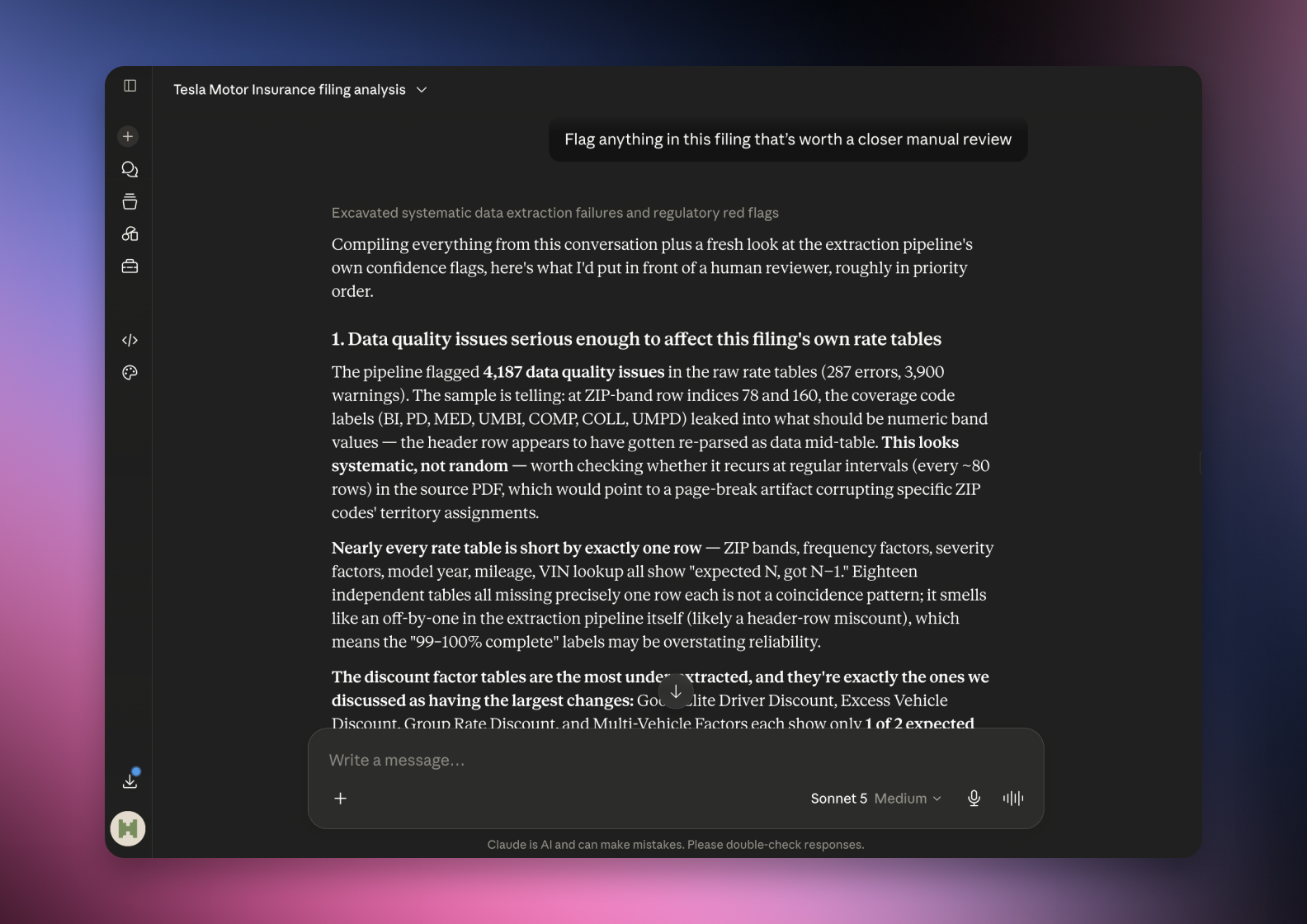

Connected via MCP to the AI you already use, Claude or ChatGPT, or through our dedicated platform, serff.ai makes searching and analysing SERFF filings effortless. Wherever the balance falls, it starts with a single question: ask for a summary, a comparison or a specific detail, cited back to the exact source, and verify it yourself in seconds.
The manual way
Read a filing in full even when you only need one detail.
With serff.ai, just ask
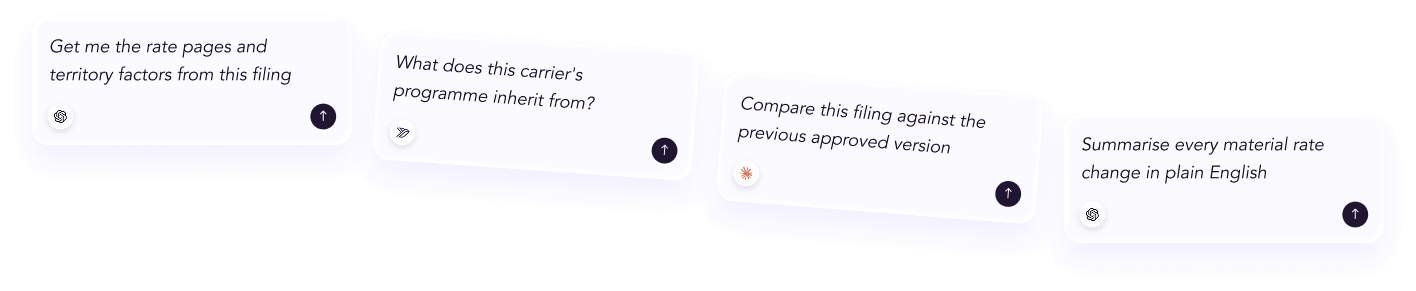
“Pull out just the details I need from this filing, with citations.”
The manual way
Choose between reading everything or risking missing something.
With serff.ai, just ask
“Flag anything in this filing that’s worth a closer manual review.”
The manual way
Spend a full day working through a stack of filings.
With serff.ai, just ask
“Summarise these filings so I know where to focus first.”
The manual way
Manually decide which filings deserve deep individual review.
With serff.ai, just ask
“Which of these filings deserve a full manual review?”
Every answer is cited back to the exact page of the source PDF and grounded only in filed values, with no invented numbers, so you can trust it the way this audience needs to. Research that took weeks takes a prompt.
No credit card required. Simply sign up and connect to Claude or ChatGPT or use Swallow’s SERFF.ai platform.
A careful manual read catches nuance that a summary can miss: the specific tone of an objection letter, an unusual clause buried in a policy form, a pattern only visible after sitting with the document for a while. It also builds a depth of familiarity with a filing that comes from direct reading, which matters when the stakes of a decision are high.
AI output needs verification, particularly for figures that will inform a real decision. It can also miss context a human would catch instinctively, like knowing that a particular regulator has a history of pushing back on a specific assumption. The reasoning covered in why AI hallucinates is worth understanding before relying on any AI-generated answer for something consequential.
Treat AI output as a strong first draft, not a final answer. Spot-check the citation against the source, especially for any number that will end up in a report or a decision.
The most effective approach uses AI for the volume work, search, first-pass summaries, and cross-filing comparison, then reserves manual reading for the filings that turn out to matter most. That combination gets through far more material than manual research alone, without giving up the depth that matters for the decisions that count.
Don't let speed become a substitute for verification. The efficiency AI provides is only valuable if the output is actually reliable, and that requires checking, not just trusting.
Manual research offers depth and nuance; AI offers volume, consistency and speed. The strongest workflow uses AI to get through the material and flag what deserves attention, then applies manual reading where it matters most, verifying AI output along the way rather than trusting it blindly.
Neither is universally better. AI excels at volume, consistency and speed; manual research excels at nuance and depth. The strongest approach combines both.
Subtle context like the tone of an objection letter, an unusual clause, or a pattern a researcher's own experience recognises that a summary might not surface.
Not for anything consequential. Spot-check citations against the source document, particularly for figures used in a decision or report.
Use AI for search, summarisation and cross-filing comparison to get through volume quickly, then apply manual reading to the filings that turn out to matter most.
Not if it's used well. AI can help you cover more material than manual research alone, as long as its output is verified rather than trusted outright.





 ChatGPT
 Claude
.png)
.png)
.png)
.png)