
Insurance filing research has, for decades, meant opening documents one at a time: searching a portal, downloading a PDF, reading it manually, and repeating that process across every company, state and product you needed to cover. AI has started to change what that work actually looks like, not by replacing the underlying documents but by changing how quickly someone can get from a question to a grounded answer.
This is a look at what has genuinely changed, what AI is good at in this specific domain, and where human judgment still does the work AI cannot.
serff.ai is built to do that for you: it indexes millions of SERFF filings and lets you ask questions in plain English instead of opening documents one by one. You can connect it to the AI assistant you already use: Claude or ChatGPT, via the serff.ai MCP server, or work directly in the web platform.
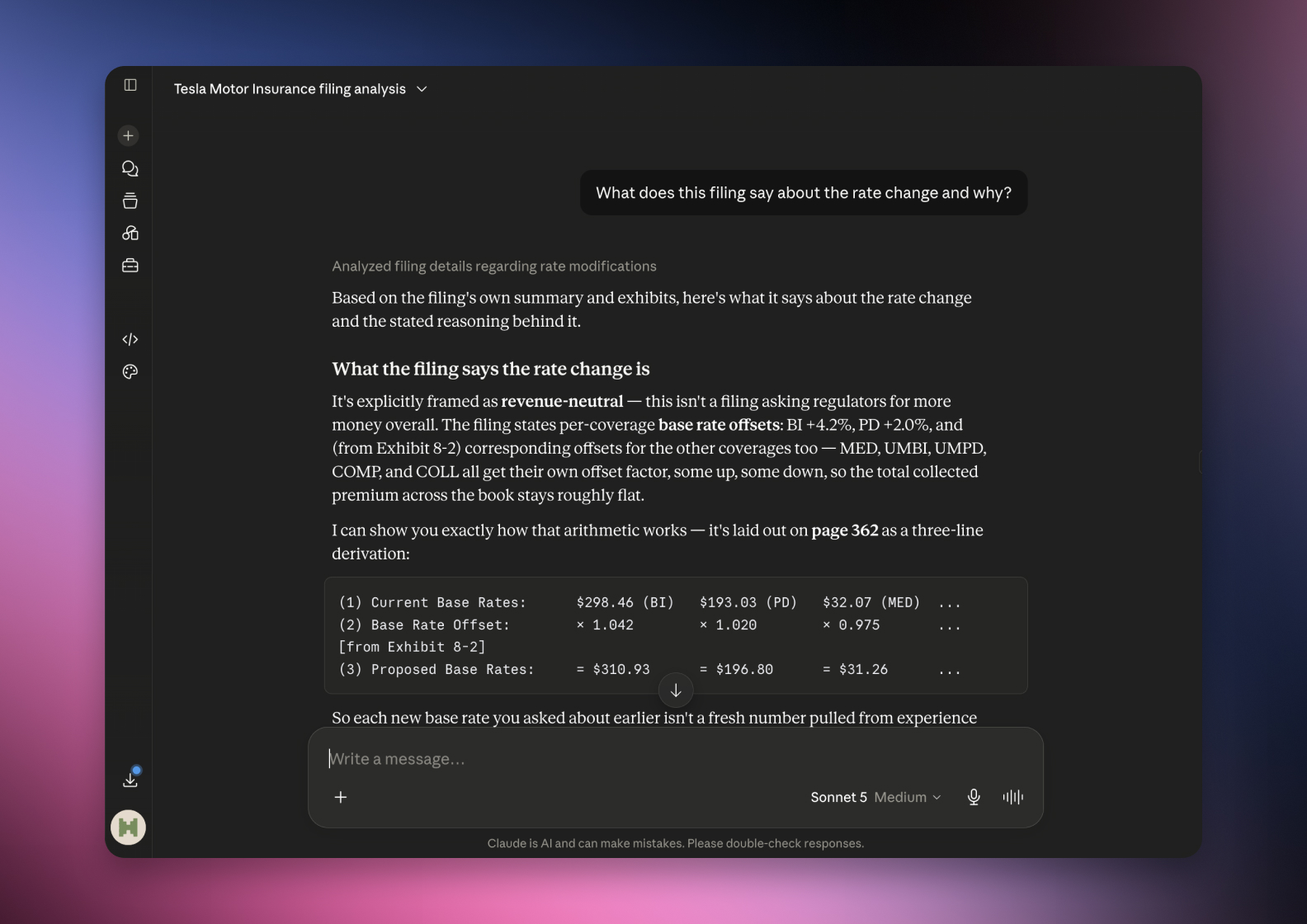

Connected via MCP to the AI you already use, Claude or ChatGPT, or through our dedicated platform, serff.ai makes searching and analysing SERFF filings effortless. The shift from manual to AI-assisted research becomes concrete with a single question: ask what changed in a filing, or how two filings compare, and get a grounded, cited answer in seconds.
The manual way
Open and read documents one at a time to find an answer.
With serff.ai, just ask
“What does this filing say about the rate change and why?”
The manual way
Manually track a research question across dozens of filings.
With serff.ai, just ask
“How does this compare across every relevant filing?”
The manual way
Re-read a whole filing to check a detail you half-remember.
With serff.ai, just ask
“Where does this number come from in the filing?”
The manual way
Wait days to get through a backlog of filings to review.
With serff.ai, just ask
“Summarise every filing in this review queue.”
Every answer is cited back to the exact page of the source PDF and grounded only in filed values, with no invented numbers, so you can trust it the way this audience needs to. Research that took weeks takes a prompt.
No credit card required. Simply sign up and connect to Claude or ChatGPT or use Swallow’s SERFF.ai platform.
The traditional workflow was linear: find a filing, open it, read it in full, extract what you need, move to the next one. AI changes the shape of that workflow by letting a researcher ask a direct question and get an answer synthesised from the source material, rather than reading the entire document to find it themselves.
None of this removes the need for judgment. Deciding what a rate change signals about a competitor's strategy, whether a rule change raises a fairness concern, or how much weight to put on one filing versus a pattern across several, still requires the expertise a pricing actuary or compliance professional brings. AI accelerates getting to the evidence; it doesn't replace deciding what the evidence means.
Use AI to get through the volume faster, then apply the same judgment you always would to the results. The value isn't in skipping analysis, it's in reaching the analysis stage much sooner.
As natural language search and grounded, cited answers become standard, the bottleneck in filing research shifts from finding and reading documents to deciding what to do with what you've learned. That is a meaningfully different place for a research team to spend its time.
AI output is only as trustworthy as its grounding. An answer without a clear citation back to the source document deserves the same scepticism as an unverified claim from any other source.
AI changes insurance filing research by collapsing the time between a question and a grounded answer, through better search, summarisation and cross-filing synthesis. It doesn't replace the judgment that turns evidence into a conclusion, and any answer worth acting on should trace back to its source.
It reduces the time between asking a question and getting a grounded answer, mainly through better search, summarisation and the ability to synthesise across many filings at once.
No. AI accelerates getting to the evidence, but deciding what that evidence means, strategically or actuarially, still requires human expertise.
The bottleneck shifts from finding and reading documents to deciding what to do with the answers, since retrieval and summarisation take far less time than before.
Not without verification. An answer should be traceable back to its source document; if it isn't, treat it with the same scepticism as any unverified claim.
No. The same speed advantage applies to individual researchers who previously had to work through filings one at a time.

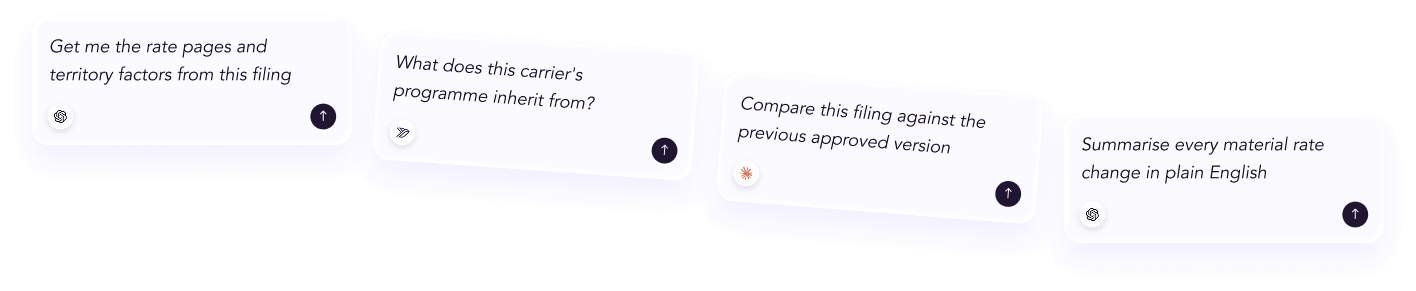




 ChatGPT
 Claude
.png)
.png)
.png)
.png)