
Researching a competitor's products means building a working picture of everything they currently offer, how it's priced, and where it's positioned, using the same public filings that document your own company's activity. Unlike a one-time benchmark against a specific metric set, this is the broader, ongoing foundation that other competitive analysis draws on.
This is how to build that picture and keep it accurate as competitors' filings continue to change.
serff.ai is built to do that for you: it indexes millions of SERFF filings and lets you ask questions in plain English instead of opening documents one by one. You can connect it to the AI assistant you already use: Claude or ChatGPT, via the serff.ai MCP server, or work directly in the web platform.
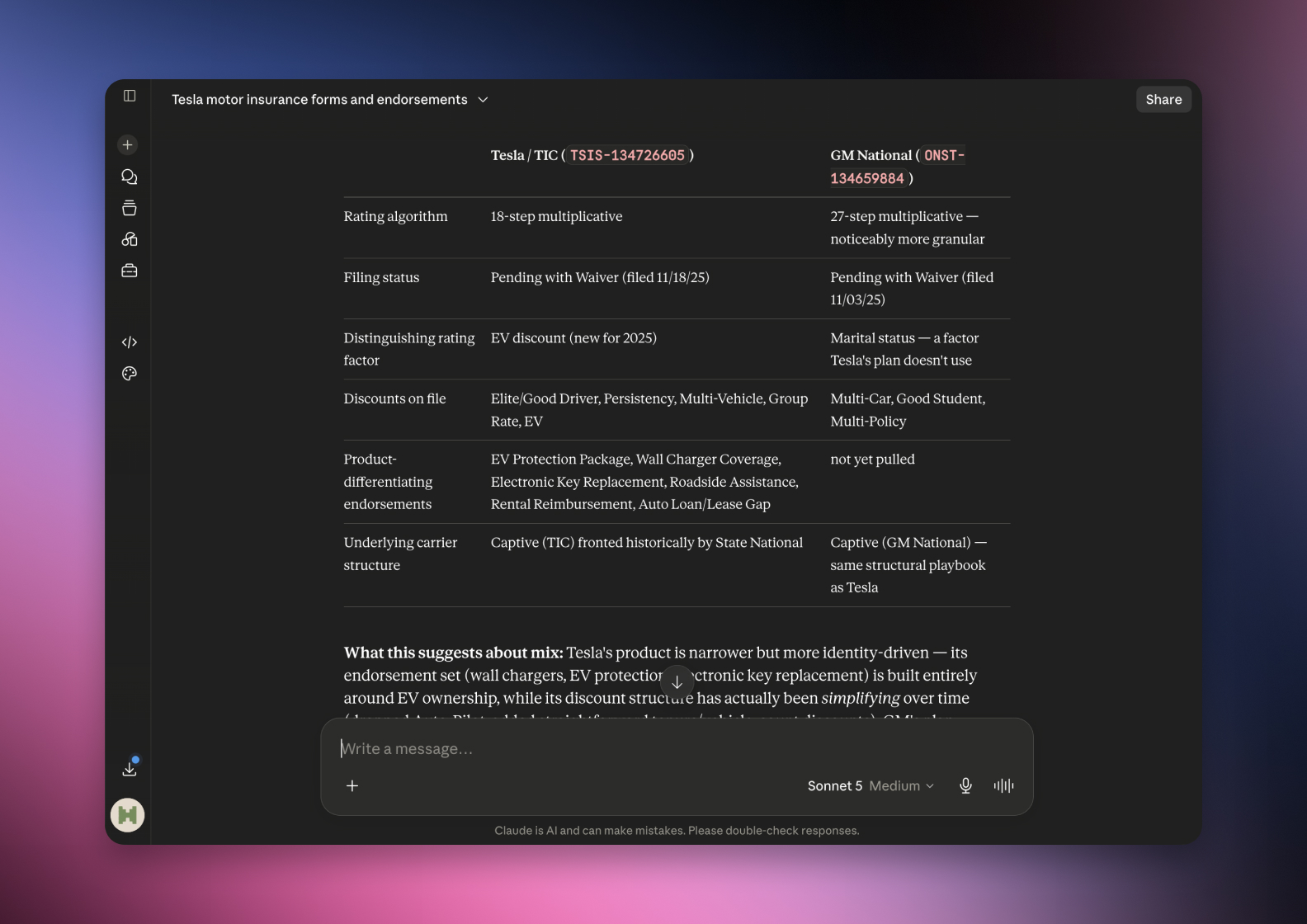

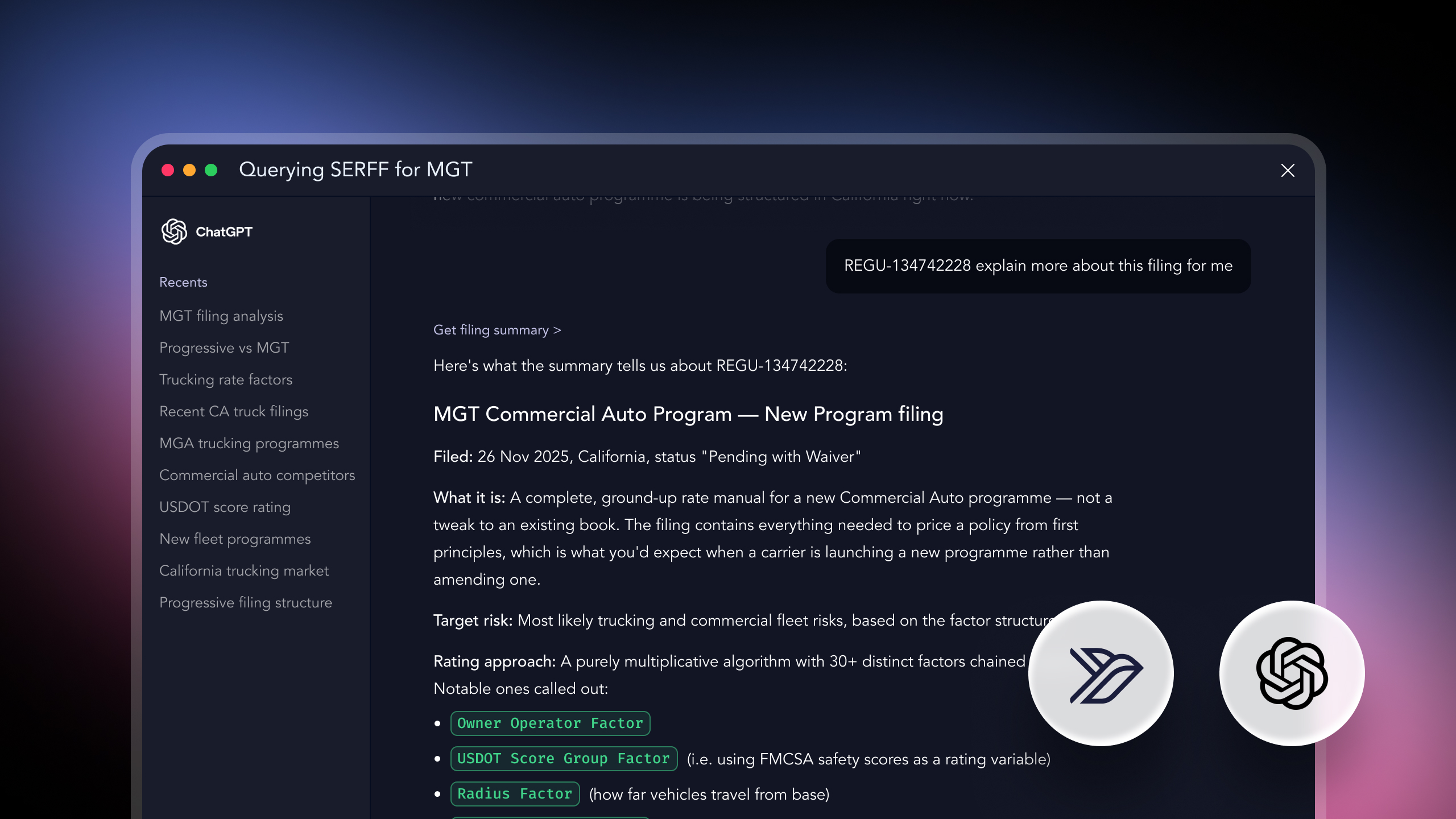
Connected via MCP to the AI you already use, Claude or ChatGPT, or through our dedicated platform, serff.ai makes searching and analysing SERFF filings effortless. Competitor research becomes a single question: ask what a company currently offers, or what's changed recently, and get a grounded, cited answer in seconds.
The manual way
Search a competitor's filings product by product.
With serff.ai, just ask
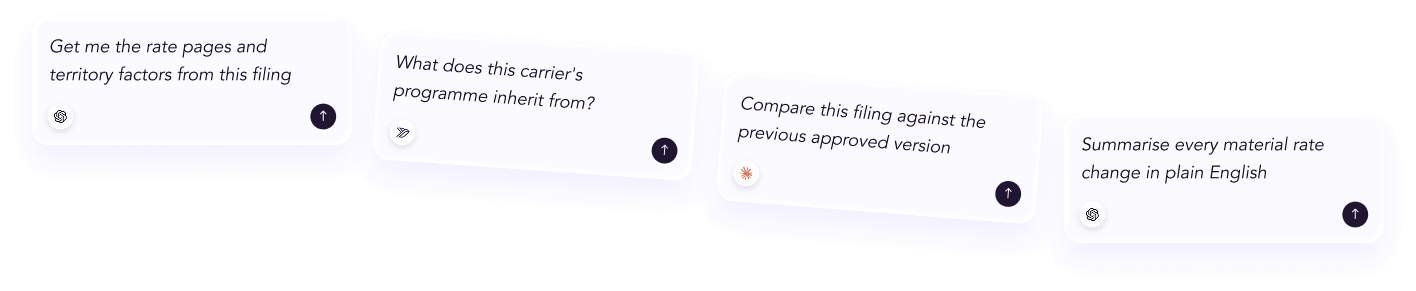
“What products does this competitor currently offer?”
The manual way
Piece together a competitor's pricing posture from scattered filings.
With serff.ai, just ask
“How is this competitor generally positioned on price?”
The manual way
Check for new competitor activity every so often by hand.
With serff.ai, just ask
“What has this competitor filed recently that's new?”
The manual way
Compare a competitor's product mix against your own by hand.
With serff.ai, just ask
“How does this competitor's product mix compare to ours?”
Every answer is cited back to the exact page of the source PDF and grounded only in filed values, with no invented numbers, so you can trust it the way this audience needs to. Research that took weeks takes a prompt.
No credit card required. Simply sign up and connect to Claude or ChatGPT or use Swallow’s SERFF.ai platform.
Research the competitor by company first, including subsidiaries, across every state relevant to your interest. This is the raw material everything else in the research draws from.
A single filing rarely reveals strategy on its own. The pattern across many filings, frequent small rate adjustments versus rare large ones, entry into new states, expansion of underwriting guidelines, tells a more reliable story about where a competitor is investing and where they're pulling back.
Set up a recurring check rather than a one-time research pass. Competitor filings continue after your first look, and a stale picture of a competitor's product lineup can be worse than no picture at all.
Pair this with ongoing monitoring of the products you care about most, so new competitor activity surfaces without requiring you to re-run the full research from scratch each time.
Don't treat a competitor's public filings as the complete picture of their strategy. Distribution decisions, marketing spend and service investments don't appear in SERFF filings at all, even though they matter to how competitive a product actually is.
Researching a competitor's products means building a full picture from their company-wide filing history: what they offer, where they're active, and what recent activity signals about their pricing posture. Keep it current with ongoing checks, and remember filings only show part of the competitive picture.
Begin with a full company-level filing search, including subsidiaries, across every state relevant to your interest.
The products they offer, which states they're active in, their recent filing activity, and their general pricing posture.
Look at the pattern across many filings rather than any single one, such as the frequency and size of rate changes or which states they're expanding into.
Set up a recurring check rather than treating it as one-time research, since competitor filings continue to change after your first pass.
No. Filings capture price, coverage and eligibility, but not distribution, marketing or service investments, which also shape how competitive a product is.





 ChatGPT
 Claude
.png)
.png)
.png)