
A rate filing is a submission an insurer makes to a state insurance department to introduce or change the prices it charges for a product. It sets out the new rates, the rating factors behind them and the actuarial justification for the change, so the regulator can decide whether the proposed prices are adequate, not excessive, and not unfairly discriminatory.
A form filing, by contrast, changes the policy wording rather than the price. The two often travel together, but they answer different questions: a rate filing is about how much a policy costs, a form filing is about what it covers. Telling them apart, and reading what a rate filing actually changes, means working through dense rate exhibits and actuarial support by hand.
serff.ai is built to do that for you: it indexes millions of SERFF filings and lets you ask questions in plain English instead of opening documents one by one. You can connect it to the AI assistant you already use: Claude or ChatGPT, via the serff.ai MCP server, or work directly in the web platform.
.jpg)

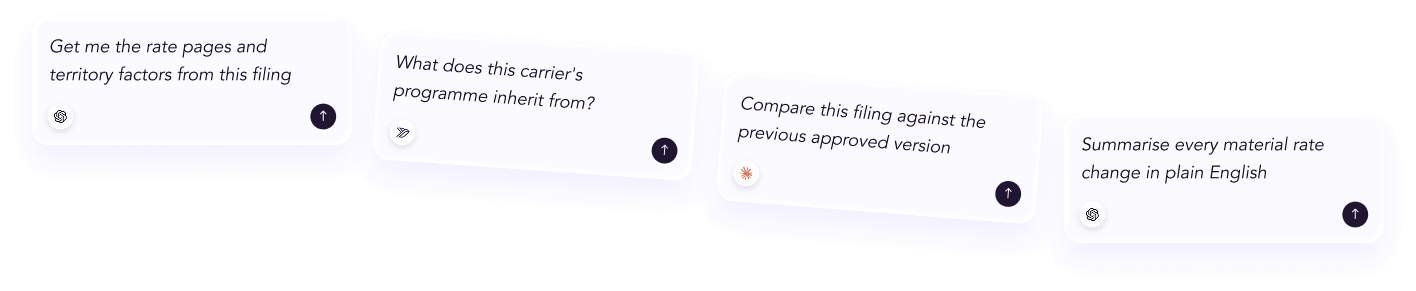
Connected via MCP to the AI you already use, Claude or ChatGPT, or through our dedicated platform, serff.ai makes searching and analysing SERFF filings effortless. A rate filing becomes a single question: ask what the change is, which factors moved, or how it compares to last year, and get a grounded, cited answer in seconds.
The manual way
Read the actuarial exhibits to find the overall rate change.
With serff.ai, just ask
“What is the overall rate change in this filing?”
The manual way
Hunt through rate pages to see which factors moved.
With serff.ai, just ask
“Which rating factors changed, and by how much?”
The manual way
Compare this filing's rates against the prior version by hand.
With serff.ai, just ask
“How does this rate change compare to the previous filing?”
The manual way
Work out whether it is a rate, form or combined filing.
With serff.ai, just ask
“Is this a rate, form or rule filing?”
Every answer is cited back to the exact page of the source PDF and grounded only in filed values, with no invented numbers, so you can trust it the way this audience needs to. Research that took weeks takes a prompt.
No credit card required. Simply sign up and connect to Claude or ChatGPT or use Swallow’s SERFF.ai platform.
A rate filing carries both the new prices and the case for them. The core pieces are the rate pages, the factors that build a premium, and the headline numbers that summarise the impact.
The factors themselves are worth understanding in their own right; see what insurance rating factors are and how they fit into the rating algorithm.
The three filing types change different things. A rate filing changes the price. A form filing changes the policy wording and coverage. A rule filing changes the underwriting or rating rules that decide how rates apply. A single submission can be any combination, so the filing type tells you which schedules to open.
A rate filing usually carries more than one rate change figure, and they rarely match. The indicated change is what the data supports, the requested change is what the insurer actually asked for, and the approved change is what the regulator ultimately allowed.
Do not treat the requested change as the change that happened. The gaps between indicated, requested and approved are often the most revealing part of the filing, showing where the insurer held back and where the regulator pushed.
How that final number is reached is set out in our guide to how insurance rate changes are reviewed by regulators.
Start with the rate information for the headline numbers, then read the actuarial memorandum for the reasoning, and finally the rate pages to see exactly which factors moved. The same deliberate order works for any filing, covered in how to read a SERFF filing.
A rate filing changes what a policy costs; a form filing changes what it covers. Inside a rate filing, the numbers that matter are the indicated, requested and approved change, and the actuarial memorandum that justifies them.
A rate filing changes the price of a policy; a form filing changes the wording and coverage. They are often submitted together but are reviewed as separate schedules.
The indicated change is the rate change the insurer's own data supports. It can differ from the requested change the insurer files for and the approved change the regulator ultimately allows.
It depends on the state. Some require prior approval before new rates can be used, while others allow file-and-use or use-and-file, where rates take effect around the time of filing.
Typically the rate pages, the rating factors and tables being changed, the rate information numbers, and an actuarial memorandum explaining the justification.
A rule filing changes the underwriting or rating rules that decide how rates are applied, rather than the rates or the policy wording themselves.





 ChatGPT
 Claude
.png)
.png)
.png)
.png)