
A single filing shows you what a company did. A pattern across many filings can show you what a company is trying to do, whether it's pursuing growth through aggressive pricing, protecting margin with frequent small adjustments, or pulling back from a segment entirely. That's a strategic read, and it takes looking at a company's filings as a set rather than individually.
This is how to build that read: the signals worth watching, and the care needed not to overstate what a filing pattern can actually tell you about intent.
serff.ai is built to do that for you: it indexes millions of SERFF filings and lets you ask questions in plain English instead of opening documents one by one. You can connect it to the AI assistant you already use: Claude or ChatGPT, via the serff.ai MCP server, or work directly in the web platform.
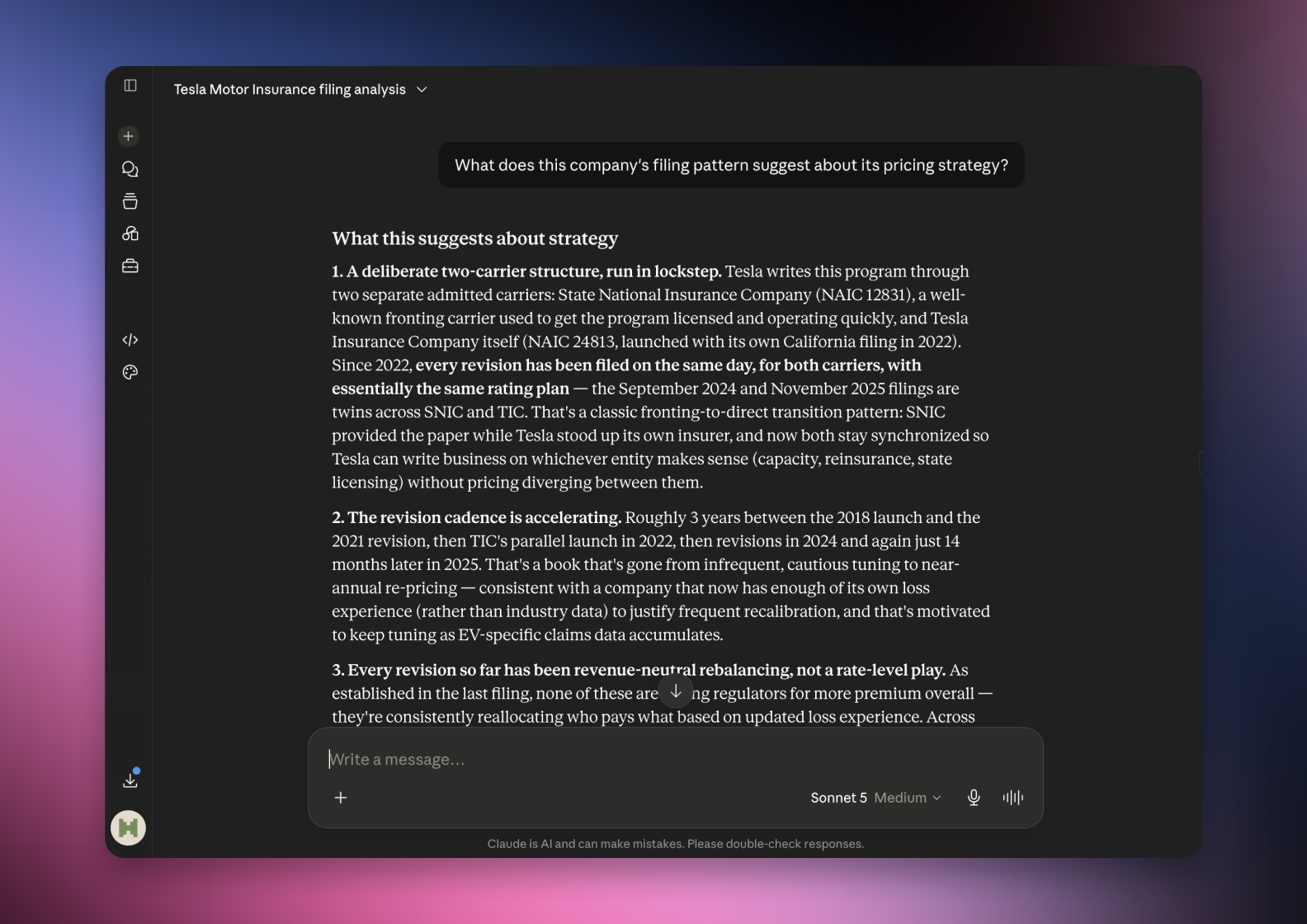

Connected via MCP to the AI you already use, Claude or ChatGPT, or through our dedicated platform, serff.ai makes searching and analysing SERFF filings effortless. Strategy analysis becomes a single question: ask what a company's recent filing pattern suggests about its pricing strategy, and get a grounded, cited answer in seconds.
The manual way
Read years of filings to spot a company's pricing pattern.
With serff.ai, just ask
“What does this company's filing pattern suggest about its pricing strategy?”
The manual way
Compare a company's approach against the market average.
With serff.ai, just ask
“Is this company pricing more or less aggressively than the market?”
The manual way
Work out whether a company is expanding or retreating.
With serff.ai, just ask
“Is this company expanding into new states or products, or pulling back?”
The manual way
Track how a company's strategy has shifted over time.
With serff.ai, just ask
“How has this company's pricing approach changed over the last few years?”
Every answer is cited back to the exact page of the source PDF and grounded only in filed values, with no invented numbers, so you can trust it the way this audience needs to. Research that took weeks takes a prompt.
No credit card required. Simply sign up and connect to Claude or ChatGPT or use Swallow’s SERFF.ai platform.
Any single rate filing can be a one-off response to a specific cost pressure. Strategy shows up in the pattern across many filings over time, ideally paired with the company's underwriting guideline activity, since pricing and eligibility decisions together tell a fuller story than either alone.
A company's own filing history means more when read against the broader market pricing trend for the same product. A company raising rates faster than the market suggests a different strategy than one raising rates in line with everyone else.
Watch for a mismatch between rate activity and product expansion. A company raising rates aggressively while also expanding eligibility is sending a genuinely different signal than one raising rates while also tightening who qualifies.
Filings reveal pricing and underwriting decisions, not the internal reasoning behind them. A company might be responding to a specific loss event, adjusting to a new reinsurance arrangement, or executing a deliberate multi-year strategy, and the filing pattern alone can't always distinguish between these with certainty.
Don't read too much conviction into a strategic read built from filings alone. It's a strong signal, not a confirmed fact about internal decision-making, and should be treated as directional evidence rather than certainty.
A company's pricing strategy shows up in the pattern across many filings, rate frequency and size, geographic and eligibility moves, benchmarked against the market, not in any single filing. Treat the resulting read as a strong signal about intent, not a certainty about internal reasoning.
You can build a reasonably strong directional read from the pattern across many filings, though it's a signal about likely intent rather than confirmed internal reasoning.
Geographic expansion, loosened underwriting eligibility, and rate changes that stay below the broader market trend can all suggest a growth posture.
Exiting states, tightening underwriting eligibility, and rate increases running ahead of the market can suggest pulling back.
A company's own rate activity means more in context. Raising rates faster than the broader market suggests a different posture than raising them in line with everyone else.
Treat it as a strong directional signal rather than a certainty, since filings show decisions but not the internal reasoning behind them.





 ChatGPT
 Claude
.png)
.png)
.png)
.png)