
AI hallucination is when a language model produces an answer that sounds confident and plausible but isn't actually supported by real, verifiable information. It's one of the most important limitations to understand before relying on AI for anything where accuracy matters, filing research included.
Understanding why it happens, and why grounding an answer in citations is the practical defence against it, makes AI tools far more useful and far less risky to work with.
serff.ai is built to do that for you: it indexes millions of SERFF filings and lets you ask questions in plain English instead of opening documents one by one. You can connect it to the AI assistant you already use: Claude or ChatGPT, via the serff.ai MCP server, or work directly in the web platform.
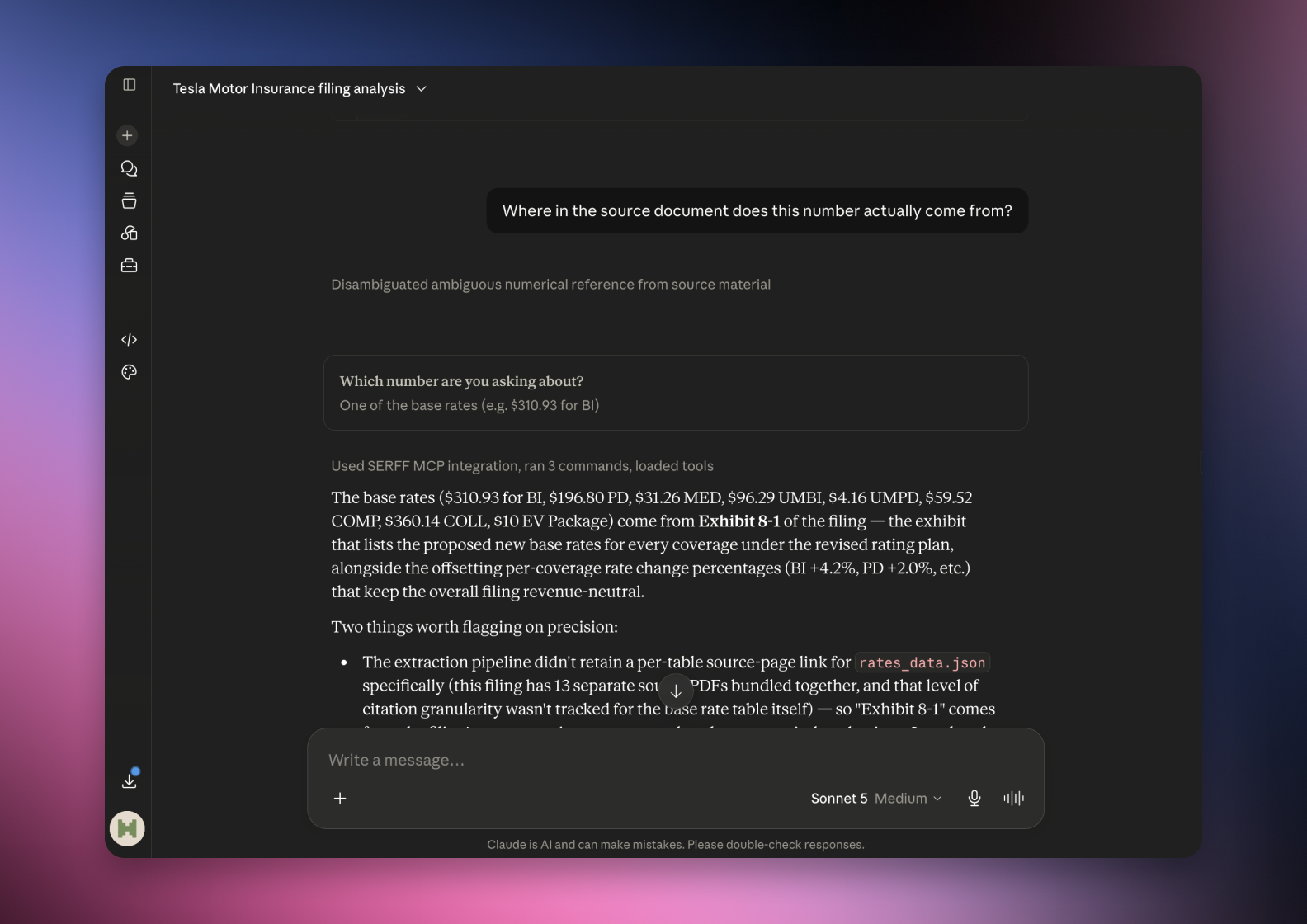

Connected via MCP to the AI you already use, Claude or ChatGPT, or through our dedicated platform, serff.ai makes searching and analysing SERFF filings effortless. Grounding becomes visible with a single question: ask anything about a filing, and check the citation yourself, right back to the exact page it came from.
The manual way
Take an AI-generated number at face value.
With serff.ai, just ask
“Where in the source document does this number actually come from?”
The manual way
Wonder whether an answer is grounded or invented.
With serff.ai, just ask
“Show me the exact passage this answer is based on.”
The manual way
Re-verify every AI claim manually against the full document.
With serff.ai, just ask
“Cite the specific page this claim is drawn from.”
The manual way
Avoid AI tools entirely because you can't trust the output.
With serff.ai, just ask
“Give me an answer I can verify myself, with the source attached.”
Every answer is cited back to the exact page of the source PDF and grounded only in filed values, with no invented numbers, so you can trust it the way this audience needs to. Research that took weeks takes a prompt.
No credit card required. Simply sign up and connect to Claude or ChatGPT or use Swallow’s SERFF.ai platform.
A language model generates text by predicting what is likely to come next, based on patterns learned from enormous amounts of training data. Most of the time, that produces accurate, useful answers. But when a model is asked something specific that isn't well represented in what it learned, a precise figure from an obscure filing, for instance, it can still generate a fluent, confident-sounding answer that is simply wrong.
Grounding an answer means having the system retrieve the actual source document and base its answer on that specific text, rather than generating from memory alone. A citation is the visible proof of that grounding: it lets you check the answer against the real filing yourself, rather than trusting the model's phrasing on faith.
Get in the habit of checking at least the citation, even when you don't have time to verify the whole answer. A citation you can click through and confirm is a meaningfully different guarantee than an answer with no source at all.
For anything that will inform a decision, spot-check the cited source directly. If an answer has no citation, or the citation doesn't actually support the claim when you check it, treat the answer with real scepticism, the same way you would an unverified claim from any other source.
A confident tone is not evidence of accuracy. Hallucinated answers are often just as fluent and assured as accurate ones, which is exactly why grounding and citation checking matter more than how convincing an answer sounds.
AI hallucination happens because language models predict plausible text rather than retrieving verified facts by default, and confident phrasing doesn't distinguish correct answers from wrong ones. Citations are the practical defence: they let you check any answer against its actual source before you rely on it.
It means the model has produced an answer that sounds confident and plausible but isn't actually supported by real, verifiable information.
They generate text by predicting likely patterns rather than retrieving verified facts by default, which can produce fluent but incorrect answers, especially for specific or obscure information.
A confident tone alone isn't a reliable signal. The practical check is whether the answer is grounded in a citation you can verify against the actual source.
It means the system retrieved the actual source document and based its answer on that specific text, rather than generating from memory or pattern alone.
For anything informing a real decision, yes. Spot-checking the citation against the source is the practical way to catch an unsupported claim before relying on it.





 ChatGPT
 Claude
.png)
.png)
.png)
.png)