
An insurance rating algorithm is the step-by-step procedure that turns a base rate and a set of rating factors into a final premium. It defines the order of operations: which factors multiply, which add, where caps and minimums apply, and how rounding is handled at each stage. It is the recipe that the rate pages and factor tables are ingredients for.
Two filings can share the same factors and still produce different premiums if the algorithm orders them differently. Reading a rate filing fully means understanding not just the factors but the sequence that combines them, which is often the most technical part of the submission.
serff.ai is built to do that for you: it indexes millions of SERFF filings and lets you ask questions in plain English instead of opening documents one by one. You can connect it to the AI assistant you already use: Claude or ChatGPT, via the serff.ai MCP server, or work directly in the web platform.
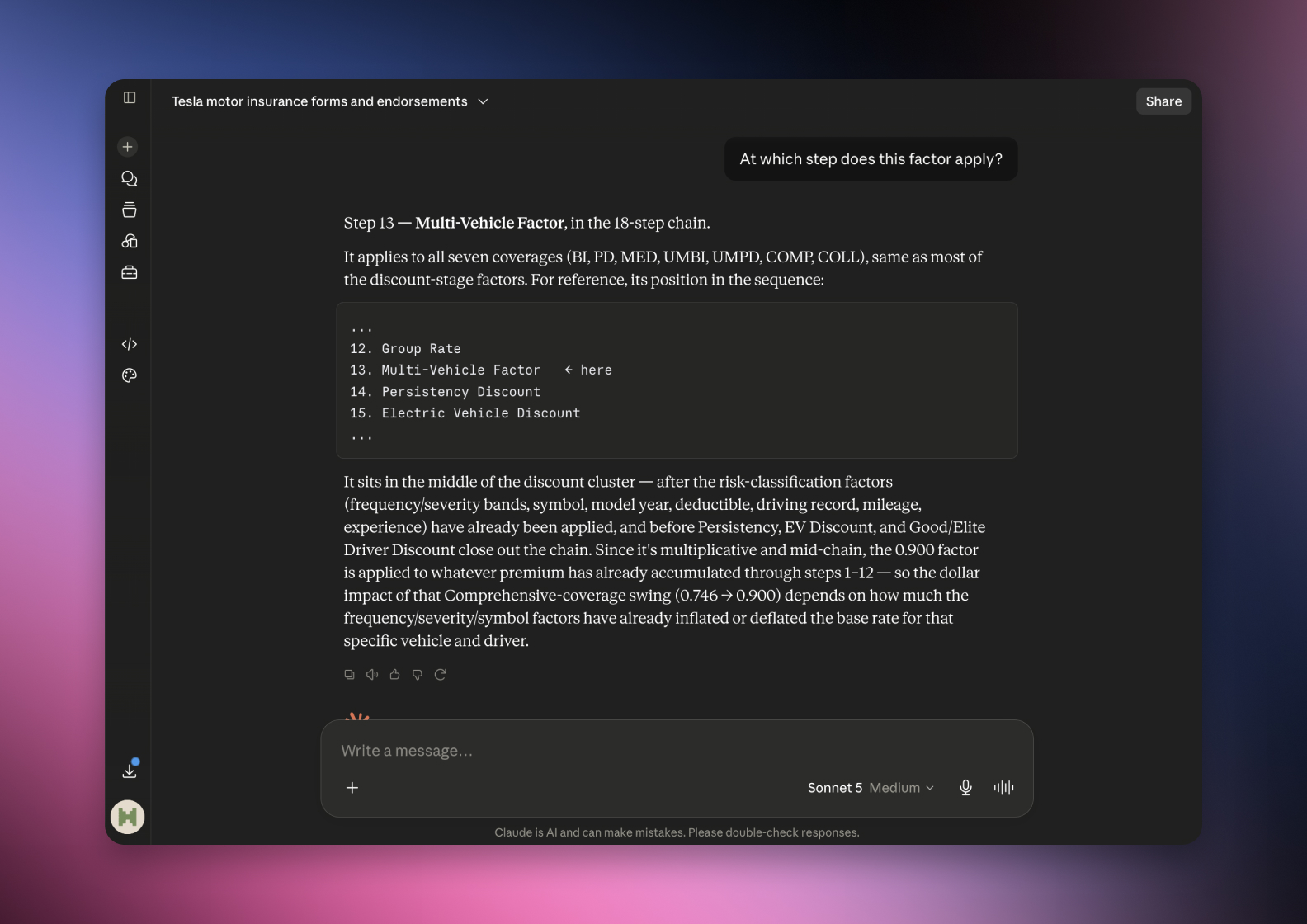

Connected via MCP to the AI you already use, Claude or ChatGPT, or through our dedicated platform, serff.ai makes searching and analysing SERFF filings effortless. A rating algorithm becomes a single question: ask what order the steps run in, where a cap applies, or how a factor enters the calculation, and get a grounded, cited answer in seconds.
The manual way
Read the rate manual to reconstruct the order of steps.
With serff.ai, just ask
“What is the order of operations in this rating algorithm?”
The manual way
Work out where a factor enters the calculation.
With serff.ai, just ask
“At which step does this factor apply?”
The manual way
Hunt for caps, minimums and rounding rules.
With serff.ai, just ask
“Where do caps or rounding rules apply?”
The manual way
Compare the algorithm against the previous version.
With serff.ai, just ask
“How did the rating algorithm change from the last filing?”
Every answer is cited back to the exact page of the source PDF and grounded only in filed values, with no invented numbers, so you can trust it the way this audience needs to. Research that took weeks takes a prompt.
No credit card required. Simply sign up and connect to Claude or ChatGPT or use Swallow’s SERFF.ai platform.
The algorithm is the sequence that assembles a premium. Even when products differ, the same kinds of step recur, and their order is what determines the final number.
The rating factors are the inputs the algorithm orders, and the rules decide when each step applies.
Order changes outcomes. Applying a cap before a surcharge produces a different premium than applying it after; multiplying two factors gives a different answer than adding them. This is why two insurers with similar factors can price the same risk differently, and why a filing that only re-orders steps can still change what customers pay.
An algorithm change can be revenue-neutral on average while moving individual premiums significantly. Do not read a change to the order of operations as cosmetic; check its effect at the level of a single risk.
The algorithm is set out in the rate/rule schedule of a rate filing, often as a worked example that walks a sample risk from base rate to final premium. The actuarial memorandum explains the reasoning behind any change to it.
Follow a single risk through it. Start from the base rate, apply each step in the stated order, and watch for the points where caps, minimums or rounding bite. Comparing the worked example in the new filing against the previous one is the quickest way to see what changed.
A rating algorithm is the order of operations that turns a base rate and factors into a premium. The same factors in a different order produce a different price, so read the sequence, not just the inputs, and follow one risk all the way through.
It is the step-by-step procedure that combines a base rate and rating factors into a final premium, defining the order of operations, caps, minimums and rounding.
Rating factors are the individual multipliers; the algorithm is the sequence that decides how and in what order they combine into a premium.
Because applying steps in a different order can produce a different premium, even with identical factors. Order is part of the price.
It appears in the rate/rule schedule, often as a worked example that walks a sample risk from base rate to final premium.
Yes. Re-ordering steps or changing where a cap applies can move individual premiums even when the base rates and factors are unchanged.





 ChatGPT
 Claude
.png)
.png)
.png)
.png)