
Reading a filing and analysing one are different skills. Reading gets you through the sections in order and tells you what each part says. Analysis asks a further question: what does this filing mean, how does it compare to others, and what should you actually take away from it.
This is how to move from reading to analysis: the signals worth extracting, how to benchmark a filing against others, and the judgment calls that separate a surface read from a genuinely useful conclusion.
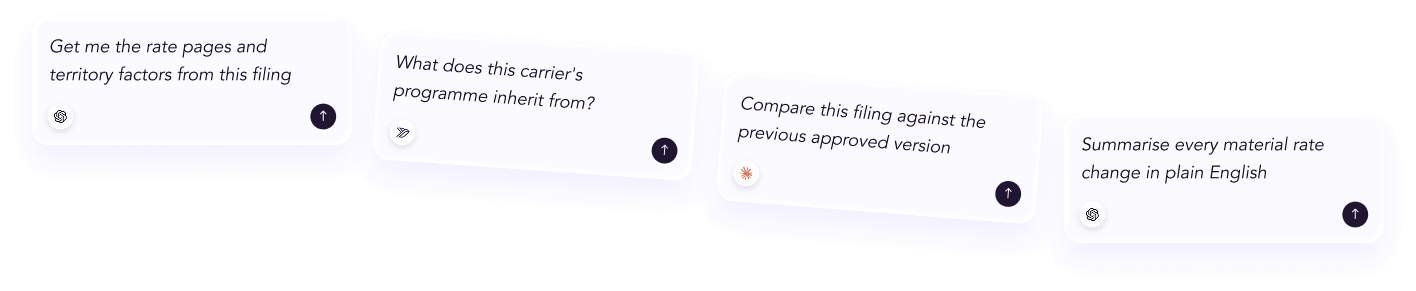
serff.ai is built to do that for you: it indexes millions of SERFF filings and lets you ask questions in plain English instead of opening documents one by one. You can connect it to the AI assistant you already use: Claude or ChatGPT, via the serff.ai MCP server, or work directly in the web platform.
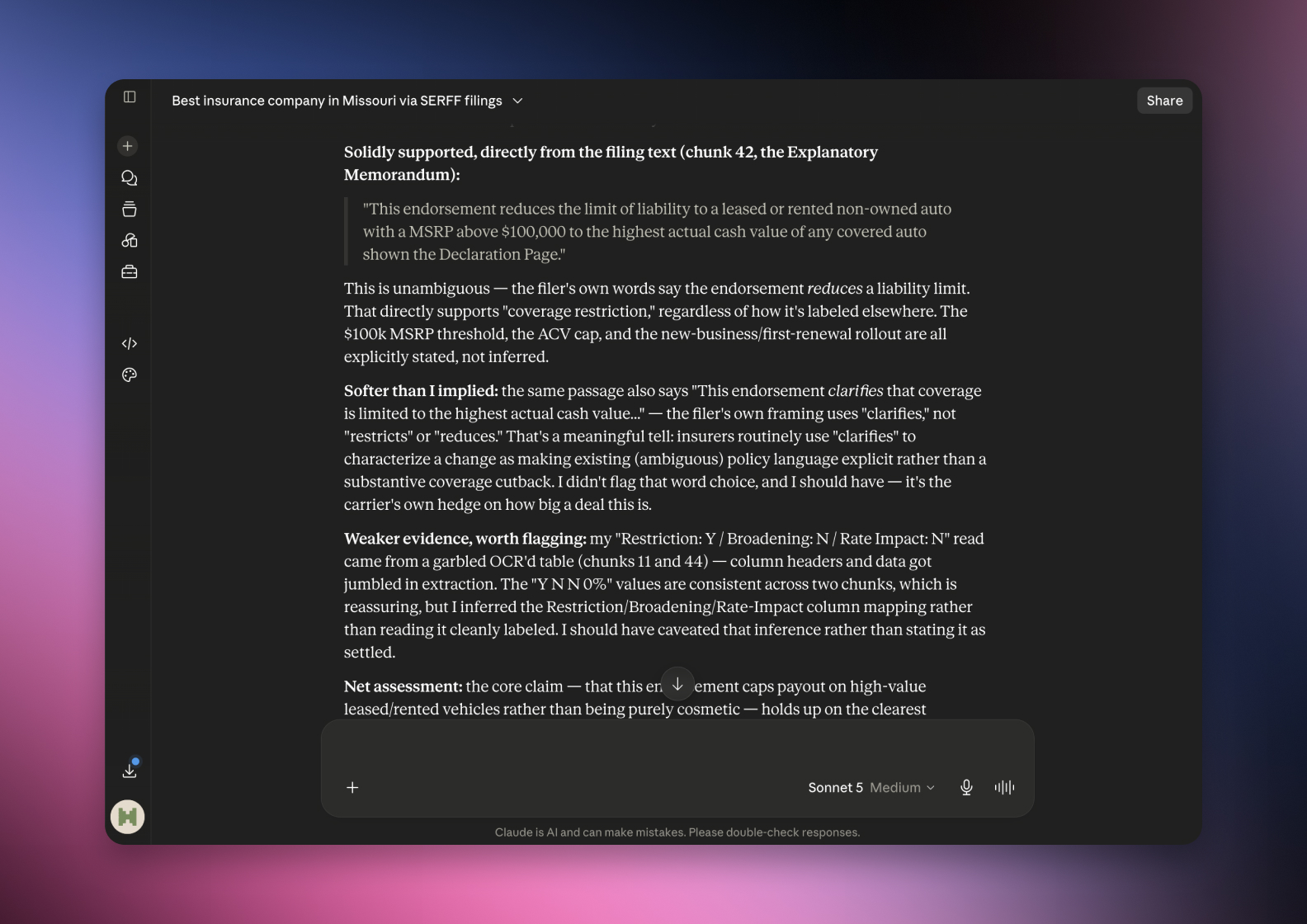

Connected via MCP to the AI you already use, Claude or ChatGPT, or through our dedicated platform, serff.ai makes searching and analysing SERFF filings effortless. Analysis becomes a single question: ask what a filing signals, how it compares to others, or what conclusion the evidence supports, and get a grounded, cited answer in seconds.
The manual way
Read a filing fully before deciding what actually matters.
With serff.ai, just ask
“What are the three most important signals in this filing?”
The manual way
Manually benchmark one filing against several others.
With serff.ai, just ask
“How does this filing compare to similar recent filings?”
The manual way
Separate a headline figure from the reasoning behind it.
With serff.ai, just ask
“What does the actuarial reasoning actually support here?”
The manual way
Draw a conclusion and then go back to check it holds up.
With serff.ai, just ask
“Does the evidence in this filing support this conclusion?”
Every answer is cited back to the exact page of the source PDF and grounded only in filed values, with no invented numbers, so you can trust it the way this audience needs to. Research that took weeks takes a prompt.
No credit card required. Simply sign up and connect to Claude or ChatGPT or use Swallow’s SERFF.ai platform.
Reading a filing means working through its sections in order. Analysis takes what you've read and asks what it signals: is this change larger or smaller than typical for this product, does the reasoning hold up, and what does it suggest about where the insurer, or the market, is heading.
A single filing rarely means much in isolation. Benchmarking it against the same company's prior filings, or against competitor filings for the same product, is what turns one data point into an actual signal. A 5% rate increase looks different depending on whether the market average is 2% or 8%.
Before drawing a conclusion from one filing, ask what the last two or three filings from the same company, on the same product, looked like. A single filing's meaning changes a lot depending on that trend line.
Good analysis distinguishes what the filing states from what it actually supports. A requested change is a request, not a fact about the market; an objection that challenges an assumption is a signal that the reasoning may be weaker than it first appears. Weigh the evidence, not just the headline.
Don't treat a single filing as representative of an entire market or trend. One data point can be an outlier, and the surest way to know is to check it against several comparable filings before generalising.
Analysing a filing means going past what it says to what it signals: extract the headline number, the reasoning, the scope and the context, then benchmark against comparable filings before drawing a conclusion. A single filing rarely tells the whole story on its own.
Reading works through the filing's sections in order; analysis asks what those sections signal, how they compare to others, and what conclusion the evidence actually supports.
The headline number, the reasoning behind it, the scope of what's affected, and how it compares to the company's or market's recent activity.
A single filing means little in isolation. Comparing it against prior filings or competitor filings turns one data point into an actual signal.
Check it against several comparable filings before generalising, since one filing can be an outlier rather than representative of a broader trend.
Not on its own. A request is a starting point; the approved figure and the reasoning behind it matter more for understanding the actual outcome.





 ChatGPT
 Claude
.png)
.png)
.png)
.png)