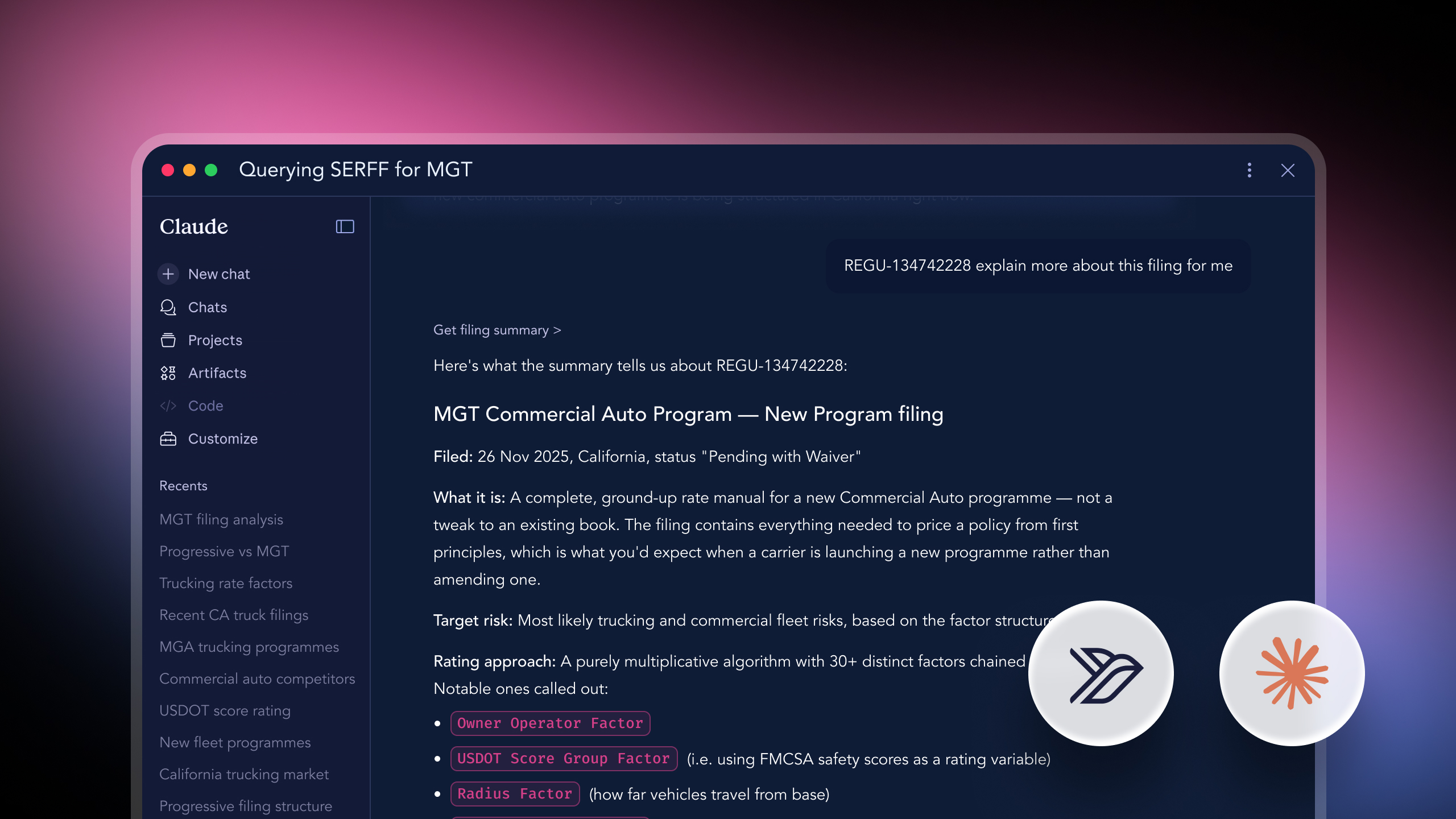
Insurance regulatory correspondence is the full record of communication between an insurer and a state regulator during a filing's review. Objection letters are the best-known piece, but the correspondence thread also holds the insurer's responses, acknowledgment notices, requests for clarification, and any other back-and-forth that shaped the outcome.
Read in order, correspondence is the closest thing a filing has to a narrative: it shows what the regulator questioned, how the insurer answered, and how the filing changed as a result.
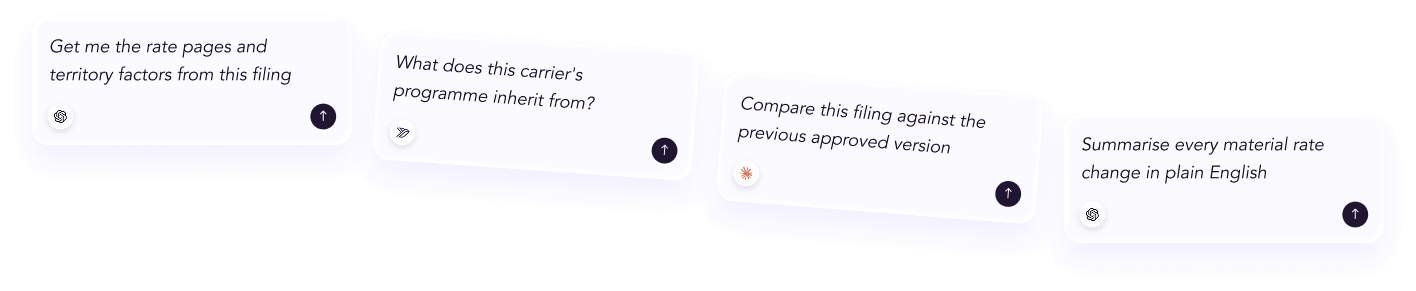
serff.ai is built to do that for you: it indexes millions of SERFF filings and lets you ask questions in plain English instead of opening documents one by one. You can connect it to the AI assistant you already use: Claude or ChatGPT, via the serff.ai MCP server, or work directly in the web platform.
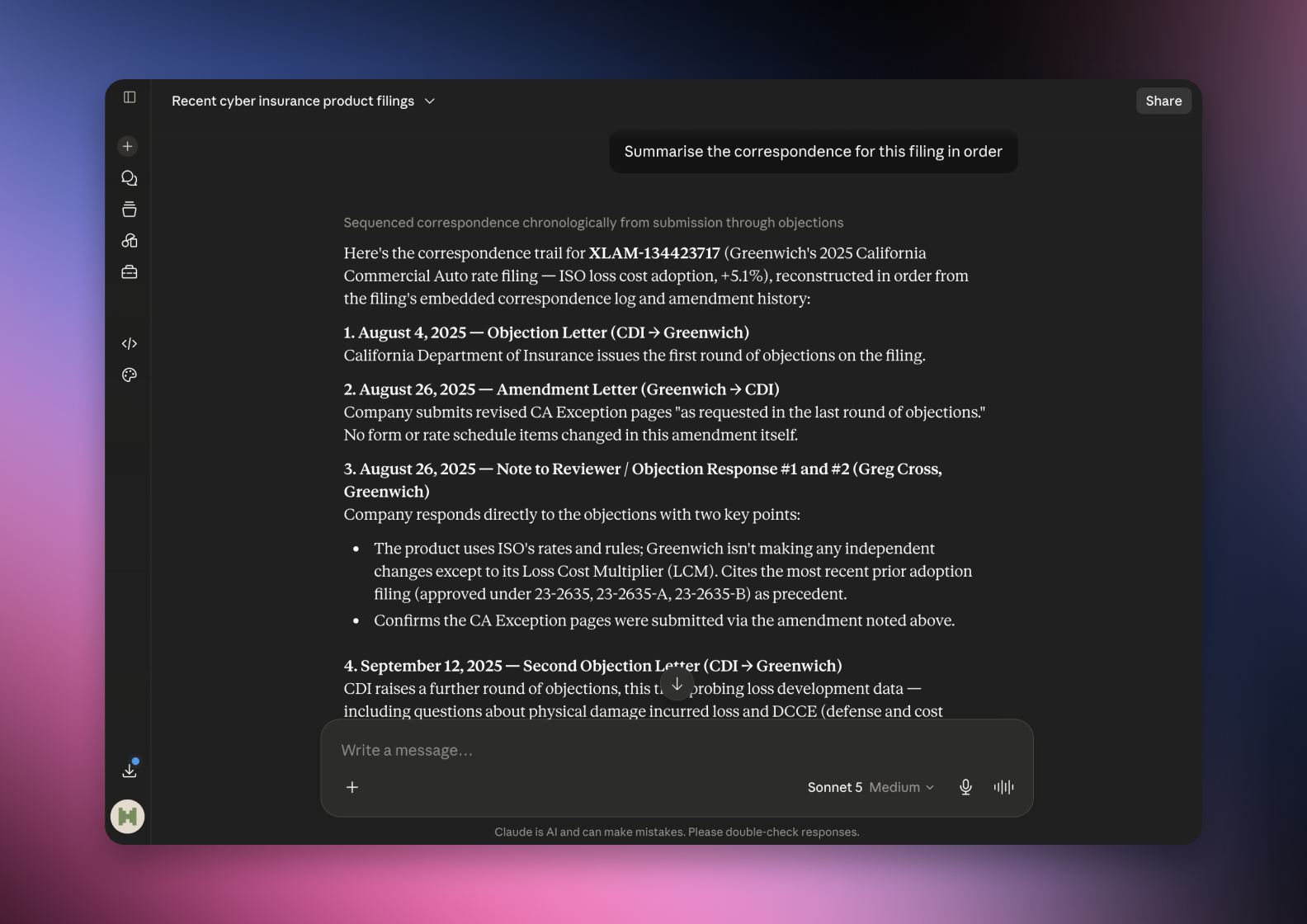

Connected via MCP to the AI you already use, Claude or ChatGPT, or through our dedicated platform, serff.ai makes searching and analysing SERFF filings effortless. Correspondence becomes a single question: ask what was exchanged, in what order, or what it led to, and get a grounded, cited answer in seconds.
The manual way
Read every message in a thread to piece together the story.
With serff.ai, just ask
“Summarise the correspondence for this filing in order.”
The manual way
Work out which messages are objections versus routine notes.
With serff.ai, just ask
“Which messages in this thread are objections?”
The manual way
Match a response back to the message that prompted it.
With serff.ai, just ask
“What was the insurer responding to in this message?”
The manual way
Check whether correspondence led to an amendment.
With serff.ai, just ask
“Did this correspondence lead to a filing amendment?”
Every answer is cited back to the exact page of the source PDF and grounded only in filed values, with no invented numbers, so you can trust it the way this audience needs to. Research that took weeks takes a prompt.
No credit card required. Simply sign up and connect to Claude or ChatGPT or use Swallow’s SERFF.ai platform.
The thread holds more than objections. It is the complete communication record for a filing's review.
Objection letters alone can make a review look adversarial when much of the exchange is routine. Reading the full thread shows the proportion: how many messages were genuine challenges versus process steps, and how quickly each was resolved. It is also where you see the reasoning an amendment responds to, rather than just the amendment itself.
Read chronologically, and pair each objection with its response before moving to the next. That pairing is what turns a list of dated messages into an actual argument: what was challenged, how it was defended, and whether the defence held.
Correspondence patterns repeat across filings from the same regulator. Reading several threads from one state tells you what that regulator consistently pushes on, which is useful groundwork before you file there yourself.
Not every jurisdiction makes the full correspondence thread public in the same level of detail. If a filing's outcome seems to shift without an obvious cause, an informal or undisclosed conversation may be part of the explanation.
Regulatory correspondence is the complete communication record for a filing, not just the objection letters within it. Reading the full thread in order shows the actual negotiation behind the approved outcome, and reading across filings from one regulator shows what they consistently scrutinise.
It is the full record of communication between an insurer and a regulator during a filing's review, including objections, responses, and routine notices.
No. Objection letters are one part of the correspondence thread, which also includes insurer responses, acknowledgments and clarification requests.
It shows the actual negotiation behind a filing's outcome, including what was challenged, how it was defended, and what changed as a result.
Availability varies by state. Some jurisdictions publish the full thread, while others disclose less detail or treat some exchanges as informal.
No. Many exchanges are resolved without a formal amendment, particularly when the insurer's response satisfies the regulator without a document change.





 ChatGPT
 Claude
.png)
.png)
.png)