
A filing amendment is a change an insurer makes to a filing after it has already been submitted. Rather than starting a new filing, the insurer revises the existing one, replacing a document, adjusting a requested figure, or narrowing what is being asked for, while the original tracking number stays the same.
Amendments are common, and they are one of the clearest signals that a filing did not sail through review unchanged. Spotting one, and understanding why it happened, tells you something the final approved documents alone will not.
serff.ai is built to do that for you: it indexes millions of SERFF filings and lets you ask questions in plain English instead of opening documents one by one. You can connect it to the AI assistant you already use: Claude or ChatGPT, via the serff.ai MCP server, or work directly in the web platform.
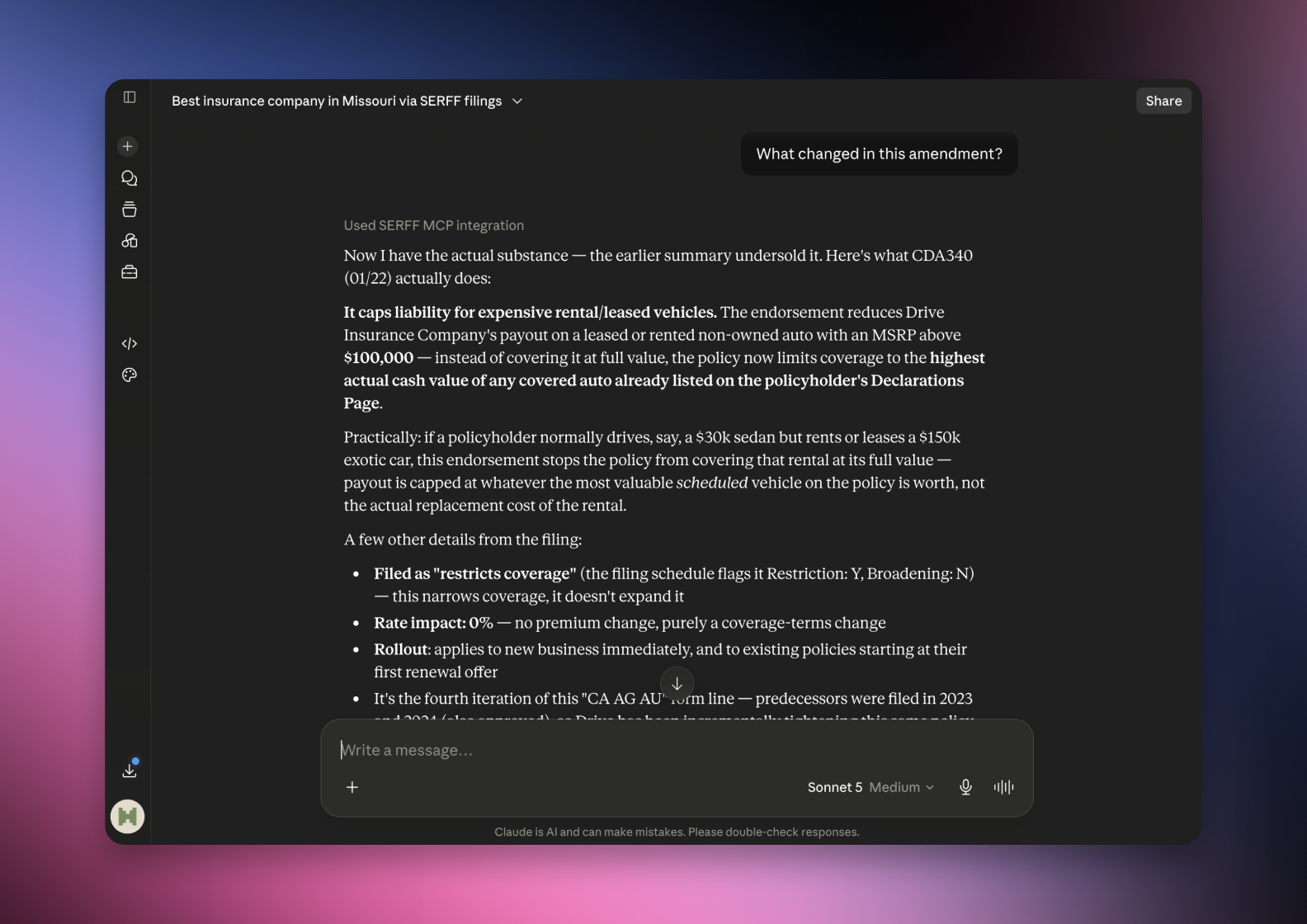

Connected via MCP to the AI you already use, Claude or ChatGPT, or through our dedicated platform, serff.ai makes searching and analysing SERFF filings effortless. An amendment becomes a single question: ask what changed, when, or why, and get a grounded, cited answer in seconds.
The manual way
Compare filing versions side by side to spot a change.
With serff.ai, just ask
“What changed in this amendment?”
The manual way
Work out why an insurer amended a filing.
With serff.ai, just ask
“Why was this filing amended?”
The manual way
Check whether an amendment followed a regulator objection.
With serff.ai, just ask
“Did this amendment respond to a regulator objection?”
The manual way
Track how many times a filing was amended before decision.
With serff.ai, just ask
“How many amendments has this filing had?”
Every answer is cited back to the exact page of the source PDF and grounded only in filed values, with no invented numbers, so you can trust it the way this audience needs to. Research that took weeks takes a prompt.
No credit card required. Simply sign up and connect to Claude or ChatGPT or use Swallow’s SERFF.ai platform.
Most amendments trace back to one of a few causes: a response to an objection letter, a correction the insurer catches itself, or a request for additional supporting data. Occasionally an insurer narrows or withdraws part of a request voluntarily as the review conversation develops.
An amendment updates an existing submission under its original tracking number. A new filing is a separate submission entirely, even if it covers similar ground. If you see the same tracking number with a later update date and a changed document, you are looking at an amendment, not a new filing.
Compare the amendment's date against the correspondence thread. An amendment that lands shortly after an objection letter is almost always the insurer's response to it, even if the filing does not say so explicitly.
An amendment can meaningfully change what the filing ends up asking for, which is why the approved figure can differ from the number in the original submission. Reading the amendment alongside the original version shows you the actual negotiation, not just its result.
Do not assume the version of a document you are reading is the final one. If a filing has been amended, an earlier document may already be superseded, so check the update date before relying on any specific figure.
A filing amendment is a change made to a submission after it was filed, most often in response to an objection. It updates the same tracking number rather than starting a new filing, and comparing versions shows you exactly what the review process reshaped.
It is a change an insurer makes to a filing after submission, updating the existing filing under its original tracking number rather than starting a new one.
Most commonly in response to a regulator's objection, but also to correct an error or to add supporting data requested during review.
An amendment updates an existing submission under its original tracking number; a new filing is a separate submission entirely.
No. Some amendments are insurer-initiated corrections or voluntary updates, though many do follow an objection.
Check the update date against the filing's correspondence and amendment history to confirm you are looking at the current version.





 ChatGPT
 Claude
.png)
.png)
.png)
.png)