
Finding a rate increase filing is a search problem. Understanding it, why it happened, how large it is relative to what's typical, and what's actually driving it, is a different and more valuable task. Rate increases are rarely arbitrary; they trace back to specific cost pressures that show up consistently across the industry when you know where to look.
This is how to research a rate increase properly: what drives one, how to judge whether it's large or typical, and where the reasoning actually lives in a filing.
serff.ai is built to do that for you: it indexes millions of SERFF filings and lets you ask questions in plain English instead of opening documents one by one. You can connect it to the AI assistant you already use: Claude or ChatGPT, via the serff.ai MCP server, or work directly in the web platform.
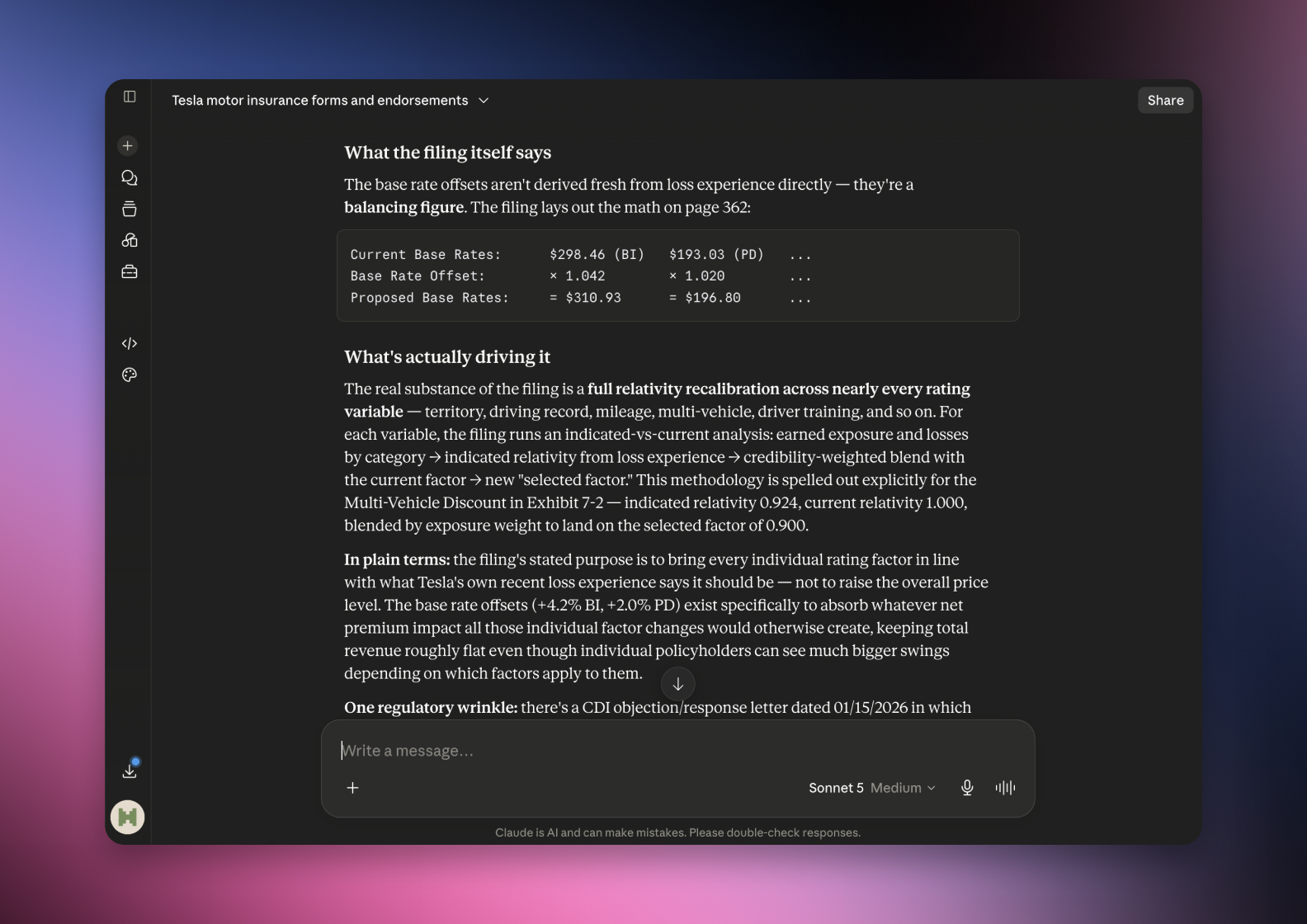

Connected via MCP to the AI you already use, Claude or ChatGPT, or through our dedicated platform, serff.ai makes searching and analysing SERFF filings effortless. Rate increase research becomes a single question: ask how large an increase is, what's driving it, or how it compares to recent history, and get a grounded, cited answer in seconds.
The manual way
Read the actuarial memorandum to find what's driving an increase.
With serff.ai, just ask
“What is driving this rate increase, according to the filing?”
The manual way
Work out if an increase is unusually large for this product.
With serff.ai, just ask
“Is this rate increase larger than typical for this product?”
The manual way
Track how often a company has raised rates recently.
With serff.ai, just ask
“How often has this company raised rates in the last two years?”
The manual way
Compare an increase's stated driver against industry patterns.
With serff.ai, just ask
“Is this driver common across other recent rate increases too?”
Every answer is cited back to the exact page of the source PDF and grounded only in filed values, with no invented numbers, so you can trust it the way this audience needs to. Research that took weeks takes a prompt.
No credit card required. Simply sign up and connect to Claude or ChatGPT or use Swallow’s SERFF.ai platform.
The stated driver sits in the actuarial memorandum, which should connect the requested change to specific evidence, trend selections, loss development, expense changes, rather than asserting a number without support. Reading that section is the difference between finding an increase and understanding it.
A single rate increase means little without context. Compare it against the same company's recent filing history and against broader pricing trends for the product to see whether it's larger, smaller or in line with what's typical right now.
Check both size and frequency together. A company filing small increases often is pursuing a different strategy than one filing rarely but in large jumps, even if the annualised impact ends up similar.
How much an increase was contested tells you something too. An increase that draws an objection letter challenging the trend selection suggests the regulator saw the justification as weaker than the insurer's stated reasoning implied, which is worth factoring into how much weight you put on the headline figure.
The requested increase and the approved increase are often different numbers. If you're researching the actual market impact, use the approved figure and its effective date, not just what was originally filed.
Researching a rate increase means reading past the headline number to its stated driver in the actuarial memorandum, then judging its size and frequency against the company's history and the wider market. The approved figure, not the requested one, is what actually reached the market.
Common drivers include loss trend, catastrophe experience, rising reinsurance costs, and inflation in repair, medical or replacement costs.
In the actuarial memorandum, which should connect the requested change to specific evidence like trend selections and loss development.
Compare it against the same company's recent filing history and against broader pricing trends for the product to see whether it's typical or an outlier.
Not necessarily unjustified, but it does suggest the regulator saw the initial justification as needing more support than first provided.
The approved figure and its effective date reflect what actually reached the market; the requested figure is only the starting ask.






 ChatGPT
 Claude
.png)
.png)
.png)
.png)