
A rule filing is a submission an insurer makes to change the rules that govern how a product is rated and underwritten: eligibility criteria, tier placement, rounding, how discounts and surcharges apply, and the order in which rating steps run. It sits between rate and form: not the price itself, and not the policy wording, but the logic that connects them.
Rule changes can shift what a customer actually pays or whether they qualify at all, even when the published rates do not move. That makes rule filings easy to overlook and important to read, because the effect often hides in the mechanics rather than in a headline number.
serff.ai is built to do that for you: it indexes millions of SERFF filings and lets you ask questions in plain English instead of opening documents one by one. You can connect it to the AI assistant you already use: Claude or ChatGPT, via the serff.ai MCP server, or work directly in the web platform.
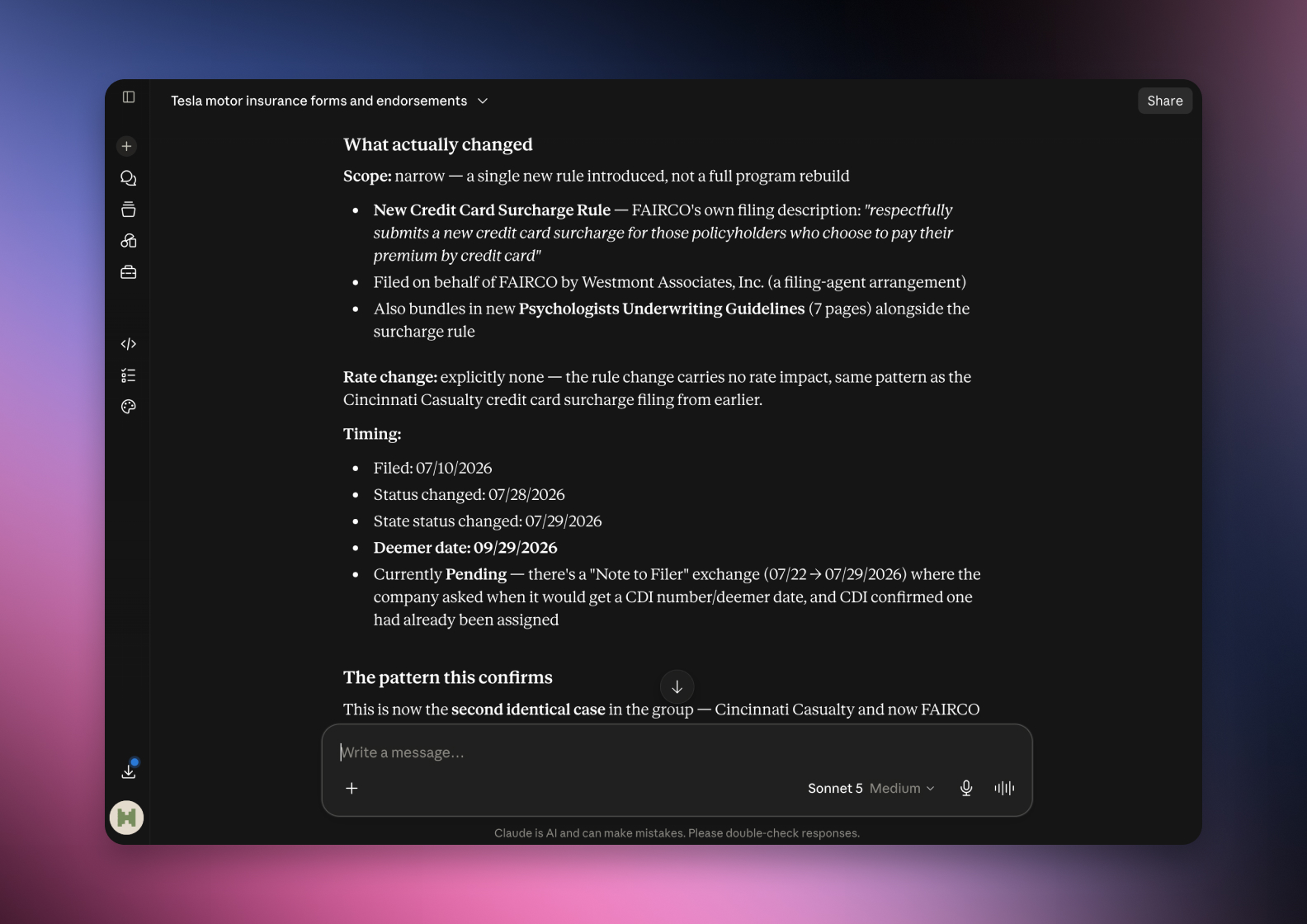

Connected via MCP to the AI you already use, Claude or ChatGPT, or through our dedicated platform, serff.ai makes searching and analysing SERFF filings effortless. A rule filing becomes a single question: ask what eligibility or tiering changed, or how a discount now applies, and get a grounded, cited answer in seconds.
The manual way
Read the rules manual to find what actually changed.
With serff.ai, just ask
“What rules changed in this filing?”
The manual way
Trace how a discount or surcharge is applied by hand.
With serff.ai, just ask
“How does this discount apply, and to whom?”
The manual way
Work out whether eligibility rules tightened or loosened.
With serff.ai, just ask
“Did eligibility or tiering rules change?”
The manual way
Cross-check the rule change against the rating steps.
With serff.ai, just ask
“How does this rule affect the rating algorithm?”
Every answer is cited back to the exact page of the source PDF and grounded only in filed values, with no invented numbers, so you can trust it the way this audience needs to. Research that took weeks takes a prompt.
No credit card required. Simply sign up and connect to Claude or ChatGPT or use Swallow’s SERFF.ai platform.
A rule filing changes entries in the rules manual, the document that tells the rating system how to treat a risk. The common building blocks are the rules that decide eligibility, placement and how adjustments apply.
Those rules drive the rating algorithm, which is where the numbers actually combine.
A rate filing changes the rates. A form filing changes the policy wording. A rule filing changes the logic that decides how rates and coverage apply to a given risk. Many submissions combine rate and rule together, because a new factor often needs a new rule to tell the system when to use it.
Rule changes rarely announce themselves with a big percentage. A tightened eligibility rule can move a whole segment of customers into a different tier; a change to how two discounts stack can shift premiums without any base rate moving. The impact is real but indirect, so it takes reading the rule against the algorithm to see it.
A filing described as revenue-neutral can still change what individual customers pay. Rule changes redistribute rather than raise, so the average holds while the winners and losers change underneath it.
Read the general information for the intent, then work through each rule change and ask what it does to eligibility, tier placement or the order of operations. Pair it with the rating factors it governs, and check the correspondence for any regulator questions about fairness or disparate impact.
A rule filing changes the logic, not the price or the wording: who is eligible, how they are tiered, and how adjustments apply. Its impact often hides in the mechanics, so read the rules against the rating algorithm they drive.
A rule filing changes the underwriting or rating rules that decide how rates and coverage apply, such as eligibility, tiering and how discounts and surcharges are used.
A rate filing changes the actual prices; a rule filing changes the logic that determines how those prices apply to a given risk. They are often filed together.
Yes. Changes to eligibility, tiering or how discounts stack can change an individual premium even when the published base rates do not move.
The rules manual is the document that tells the rating system how to treat a risk, covering eligibility, placement, rounding and the order of rating operations.
As with rate and form filings, it depends on the state and the product, ranging from prior approval to file-and-use.

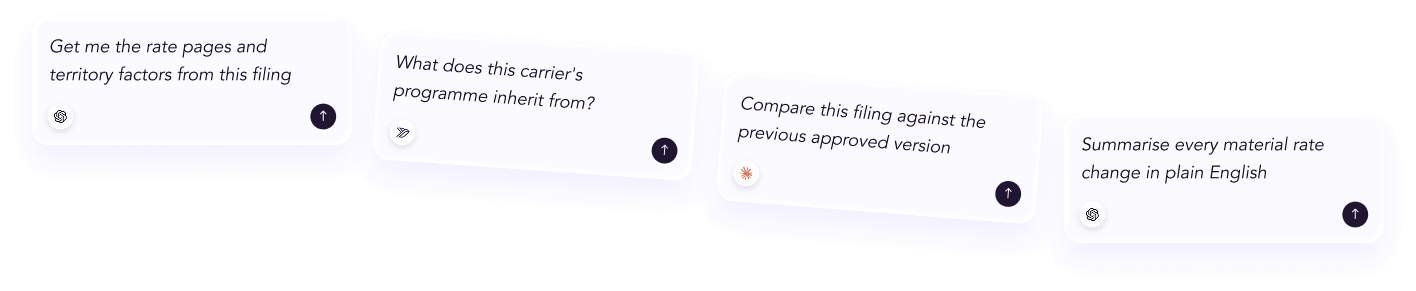




 ChatGPT
 Claude
.png)
.png)
.png)
.png)