
Insurance filings are one of the earliest visible signals that an emerging risk, a new type of exposure the industry is still learning to price, has started to matter enough for insurers to act on it. A new exclusion, a novel endorsement, or a form revision addressing something that wasn't part of standard coverage a few years ago all point to where risk is shifting before it becomes common knowledge.
This is how to read filings for that signal specifically, and how to avoid mistaking a single company's cautious move for an industry-wide recognition of a new risk.
serff.ai is built to do that for you: it indexes millions of SERFF filings and lets you ask questions in plain English instead of opening documents one by one. You can connect it to the AI assistant you already use: Claude or ChatGPT, via the serff.ai MCP server, or work directly in the web platform.
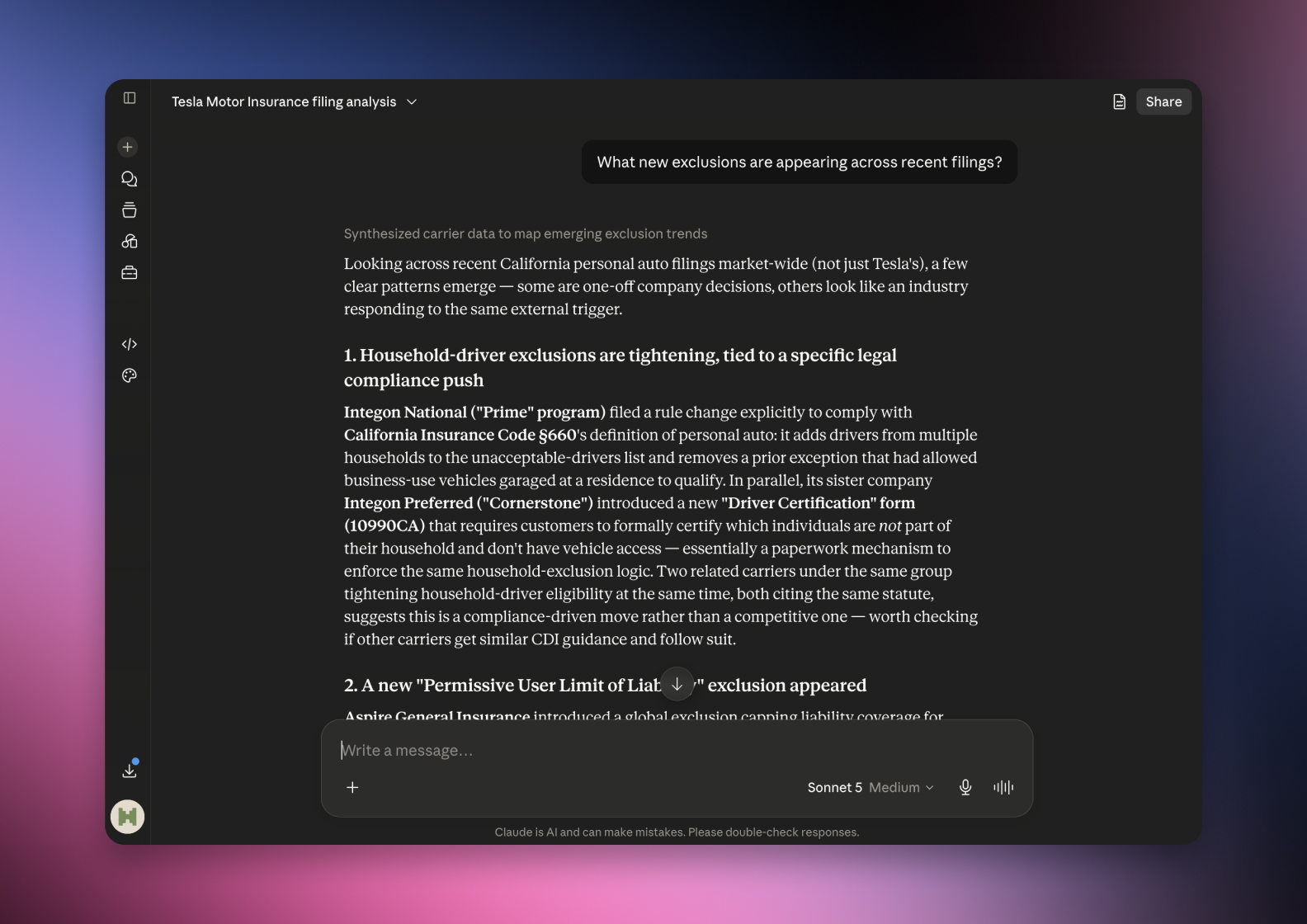

Connected via MCP to the AI you already use, Claude or ChatGPT, or through our dedicated platform, serff.ai makes searching and analysing SERFF filings effortless. Emerging risk research becomes a single question: ask what new exclusions or coverages are appearing across recent filings, and get a grounded, cited answer in seconds.
The manual way
Read form filings across companies to spot a new exclusion.
With serff.ai, just ask
“What new exclusions are appearing across recent filings?”
The manual way
Work out if a new coverage is a genuine emerging risk signal.
With serff.ai, just ask
“Is this a genuine emerging risk or a one off?”
The manual way
Track how quickly a new exclusion spreads industry-wide.
With serff.ai, just ask
“Which insurers have started addressing this risk?”
The manual way
Compare how different insurers are approaching the same risk.
With serff.ai, just ask
“How are insurers approaching this emerging risk?”
Every answer is cited back to the exact page of the source PDF and grounded only in filed values, with no invented numbers, so you can trust it the way this audience needs to. Research that took weeks takes a prompt.
No credit card required. Simply sign up and connect to Claude or ChatGPT or use Swallow’s SERFF.ai platform.
Because form filings require insurers to specify their wording precisely, and regulators review that wording, filings force a level of explicitness that other public sources rarely provide this early. An insurer addressing a risk in policy language is a concrete commitment, not speculation.
A single company adding an unusual exclusion could reflect one specific bad claims experience rather than an industry-wide recognition of a new risk category. The stronger signal is the same kind of language appearing independently across multiple, unrelated insurers within a similar window, echoing the same pattern that distinguishes a real product trend from a one-off.
Search across several unrelated product lines, not just one, when investigating a suspected emerging risk. A genuinely new exposure, like a technology or climate-related risk, often surfaces in filings across multiple product types around the same time.
Once a risk is confirmed as emerging, tracking how coverage language evolves across subsequent filings shows how the industry's understanding matures, from cautious blanket exclusions early on to more precise, narrower language as insurers gain more experience with the risk.
An early exclusion doesn't tell you how the industry will ultimately price or cover a risk long term. Early responses are often conservative and change substantially as insurers gain more data and experience.
Emerging risks show up early in insurance filings as new exclusions, endorsements and definitional changes, often before broader industry recognition. Confirm the signal by checking whether it appears independently across multiple insurers and product lines, and expect coverage language to evolve as understanding of the risk matures.
A new exclusion, endorsement or definitional change addressing a previously uncovered exposure is a concrete signal that insurers have started responding to a new risk category.
Check whether similar language appears independently across multiple unrelated insurers and product lines, not just in one company's filing.
Filings require precise policy wording that regulators review, which forces a level of specificity and commitment that other early sources of information rarely provide.
Not reliably. Early responses tend to be conservative and often change as insurers gain more data and experience with the risk.
No. Genuinely new risks often surface across multiple product types around the same time, so searching broadly gives a stronger signal.





 ChatGPT
 Claude
.png)
.png)
.png)
.png)