
An insurance premium can change for reasons specific to one policyholder, or for reasons that apply across an entire book of business. Untangling the two is often the first step in understanding why any particular premium moved, whether you're researching one customer's renewal or an entire market's pricing direction.
This lays out the main categories of drivers, in plain terms, and how they show up differently in a SERFF filing versus an individual bill.
serff.ai is built to do that for you: it indexes millions of SERFF filings and lets you ask questions in plain English instead of opening documents one by one. You can connect it to the AI assistant you already use: Claude or ChatGPT, via the serff.ai MCP server, or work directly in the web platform.
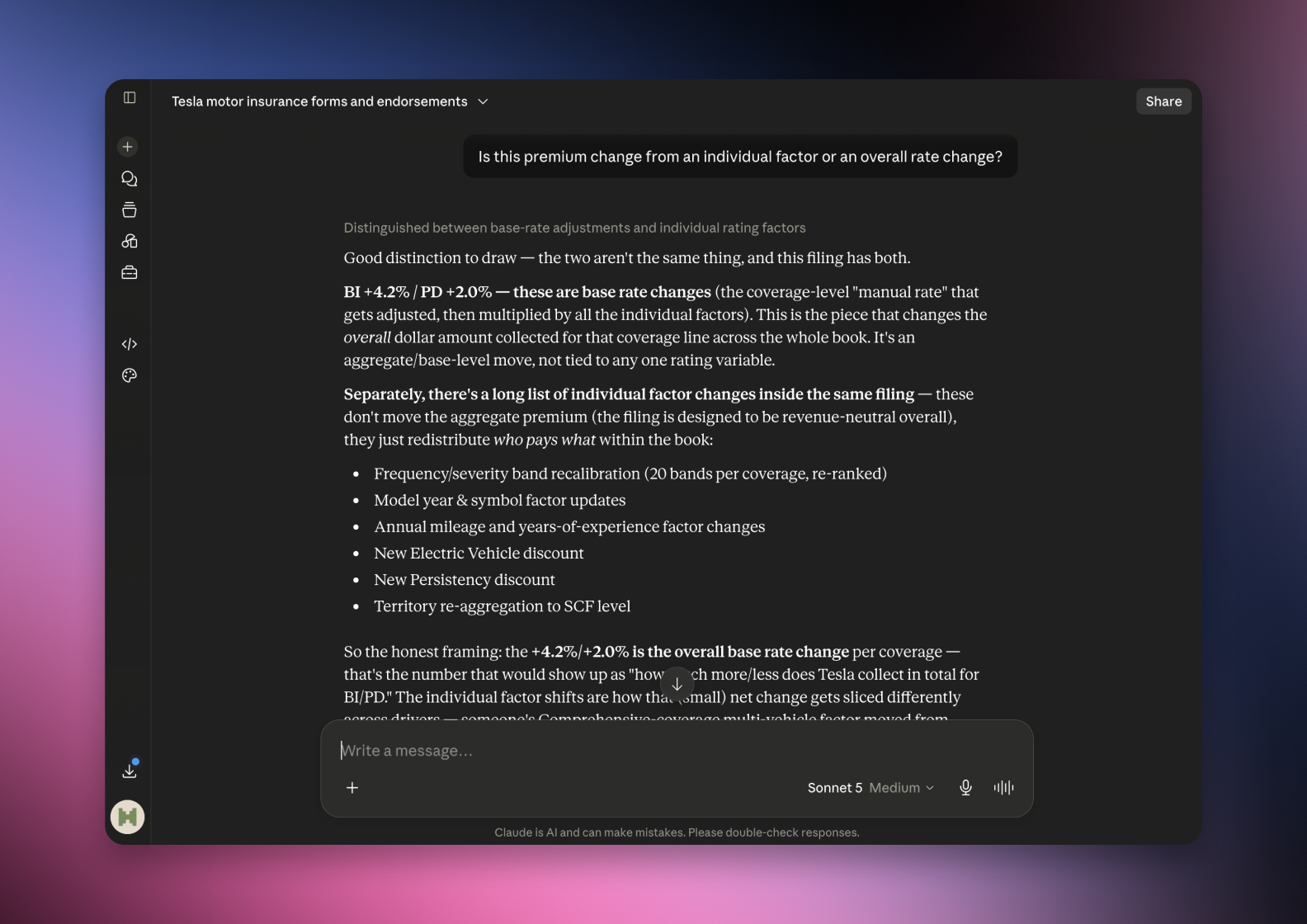

Connected via MCP to the AI you already use, Claude or ChatGPT, or through our dedicated platform, serff.ai makes searching and analysing SERFF filings effortless. Understanding a premium change becomes a single question: ask what's driving a rate change, or how a specific factor affects premium, and get a grounded, cited answer in seconds.
The manual way
Guess whether a premium change is individual or market-wide.
With serff.ai, just ask
“Is this premium change from an individual factor or an overall rate change?”
The manual way
Read a filing to find the stated reason for a rate change.
With serff.ai, just ask
“What does the filing say is driving this rate change?”
The manual way
Work out how a specific rating factor affects one premium.
With serff.ai, just ask
“How does this specific rating factor affect the premium?”
The manual way
Compare this year's driver against last year's filing.
With serff.ai, just ask
“Is the same factor driving the change as last time?”
Every answer is cited back to the exact page of the source PDF and grounded only in filed values, with no invented numbers, so you can trust it the way this audience needs to. Research that took weeks takes a prompt.
No credit card required. Simply sign up and connect to Claude or ChatGPT or use Swallow’s SERFF.ai platform.
Some premium changes are specific to one policyholder, driven by a change in the rating factors that apply to their particular risk: a change in address, a new claim on record, a vehicle or property change, or simply moving into a new age or risk tier at renewal.
A rate filing tells you about the market-wide piece: the overall change an insurer applied to a whole book of business. An individual policyholder's specific increase is usually some combination of that market-wide change and their own rating factors shifting, which a filing alone won't fully explain for any one person.
If you're researching why premiums are rising broadly for a product, start with recent rate filings and their actuarial memoranda. If you're explaining one customer's specific bill, the answer usually needs both the filing and their individual rating detail.
The actuarial memorandum in a rate filing is where the market-wide reasoning is spelled out in detail, connecting a specific driver, trend, catastrophe experience, reinsurance cost, to the requested change.
Don't assume every premium increase reflects a formal rate filing. Some changes come purely from an individual's own rating factors shifting at renewal, with no market-wide rate change involved at all.
Premiums change for individual reasons, shifts in one policyholder's own rating factors, and market-wide reasons like loss trend, catastrophe experience and reinsurance costs. A rate filing explains the market-wide piece; an individual's full picture usually needs both that and their specific rating detail.
It could reflect a change in your own rating factors at renewal, a market-wide rate change the insurer filed, or both together.
Loss trend, catastrophe experience, rising reinsurance costs, and regulatory or legal changes affecting claims costs across the book.
Check the company's recent rate filings and read the actuarial memorandum, which explains the stated driver behind the change.
Yes. An individual's premium can change purely from their own rating factors shifting at renewal, without any market-wide rate filing involved.
Not fully. It explains the market-wide change; an individual's full premium picture also depends on their own specific rating factors.





 ChatGPT
 Claude
.png)
.png)
.png)
.png)