
Analysing a filing with AI means using it to accelerate the extraction and benchmarking work, finding the headline figures, comparing against other filings, spotting a pattern across a large set, while keeping the interpretive judgment in human hands. Done well, it turns hours of extraction work into a starting point you can verify and build on in minutes.
This is how to actually do it: what AI is genuinely good at extracting, how to ask questions that produce useful analysis rather than surface-level summaries, and how to check the results before relying on them.
serff.ai is built to do that for you: it indexes millions of SERFF filings and lets you ask questions in plain English instead of opening documents one by one. You can connect it to the AI assistant you already use: Claude or ChatGPT, via the serff.ai MCP server, or work directly in the web platform.
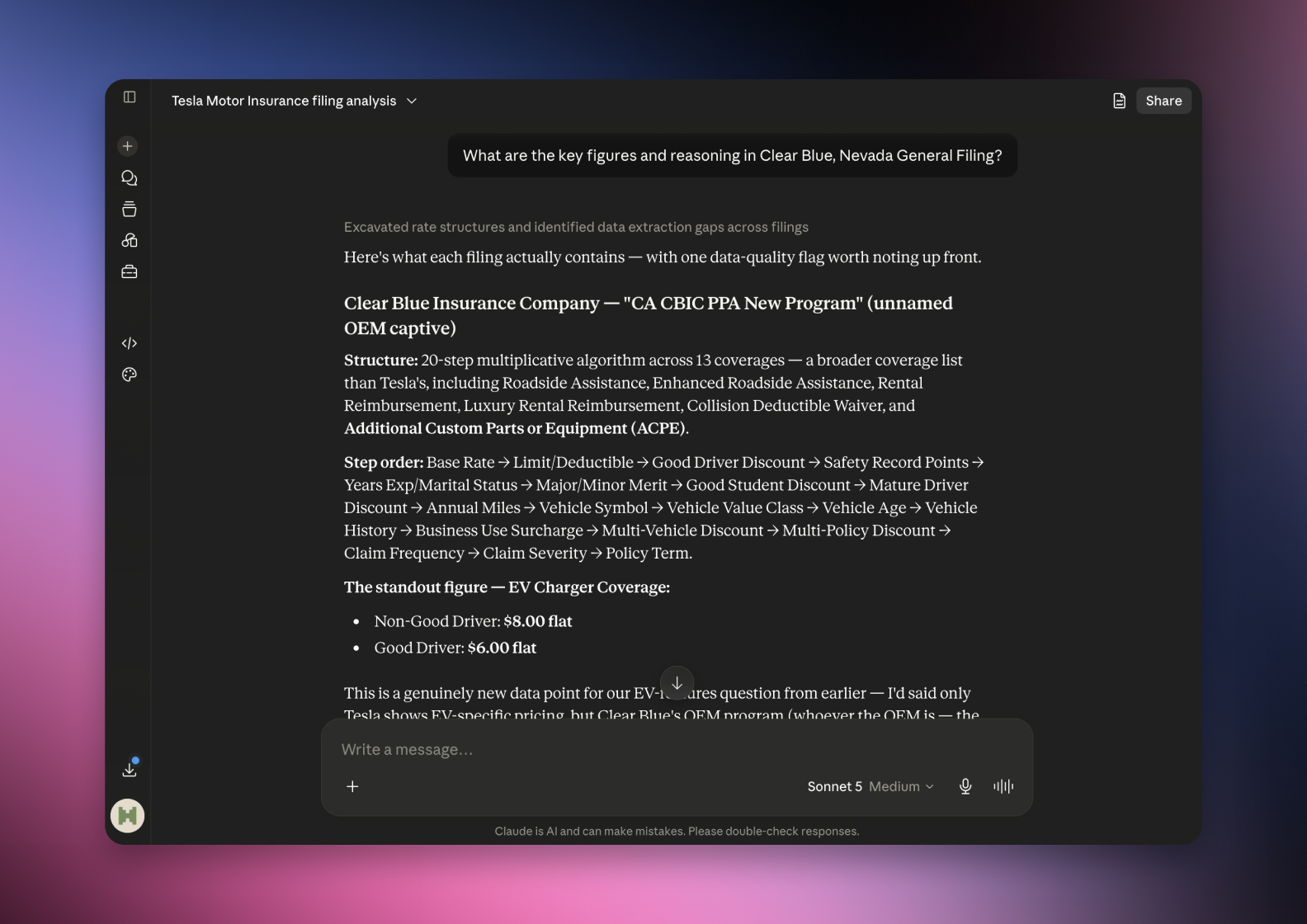

Connected via MCP to the AI you already use, Claude or ChatGPT, or through our dedicated platform, serff.ai makes searching and analysing SERFF filings effortless. AI-assisted analysis becomes a single question: ask what a filing signals, how it compares to others, or what the reasoning actually supports, and get a grounded, cited answer in seconds.
The manual way
Manually extract the headline figures from a filing.
With serff.ai, just ask
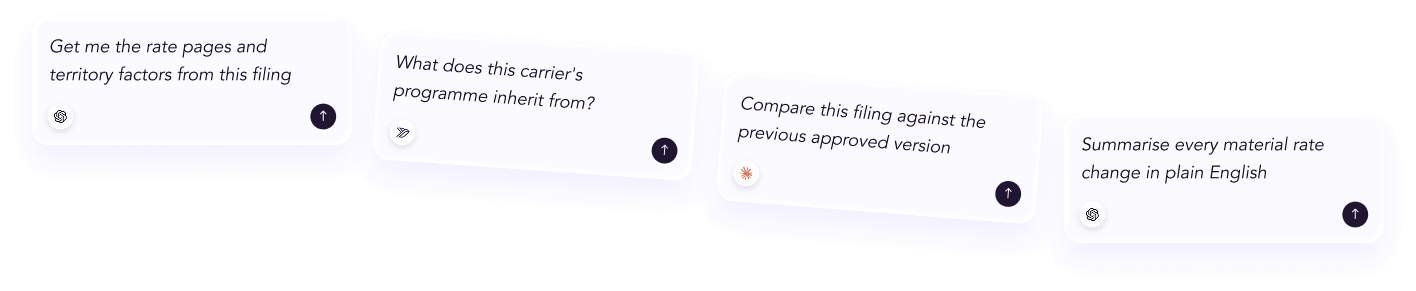
“What are the key figures and reasoning in this filing?”
The manual way
Benchmark one filing against several others by hand.
With serff.ai, just ask
“How does this filing compare to similar recent ones?”
The manual way
Ask a vague question and get a shallow summary back.
With serff.ai, just ask
“Does the actuarial reasoning here actually support the requested change?”
The manual way
Re-check every AI-generated figure against the source.
With serff.ai, just ask
“Cite the exact source for every figure in this summary.”
Every answer is cited back to the exact page of the source PDF and grounded only in filed values, with no invented numbers, so you can trust it the way this audience needs to. Research that took weeks takes a prompt.
No credit card required. Simply sign up and connect to Claude or ChatGPT or use Swallow’s SERFF.ai platform.
AI is well suited to pulling out the pieces filing analysis depends on: the headline rate change, the stated reasoning, the scope of what's affected, and how the current filing compares to a company's prior ones. This is the extraction layer that used to take the most manual time.
A vague prompt produces a vague summary. Asking a specific, analytical question, does the reasoning support the requested change, how does this compare to the last three filings, what changed since the prior version, gets you an answer closer to actual analysis rather than a restatement of the document.
Ask AI to compare or evaluate, not just summarise. 'Summarise this filing' produces a description; 'does this filing's evidence support its conclusion' produces something closer to genuine analysis.
Every figure and claim used in a real conclusion deserves a citation check. This matters more, not less, once AI is doing analytical work rather than simple lookup, since a plausible-sounding comparison or benchmark can be just as susceptible to hallucination as any other AI output.
A benchmark or comparison is only as good as the filings it's built from. Confirm the comparison set is actually appropriate, not just that the numbers look reasonable, before treating the conclusion as settled.
AI accelerates the extraction and benchmarking layer of filing analysis, pulling headline figures, reasoning and comparative context quickly. Ask specific, evaluative questions rather than vague ones, and verify the figures and comparison set behind any conclusion before relying on it.
Headline rate figures, the stated actuarial reasoning, the scope of what's affected, and how the filing compares to a company's prior activity.
Ask specific, evaluative questions, such as whether the evidence supports the conclusion, rather than a general request to summarise the filing.
The underlying judgment stays the same, but AI removes much of the manual extraction and benchmarking time, letting you reach the analysis stage faster.
Yes, especially figures and comparisons that feed into a conclusion. Check the citations and confirm the comparison set is actually appropriate.
That it's built from an appropriate, genuinely comparable set of filings, not just that the resulting numbers look reasonable on their face.





 ChatGPT
 Claude
.png)
.png)
.png)
.png)