
A new product has to be filed, and in many states approved, before an insurer can start selling it. That regulatory requirement creates a window: filings can reveal a competitor's next move before it's publicly marketed, sometimes by weeks or months, if you know what to watch for.
This is how to use that window: the signals that suggest a new product is coming, and the caution needed not to over-read an early filing as more certain than it is.
serff.ai is built to do that for you: it indexes millions of SERFF filings and lets you ask questions in plain English instead of opening documents one by one. You can connect it to the AI assistant you already use: Claude or ChatGPT, via the serff.ai MCP server, or work directly in the web platform.
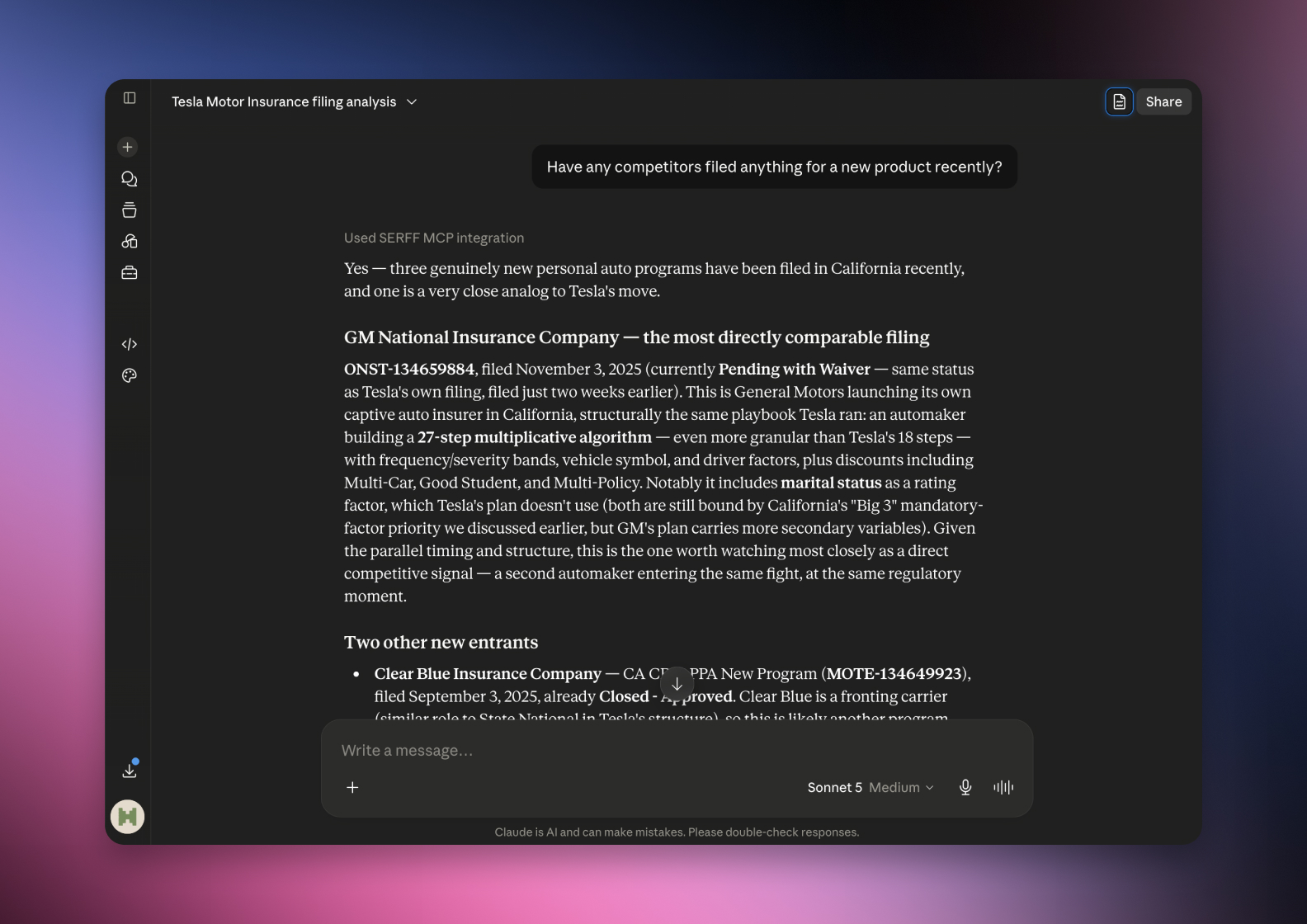

Connected via MCP to the AI you already use, Claude or ChatGPT, or through our dedicated platform, serff.ai makes searching and analysing SERFF filings effortless. Early product research becomes a single question: ask what new product activity a competitor has filed recently, and get a grounded, cited answer in seconds.
The manual way
Watch a competitor's filings constantly for something new.
With serff.ai, just ask
“Has this competitor filed anything for a new product recently?”
The manual way
Work out if a new TOI filing signals a real launch.
With serff.ai, just ask
“Does this filing look like a new product launch or a minor update?”
The manual way
Check whether a filing is live yet or still pending.
With serff.ai, just ask
“Is this new product filing approved and in effect yet?”
The manual way
Compare a new filing against the competitor's existing lineup.
With serff.ai, just ask
“Is this genuinely new for this competitor, or an existing product?”
Every answer is cited back to the exact page of the source PDF and grounded only in filed values, with no invented numbers, so you can trust it the way this audience needs to. Research that took weeks takes a prompt.
No credit card required. Simply sign up and connect to Claude or ChatGPT or use Swallow’s SERFF.ai platform.
Under prior approval regimes, an insurer must wait for sign-off before using a new product, and even under file-and-use, there is typically some lag between filing and public availability. That lag is the window where a filing exists before the market sees the product.
The size of the window depends entirely on the review regime and the state. A file-and-use filing might only precede launch by days; a prior-approval filing with a long review can give you months of lead time. Check the filing status directly rather than assuming a fixed lag.
Cross-check a suspected new-product filing against the competitor's existing product list before concluding it's genuinely new. What looks new to you may simply be a product you hadn't catalogued yet.
Not every unusual filing becomes a market launch. Filings can be withdrawn, delayed indefinitely, or approved but never actually brought to market for internal reasons that never appear in SERFF. Treat an early signal as a lead worth watching, not a confirmed launch.
Don't treat a filed-but-not-yet-effective product as guaranteed to reach the market. Some approved filings are shelved, and reading too much certainty into an early filing can lead to an overreaction to something that never actually launches.
New products must be filed, and often approved, before they reach the market, which creates a real window to spot a competitor's next move early. Watch for new product classifications, fresh form and rate combinations, and unusually detailed descriptions, but treat any early signal as a lead to monitor, not a confirmed launch.
Yes, in many cases. Filings often precede public launch, sometimes by weeks or months depending on the review regime and state.
A new product classification or name, an unusually detailed general information section, and a fresh form and rate combination filed together.
It varies widely; file-and-use filings may only precede launch by days, while prior-approval filings with a long review can give months of lead time.
No. Some approved filings are never brought to market, so an early signal should be treated as worth monitoring rather than a confirmed launch.
Cross-check it against the competitor's existing product list to rule out that it's simply an update to something already in their lineup.

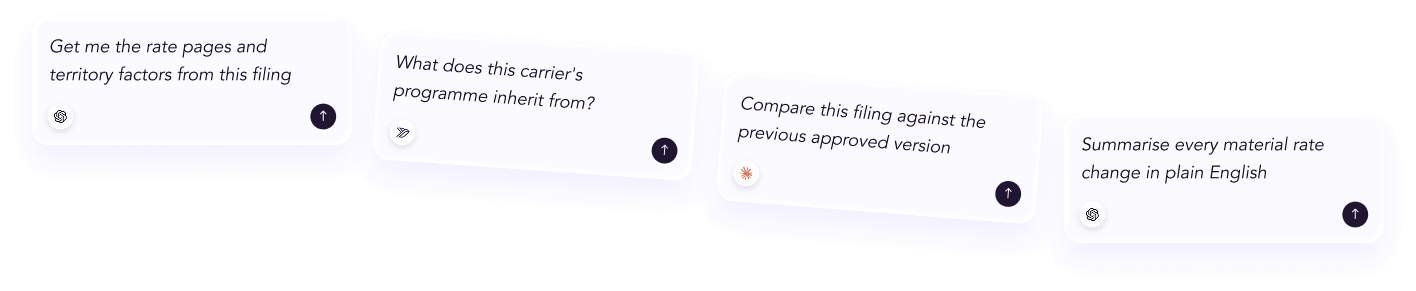




 ChatGPT
 Claude
.png)
.png)
.png)