
Researching a product with AI means using it to synthesise information across many filings, often spanning several companies and states, far faster than reading each one individually. Where classifying and locating filings by product type is a search problem, this is about turning what you find into an actual picture of how a product is priced, structured and positioned across the market.
This is how to use AI for that kind of product research well: what to ask, how to keep the results comprehensive rather than narrow, and how to check what you learn before relying on it.
serff.ai is built to do that for you: it indexes millions of SERFF filings and lets you ask questions in plain English instead of opening documents one by one. You can connect it to the AI assistant you already use: Claude or ChatGPT, via the serff.ai MCP server, or work directly in the web platform.
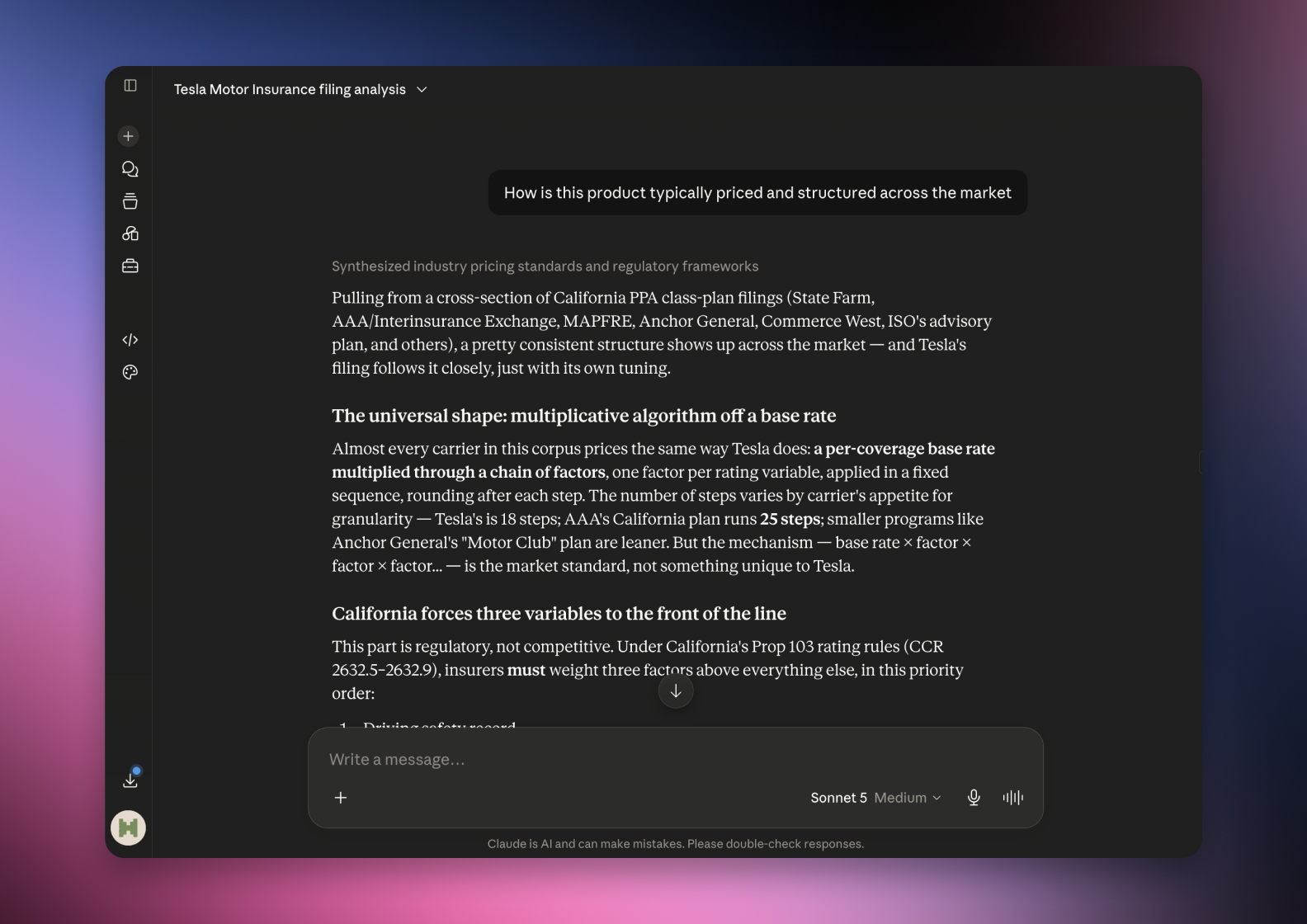

Connected via MCP to the AI you already use, Claude or ChatGPT, or through our dedicated platform, serff.ai makes searching and analysing SERFF filings effortless. Product research becomes a single question: ask how a product is priced or structured across the market, and get a grounded, cited answer in seconds.
The manual way
Read filings from many companies to build a market view.
With serff.ai, just ask
“How is this product typically priced and structured across the market?”
The manual way
Manually track which companies offer a specific product.
With serff.ai, just ask
“Which companies currently offer this product, and where?”
The manual way
Compare a product's coverage across insurers by hand.
With serff.ai, just ask
“How does this product's coverage differ between these insurers?”
The manual way
Spend days assembling a competitive product landscape.
With serff.ai, just ask
“Build a picture of this product's competitive landscape.”
Every answer is cited back to the exact page of the source PDF and grounded only in filed values, with no invented numbers, so you can trust it the way this audience needs to. Research that took weeks takes a prompt.
No credit card required. Simply sign up and connect to Claude or ChatGPT or use Swallow’s SERFF.ai platform.
Beyond locating filings by product type, AI-assisted research synthesises what those filings actually say: how a product is typically priced, which rating factors are common across insurers, and how coverage tends to vary between competitors offering something similar.
A narrow question produces a narrow answer. Asking for the full market picture, how is this product typically structured, not just what does one company's version look like, produces something closer to genuine competitive intelligence rather than a single data point.
If you're researching a product for a market entry decision, ask specifically for variation, not just typical practice. The outliers and edge cases often matter as much as the norm for that kind of decision.
Product research spans many filings and many sources, which is exactly where verification matters most. Spot-check the citations behind any claim about pricing or coverage before it goes into a report, and treat surprising findings, an unusually low or high price point, an unexpected coverage gap, as worth a direct check against the source filing.
Product research that spans dozens of filings has more room for a single AI-generated claim to slip through unverified. Be more, not less, careful with citation-checking as the scope of a research question grows.
AI-assisted product research synthesises pricing, rating factors and coverage variation across many filings at once, turning what used to be days of reading into a fast first pass. Ask for the full market picture rather than a narrow one, and verify surprising or consequential findings against their source before relying on them.
It synthesises what many filings say about a product: typical pricing, common rating factors, coverage variation between insurers, and which companies are active in the space.
Searching by product type locates the relevant filings; AI-assisted research goes further, synthesising what those filings collectively say into a market view.
Ask for the full market picture explicitly, how a product is typically structured across companies, rather than asking about a single insurer's version.
Yes, especially surprising results. Spot-check citations behind pricing or coverage claims before they inform a report or decision.
Generally yes. The more filings a synthesis spans, the more room there is for an individual claim to go unchecked, so broader questions warrant more careful spot-checking.

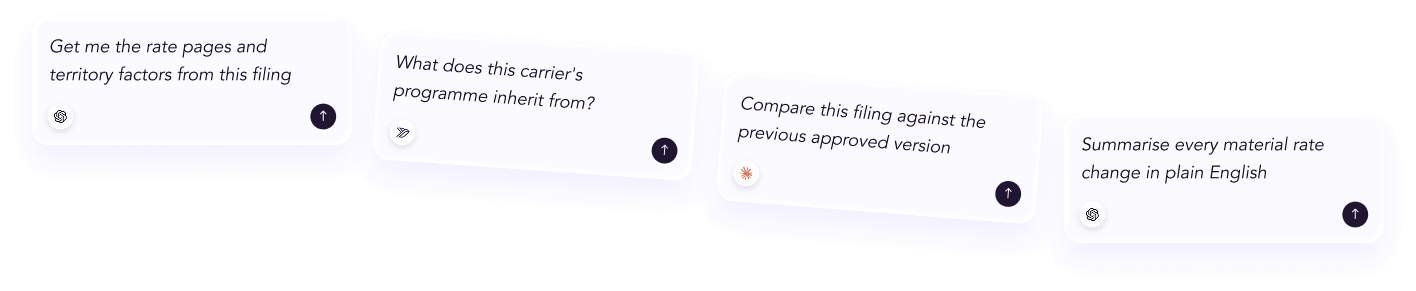




 ChatGPT
 Claude
.png)
.png)
.png)
.png)