
A SERFF filing is the submission an insurer sends to a state insurance department to introduce or change its rates, rules or policy forms. It is filed through the System for Electronic Rates & Forms Filing (SERFF), the platform run by the National Association of Insurance Commissioners (NAIC) that connects insurers with regulators in almost every US state. In practice, nearly every rate change, new product and policy-wording update an insurer makes begins life as a SERFF filing.
A single filing bundles together everything a regulator needs to review that change: the rate pages or policy forms themselves, the supporting actuarial work, and the correspondence between the insurer and the department. Understanding one from the outside means opening each of those pieces and fitting them together by hand.
serff.ai is built to do that for you: it indexes millions of SERFF filings and lets you ask questions in plain English instead of opening documents one by one. You can connect it to the AI assistant you already use: Claude or ChatGPT, via the serff.ai MCP server, or work directly in the web platform.
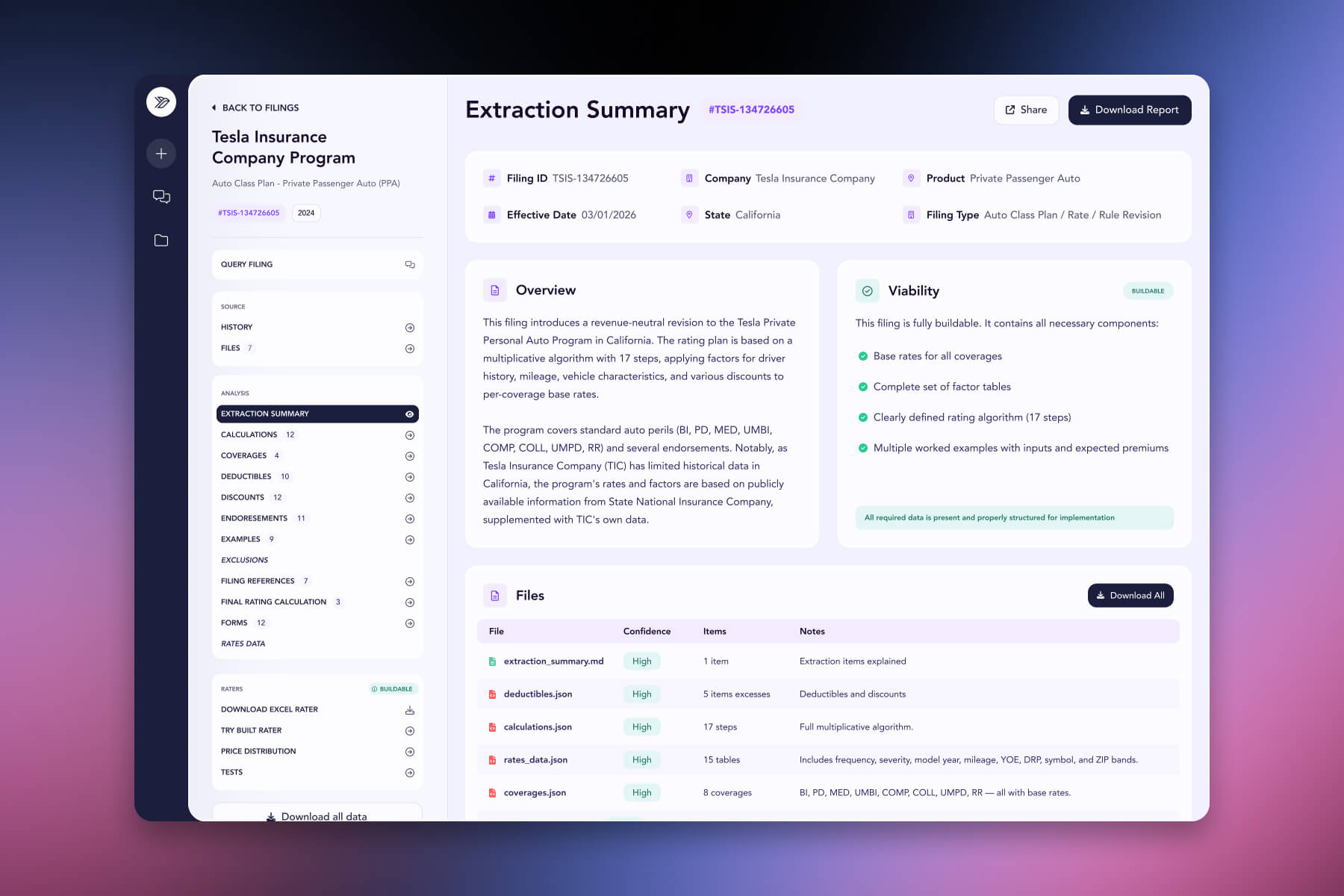

Connected via MCP to the AI you already use, Claude or ChatGPT, or through our dedicated platform, serff.ai makes searching and analysing SERFF filings effortless. Understanding a filing becomes a single question: ask what it is, what it changes, or who filed it, and get a grounded, cited answer in seconds.
The manual way
Open every tab of the filing to work out what it actually is.
With serff.ai, just ask
“What is this filing and what does it change?”
The manual way
Piece the insurer, state and product together from scattered fields.
With serff.ai, just ask
“Who filed this, in which state, for what product?”
The manual way
Skim a 200-page submission to find the headline change.
With serff.ai, just ask
“Summarise this filing in three points.”
The manual way
Dig back through the record to find earlier versions.
With serff.ai, just ask
“Show the previous versions of this filing.”
Every answer is cited back to the exact page of the source PDF and grounded only in filed values, with no invented numbers, so you can trust it the way this audience needs to. Research that took weeks takes a prompt.
No credit card required. Simply sign up and connect to Claude or ChatGPT or use Swallow’s SERFF.ai platform.
Think of a SERFF filing as a complete case file for one change an insurer wants to make. It carries the change itself, the evidence for it, and a record of the regulator's review, all under a single tracking number. Almost every filing is organised into the same handful of sections.
If you want to work through those sections in the right order, see our guide on how to read a SERFF filing.
Insurers and their filing teams submit SERFF filings to get a regulator's sign-off before they use new rates or forms in a state. Some states require prior approval before a change can take effect; others allow file-and-use, where the insurer files around the time the change goes live. Either way, the filing is the official, public-facing record of what changed and why.
Most filings fall into three families. A rate filing changes prices; a rule filing changes the rules that decide how those prices apply; and a form filing changes the policy wording. Many submissions combine more than one, which is why the filing type is the first thing worth checking.
Much of a filing is publicly viewable through SERFF Filing Access, the public portal where you can search filings by state, company and product. Participation and the exact documents released vary by state, and the naming can be confusing: SERFF is the system insurers and regulators work in, while SERFF Filing Access is the public window onto many of those filings after the fact.
Not everything is public. Certain items, particularly some actuarial exhibits, can be filed as confidential and withheld from public view, so an apparent gap in a filing is often a withheld exhibit rather than a missing piece.
For pricing and product teams, filings are the clearest public signal of what competitors are doing: where they are raising or cutting rates, which factors they are changing, and what new products they are bringing to market. For compliance teams, they are the system of record for regulatory approval. Read across companies and over time, they are one of the richest sources of market intelligence in insurance.
A SERFF filing is one insurer's request to change a rate, rule or form in one state, filed through the NAIC's SERFF system. It bundles the change, the actuarial justification and the regulator's review into a single record, much of which is public through SERFF Filing Access.
SERFF stands for the System for Electronic Rates & Forms Filing, the electronic system insurers use to submit rate, rule and form filings to state insurance departments.
SERFF is operated by the National Association of Insurance Commissioners (NAIC) and is used by insurance departments in almost every US state.
Much of a filing is publicly viewable through SERFF Filing Access, but participation varies by state and certain items, such as some actuarial exhibits, can be filed as confidential and withheld.
No. SERFF is the system insurers and regulators use to submit and review filings; SERFF Filing Access is the public portal where anyone can search many of those filings after the fact.
A rate filing changes prices, a rule filing changes the rules that apply those prices, and a form filing changes the policy wording. Many submissions combine more than one.





 ChatGPT
 Claude
.png)
.png)
.png)
.png)