
When an insurer files a rate change, a state regulator reviews it against a consistent standard: rates must be adequate to cover claims and expenses, not excessive relative to the risk, and not unfairly discriminatory between similar policyholders. How that review actually happens, and how much of it you can see, depends on the state's review regime and the product being filed.
Understanding that process explains a lot about why a filing looks the way it does: why some rate changes sail through in days and others generate months of correspondence, and why the approved figure so often differs from what was first requested.
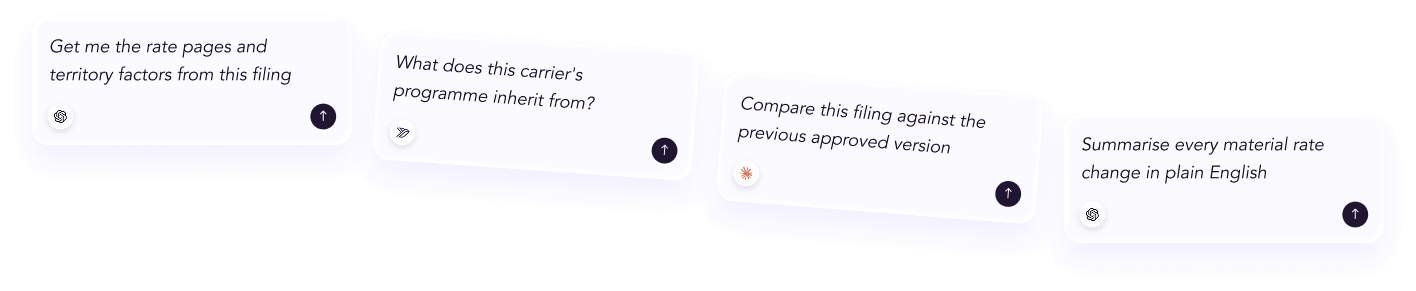
serff.ai is built to do that for you: it indexes millions of SERFF filings and lets you ask questions in plain English instead of opening documents one by one. You can connect it to the AI assistant you already use: Claude or ChatGPT, via the serff.ai MCP server, or work directly in the web platform.
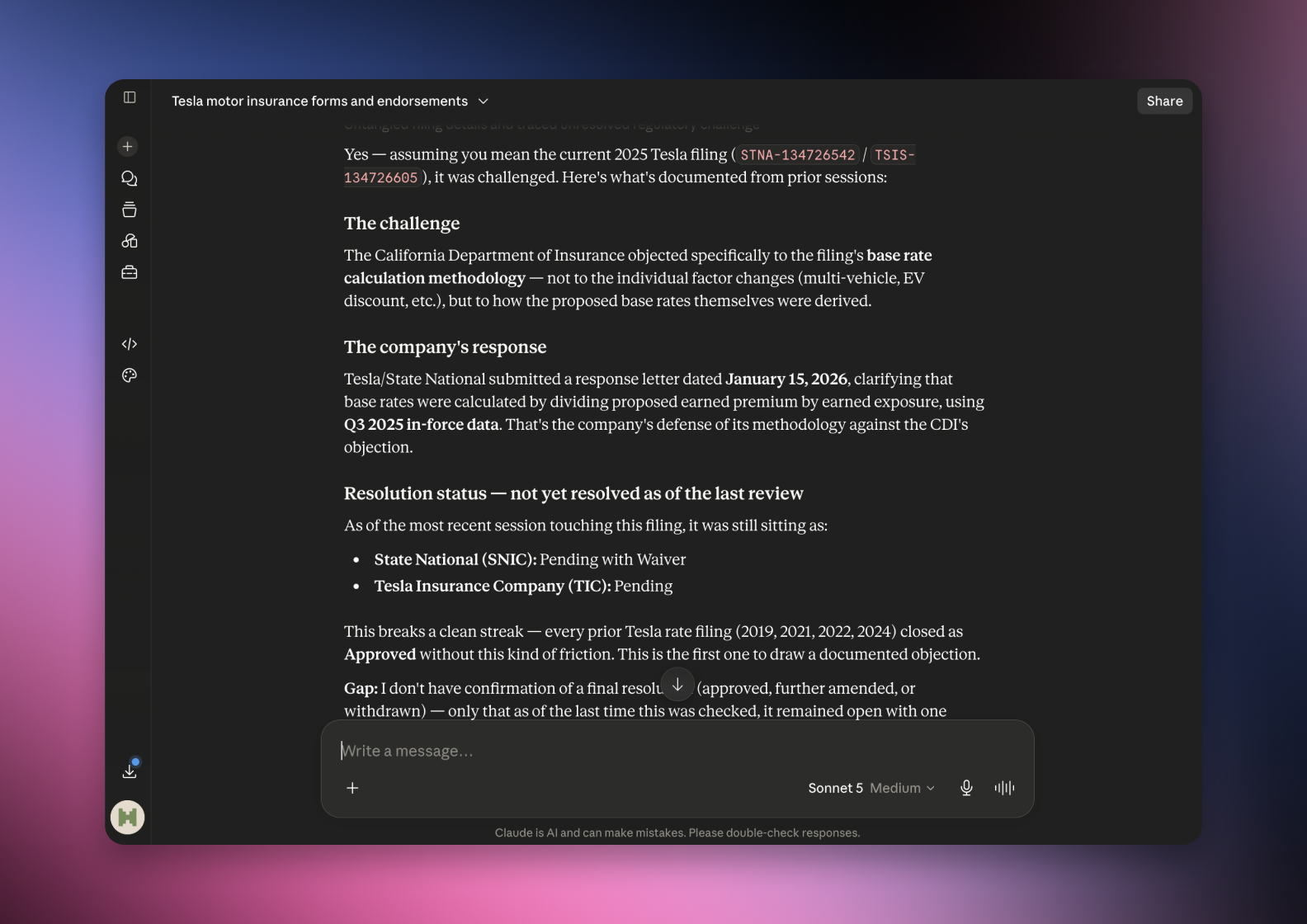

Connected via MCP to the AI you already use, Claude or ChatGPT, or through our dedicated platform, serff.ai makes searching and analysing SERFF filings effortless. Regulatory review becomes a single question: ask which regime applied, what the regulator questioned, or how long review took, and get a grounded, cited answer in seconds.
The manual way
Work out which review regime applies to a state and product.
With serff.ai, just ask
“What review regime applies to this filing?”
The manual way
Read the whole file to see if a rate change was challenged.
With serff.ai, just ask
“Was this rate change challenged, and how was it resolved?”
The manual way
Track review timelines across many filings by hand.
With serff.ai, just ask
“How long did regulatory review take for this filing?”
The manual way
Compare how strictly two states reviewed similar filings.
With serff.ai, just ask
“How did review differ between these two states?”
Every answer is cited back to the exact page of the source PDF and grounded only in filed values, with no invented numbers, so you can trust it the way this audience needs to. Research that took weeks takes a prompt.
No credit card required. Simply sign up and connect to Claude or ChatGPT or use Swallow’s SERFF.ai platform.
Across states, the underlying test for a rate is broadly consistent: adequate, not excessive, and not unfairly discriminatory. Adequate means the rate covers expected claims and expenses so the insurer stays solvent. Not excessive means it is not priced well above what the risk justifies. Not unfairly discriminatory means similar risks are charged similarly, and any difference is actuarially justified.
How much happens before a rate can be charged depends on the state's regime.
The regime shapes both the timeline and how much back-and-forth is visible in the correspondence.
A reviewer works through the actuarial memorandum and its exhibits to test whether the loss experience, trend and methodology support the requested change. They also check the change against rating factors, prior filings from the same insurer, and, in some states, an explicit benchmark for what counts as excessive.
If something in the filing does not hold up, the reviewer raises an objection letter. The insurer's response can lead to a filing amendment, and the exchange continues until the reviewer is satisfied or the filing is withdrawn.
Read the review the same way across filings: the standard rarely changes, but how hard a state pushes on trend selection, credibility or a specific rating factor tells you what that regulator actually prioritises.
Review closes with a disposition: approved, approved with conditions, filed, withdrawn or disapproved. What happens across the whole journey, from submission to that final decision, is covered in what happens after a filing is submitted.
The requested rate change and the approved one are often different numbers precisely because of this review. Reading only the final figure misses the negotiation that produced it.
Regulators test every rate change against the same standard: adequate, not excessive, not unfairly discriminatory. The regime, prior approval, file-and-use or use-and-file, sets the timeline, and the actual scrutiny happens in the exchange between actuarial support and objection.
The common standard is that rates must be adequate, not excessive, and not unfairly discriminatory between similar risks.
Under prior approval, the insurer waits for sign-off before using a new rate; under file-and-use, it can use the rate around the time of filing, subject to review.
A reviewer at the relevant state insurance department, often supported by a department actuary for complex or large rate changes.
Common triggers include unsupported trend assumptions, low credibility data, or a rating factor that raises a fairness concern.
Yes. If the filing cannot satisfy the adequate, not excessive, not unfairly discriminatory standard, the outcome can be disapproval or withdrawal.





 ChatGPT
 Claude
.png)
.png)
.png)
.png)