
Policy forms are rarely static. Over years, the same base form goes through repeated editions, driven by litigation, new risks, regulatory requirements and plain-language rewrites. Looking at a single wording change tells you what moved between two editions; looking at a form's whole history tells you a longer story about why the product looks the way it does today.
This is what typically drives that evolution, and what a long edition history can reveal about a product's maturity and the pressures shaping it.
serff.ai is built to do that for you: it indexes millions of SERFF filings and lets you ask questions in plain English instead of opening documents one by one. You can connect it to the AI assistant you already use: Claude or ChatGPT, via the serff.ai MCP server, or work directly in the web platform.
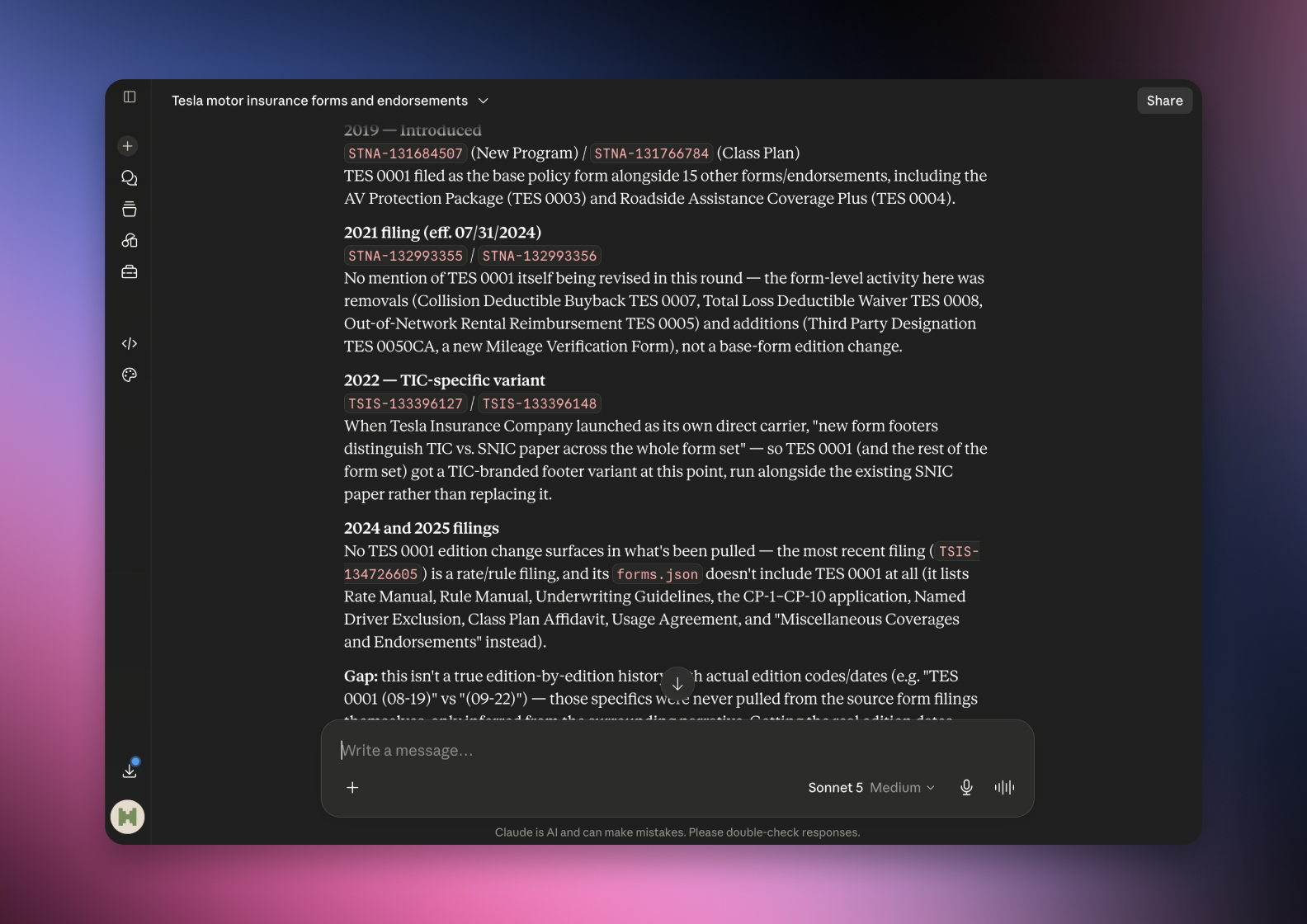

Connected via MCP to the AI you already use, Claude or ChatGPT, or through our dedicated platform, serff.ai makes searching and analysing SERFF filings effortless. Form evolution becomes a single question: ask how a form has changed over its history, or what drove a specific edition, and get a grounded, cited answer in seconds.
The manual way
Trace a form's edition history one filing at a time.
With serff.ai, just ask
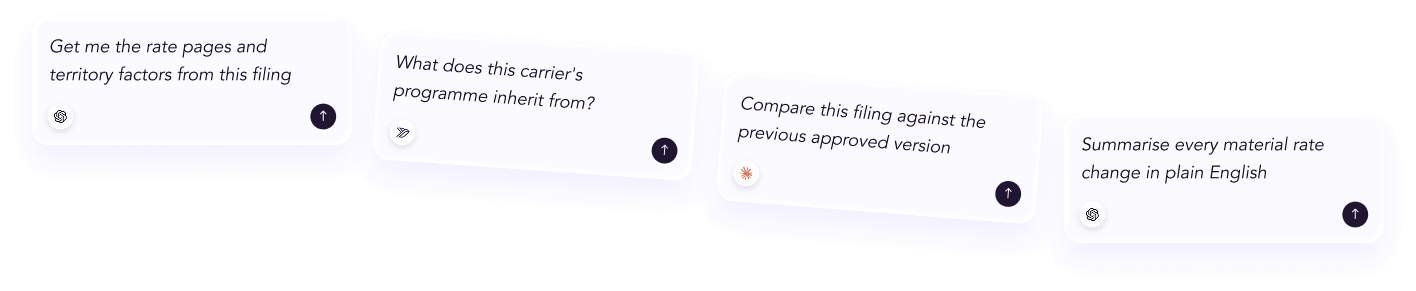
“Show this form's full edition history in order.”
The manual way
Work out why a specific revision was made.
With serff.ai, just ask
“What drove this particular edition change?”
The manual way
Compare how much a form has changed since its original version.
With serff.ai, just ask
“How different is the current edition from the original form?”
The manual way
Spot a pattern across many forms revised for the same reason.
With serff.ai, just ask
“Have other forms been revised for a similar reason recently?”
Every answer is cited back to the exact page of the source PDF and grounded only in filed values, with no invented numbers, so you can trust it the way this audience needs to. Research that took weeks takes a prompt.
No credit card required. Simply sign up and connect to Claude or ChatGPT or use Swallow’s SERFF.ai platform.
The mechanics of comparing two specific editions are covered in identifying wording changes and researching policy forms. This is the higher-level view: reading a form's full sequence of editions as a narrative of what pressures have shaped the product over its life.
A form with many editions over a short period often signals a product responding to active litigation or a fast-changing risk environment. A form that has barely changed in years suggests a mature, stable product with few open coverage disputes. Neither is inherently good or bad, but the pattern tells you something about what to expect going forward.
If you're evaluating a product for the first time, checking its form's edition frequency is a quick way to gauge how actively it's still being shaped by claims and litigation experience.
A form revision rarely happens in isolation. It's often paired with, or follows shortly after, a rate or rule change, since a shift in coverage frequently has a pricing consequence. Reading the two together gives a fuller picture than either alone.
Don't assume a form revision always narrows coverage. Many revisions clarify ambiguous language or broaden coverage in response to a market or competitive pressure, not just to add exclusions.
Policy forms evolve in response to litigation, emerging risks, readability requirements and regulatory mandates. A form's edition frequency tells you something about how actively its coverage is still being shaped, and reading form changes alongside related rate or rule filings gives the fullest picture of why a product looks the way it does.
Common drivers include litigation and claims experience, emerging risks, state readability requirements, and regulatory mandates requiring specific wording.
Not necessarily. It often signals the product is responding actively to litigation or a changing risk environment, which isn't inherently negative.
Typically a mature, stable product with relatively few open coverage disputes or emerging pressures requiring revision.
No. Many revisions clarify ambiguous wording or broaden coverage in response to market or competitive pressure, not only to add exclusions.
Yes. A coverage change often has a pricing consequence, so reading related rate or rule filings together with a form revision gives a fuller picture.





 ChatGPT
 Claude
.png)
.png)
.png)
.png)