
A pricing trend is a market-wide pattern, not any single company's rate change. Seeing it clearly means aggregating rate activity across many insurers and over time, rather than reading individual filings one at a time and trying to hold the pattern in your head.
This is how to build that market-wide view: what to aggregate, how to avoid a few large filings distorting the picture, and how to read the resulting trend for what it actually says.
serff.ai is built to do that for you: it indexes millions of SERFF filings and lets you ask questions in plain English instead of opening documents one by one. You can connect it to the AI assistant you already use: Claude or ChatGPT, via the serff.ai MCP server, or work directly in the web platform.
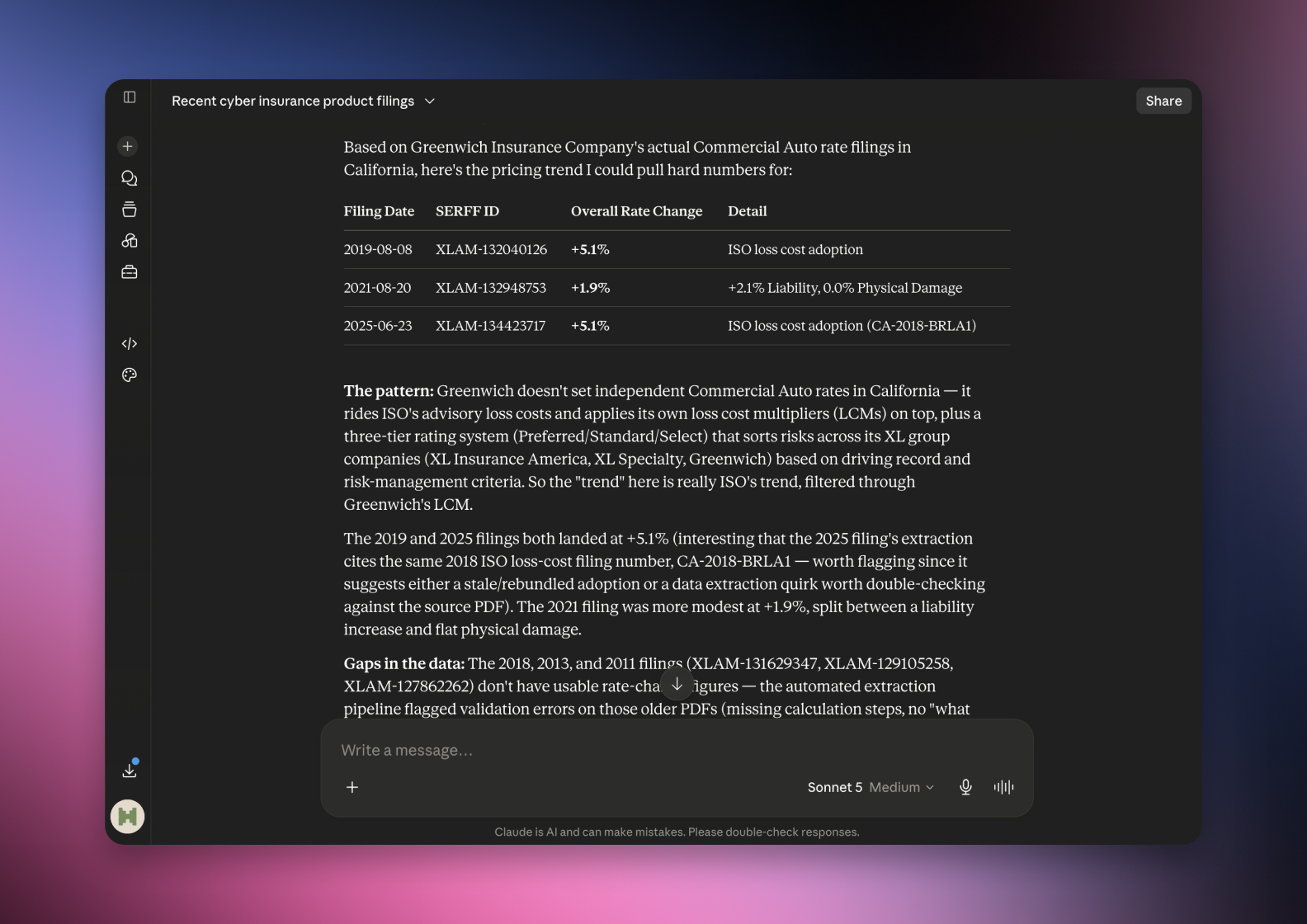

Connected via MCP to the AI you already use, Claude or ChatGPT, or through our dedicated platform, serff.ai makes searching and analysing SERFF filings effortless. Pricing trend research becomes a single question: ask how prices are moving for a product across the market, and get a grounded, cited answer in seconds.
The manual way
Average rate changes across dozens of filings by hand.
With serff.ai, just ask
“What is the average rate change for this product across the market?”
The manual way
Read individual filings to sense a market-wide direction.
With serff.ai, just ask
“Is pricing for this product trending up or down right now?”
The manual way
Track how a trend has shifted over the last few years.
With serff.ai, just ask
“How has the pricing trend for this product changed over time?”
The manual way
Check whether one large filing is skewing your read.
With serff.ai, just ask
“Is this trend consistent across companies, or driven by an outlier?”
Every answer is cited back to the exact page of the source PDF and grounded only in filed values, with no invented numbers, so you can trust it the way this audience needs to. Research that took weeks takes a prompt.
No credit card required. Simply sign up and connect to Claude or ChatGPT or use Swallow’s SERFF.ai platform.
Pull rate filings for the product across a meaningful number of companies and states, then look at the distribution, not just an average. A single average figure can hide a market where most insurers are stable and a handful are moving sharply, which is a very different story than uniform movement.
A market-wide trend can be skewed by one or two very large filings if you're not careful. Check whether the pattern holds across the majority of companies in your sample, not just in the aggregate number, before describing something as a broad trend.
Look at the median rate change alongside the average. A market with a few very large increases and many small ones will show a misleadingly high average; the median often gives a more representative picture of the typical filing.
Once built, a pricing trend answers a different question than any single filing can: not just what one insurer did, but where the whole market for a product appears to be heading, and how that compares to the broader product trend shaping the same category.
A pricing trend built from a short time window can reflect a temporary spike rather than a durable shift. Check the trend over a longer period before drawing a conclusion about where pricing is genuinely heading.
A pricing trend is a market-wide pattern built by aggregating rate activity across many companies, not any single filing. Look at the distribution and median alongside the average to avoid outlier distortion, and check the trend over a meaningful time window before treating it as durable.
A market-wide pattern in how rates for a product are moving, built by aggregating rate activity across many companies rather than reading a single filing.
Look at the median rate change alongside the average, and check whether the pattern holds across most companies in the sample, not just in an aggregate figure.
Enough to represent a meaningful spread of companies, not just two or three, since a small sample is easily distorted by an outlier.
Not necessarily. A short window can capture a temporary spike; checking the trend over a longer period gives a more reliable read on where pricing is durably heading.
A single rate increase is one company's filing; a pricing trend is the aggregate pattern across the market, built from many such filings over time.





 ChatGPT
 Claude
.png)
.png)
.png)
.png)