
An underwriting guideline is an insurer's internal rule for deciding whether to accept a risk, how to classify it, and on what terms. Where a rating rule decides how a price applies once a risk is accepted, an underwriting guideline decides whether it is accepted in the first place, and which tier or program it lands in.
Guidelines are not always public in the same way rates and forms are, but they are frequently referenced in filings and reviewed for fairness, since they shape who can buy a product at all.
serff.ai is built to do that for you: it indexes millions of SERFF filings and lets you ask questions in plain English instead of opening documents one by one. You can connect it to the AI assistant you already use: Claude or ChatGPT, via the serff.ai MCP server, or work directly in the web platform.
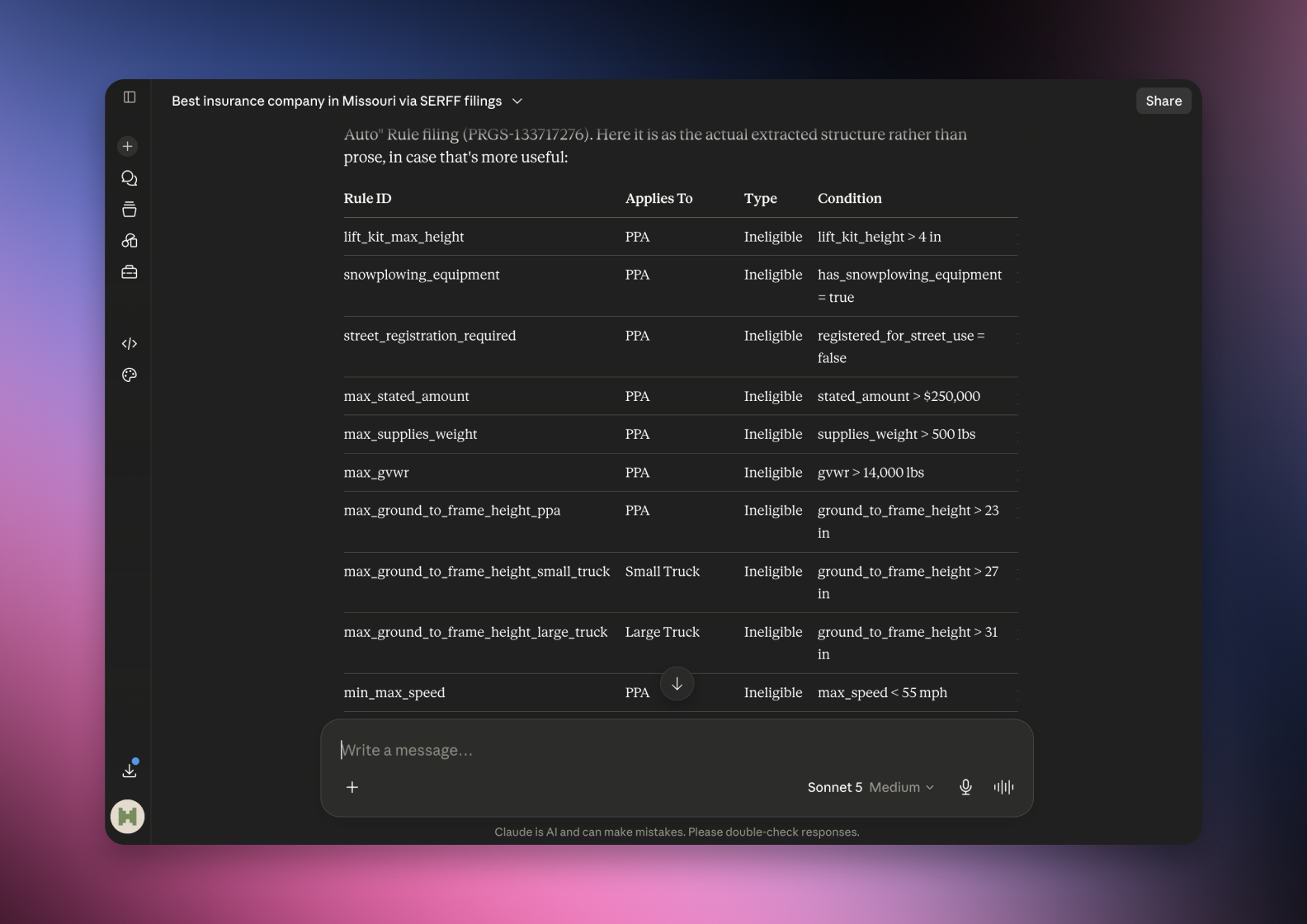

Connected via MCP to the AI you already use, Claude or ChatGPT, or through our dedicated platform, serff.ai makes searching and analysing SERFF filings effortless. An underwriting guideline becomes a single question: ask what qualifies a risk, what triggers a referral, or how classification works, and get a grounded, cited answer in seconds.
The manual way
Read a dense guidelines manual to find eligibility rules.
With serff.ai, just ask
“What are the eligibility criteria for this product?”
The manual way
Work out what triggers manual underwriter review.
With serff.ai, just ask
“What triggers a referral to underwriting?”
The manual way
Compare classification rules across two guideline versions.
With serff.ai, just ask
“How did the classification rules change?”
The manual way
Check whether a guideline references a specific rating factor.
With serff.ai, just ask
“Does this guideline connect to a specific rating factor?”
Every answer is cited back to the exact page of the source PDF and grounded only in filed values, with no invented numbers, so you can trust it the way this audience needs to. Research that took weeks takes a prompt.
No credit card required. Simply sign up and connect to Claude or ChatGPT or use Swallow’s SERFF.ai platform.
Guidelines set the boundaries and the sorting logic for a book of business, before pricing is even applied.
The two work together but answer different questions. A rule filing changes how price and coverage apply once a risk is accepted. An underwriting guideline decides whether that risk is accepted in the first place, and which tier it lands in before rating factors are even applied.
Because eligibility and classification decide who can access a product, guidelines draw scrutiny for fair access and potential discrimination, much like rating factors do. A guideline that effectively excludes a protected class, even without naming it directly, can draw the same kind of objection a rating factor would.
Read a guideline for what it does, not just what it says. A neutral-sounding criterion can still have a disparate effect depending on how it interacts with geography or other correlated variables.
Guidelines are not always filed publicly in full, and some jurisdictions treat them as confidential business information. If a filing references a guideline you cannot see, the underlying rule may still be sound; it is simply not disclosed the way rates and forms are.
An underwriting guideline decides whether a risk is accepted and how it is classified, before rating rules ever apply. It is reviewed for fair access the same way rating factors are, and its effect is often in the interaction between criteria rather than any single one.
It is an insurer's internal rule for deciding whether to accept a risk, how to classify it, and on what terms, before pricing is applied.
A rating rule decides how price and coverage apply once a risk is accepted; an underwriting guideline decides whether it is accepted at all.
Not always in full. Some jurisdictions treat detailed guidelines as confidential business information, even when the filing references them.
Because eligibility and classification rules can affect fair access to a product, similar to concerns raised about rating factors.
A condition in a guideline that requires manual underwriter review rather than automatic acceptance or decline.





 ChatGPT
 Claude
.png)
.png)
.png)
.png)