
Finding an older insurance filing means working within the limits of how far back a state's searchable records go, and how consistently they were indexed at the time. Historical research rewards patience: the filing you want often exists, but finding it can mean tracing a lineage of tracking numbers rather than a single lucky search.
This is how to approach it: what to search first, how to follow a product's history backward, and where older records tend to fall short.
serff.ai is built to do that for you: it indexes millions of SERFF filings and lets you ask questions in plain English, or see the timeline in the platform, instead of opening documents one by one. You can connect it to the AI assistant you already use: Claude or ChatGPT, via the serff.ai MCP server, or work directly in the web platform.
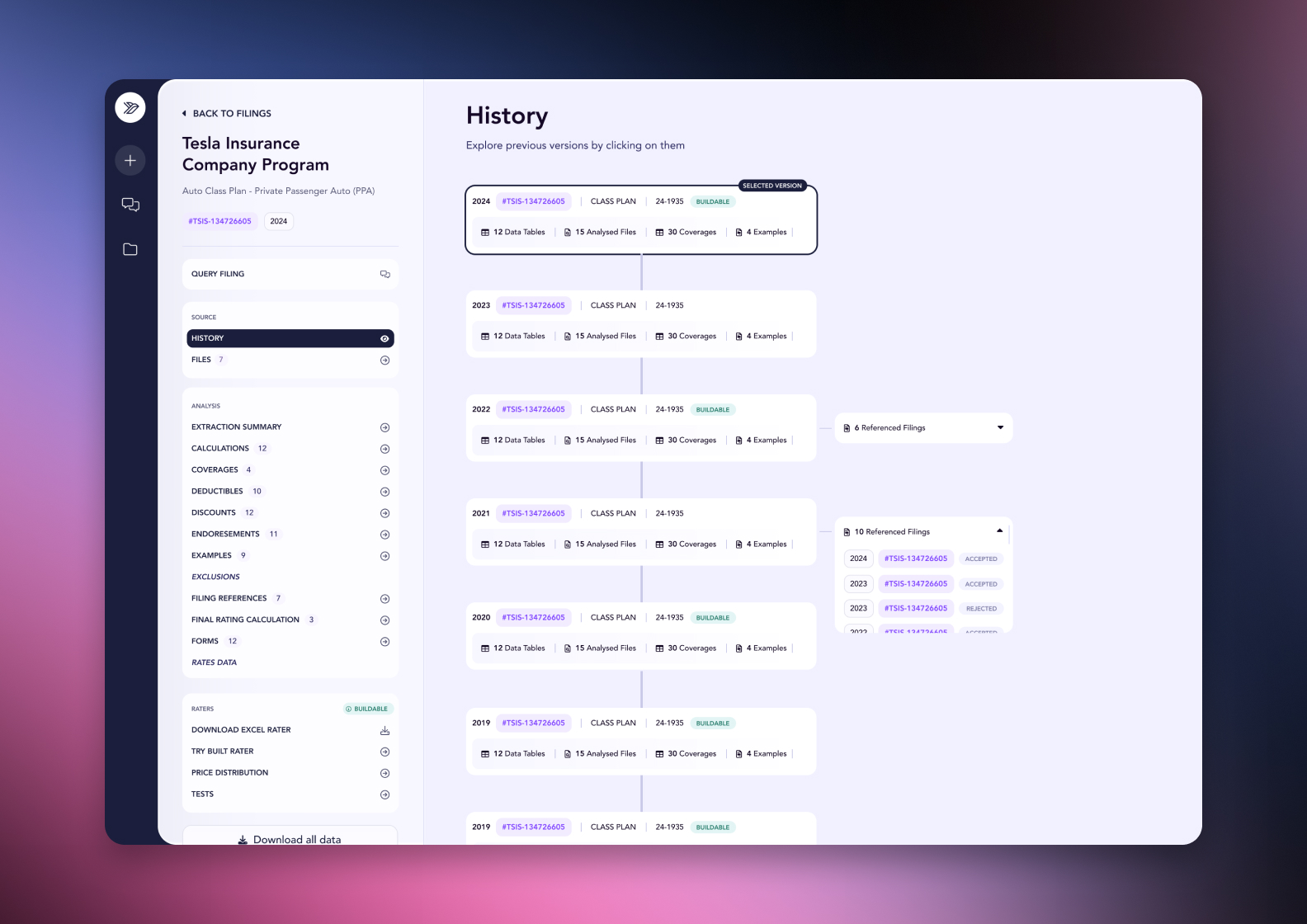

Connected via MCP to the AI you already use, Claude or ChatGPT, or through our dedicated platform, serff.ai makes searching and analysing SERFF filings effortless. Historical research becomes a single question: ask for a product's filing history, or what changed between two points in time, and get a grounded, cited answer in seconds.
The manual way
Search year by year to piece together a product's history.
With serff.ai, just ask
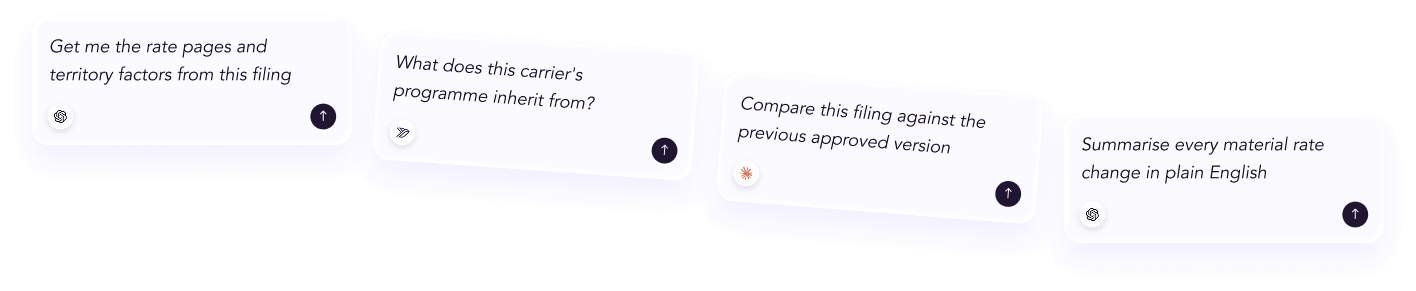
“Show me this product's filing history over the last five years.”
The manual way
Trace tracking numbers backward through predecessor filings.
With serff.ai, just ask
“What is the earliest version of this filing on record?”
The manual way
Guess how far back a state's records actually go.
With serff.ai, just ask
“How far back does this state's filing history go for this product?”
The manual way
Compare an old filing against a recent one by hand.
With serff.ai, just ask
“How has this filing changed since its earliest version?”
Every answer is cited back to the exact page of the source PDF and grounded only in filed values, with no invented numbers, so you can trust it the way this audience needs to. Research that took weeks takes a prompt.
No credit card required. Simply sign up and connect to Claude or ChatGPT or use Swallow’s SERFF.ai platform.
The company tracking number on a current filing is often your best lead into its history, since insurers reuse or reference it across related submissions. Starting recent and tracing backward is usually faster than trying to find an old filing directly.
A product's history is rarely one filing. It's a chain: an original filing, followed by rate amendments, rule filings, and form filings over years. Reconstructing that chain means treating each filing as a link, using its tracking numbers and dates to find the one before and after it.
If a company has merged or changed names, search under both the current and prior name. Older filings are often still indexed under the original entity.
If a state's searchable window doesn't reach as far as you need, check whether the same product was filed in other states around the same period. Multi-state products are often filed with similar timing and content across jurisdictions, so a gap in one state's records doesn't always mean the information is unavailable elsewhere.
A missing older filing doesn't always mean it never existed. It can mean the record predates the portal's searchable window, or that a company or product name change broke the trail. Don't conclude too quickly.
Historical filing research works best backward from the most recent version, following tracking numbers as links in a chain. Expect indexing and format inconsistencies in older records, and check company name changes and other states before assuming a filing doesn't exist.
It varies by state; most portals have a fully searchable window, with older filings sometimes indexed less completely or unavailable entirely.
Start from the most recent filing for that product and work backward using tracking numbers, rather than searching for the old filing directly.
The company may have merged, been acquired, or changed names; search under both the current and prior entity name.
No. Participation and the length of the searchable window vary by state, so a gap in one state doesn't necessarily mean the filing doesn't exist.
Use company and state tracking numbers as links, connecting each filing to its predecessor and successor over time.





 ChatGPT
 Claude
.png)
.png)
.png)
.png)