
Insurance rating factors are the variables an insurer uses to adjust a base rate up or down for the specific risk being priced. Age, location, vehicle type, construction, prior claims and dozens of other characteristics each carry a factor, and multiplying them against the base rate is how a single price becomes thousands of individualised premiums.
When an insurer changes a factor, it changes what a whole segment of customers pays. Reading a rate filing well means finding which factors moved, by how much, and who is affected, which takes working through rate pages and factor tables by hand.
serff.ai is built to do that for you: it indexes millions of SERFF filings and lets you ask questions in plain English instead of opening documents one by one. You can connect it to the AI assistant you already use: Claude or ChatGPT, via the serff.ai MCP server, or work directly in the web platform.
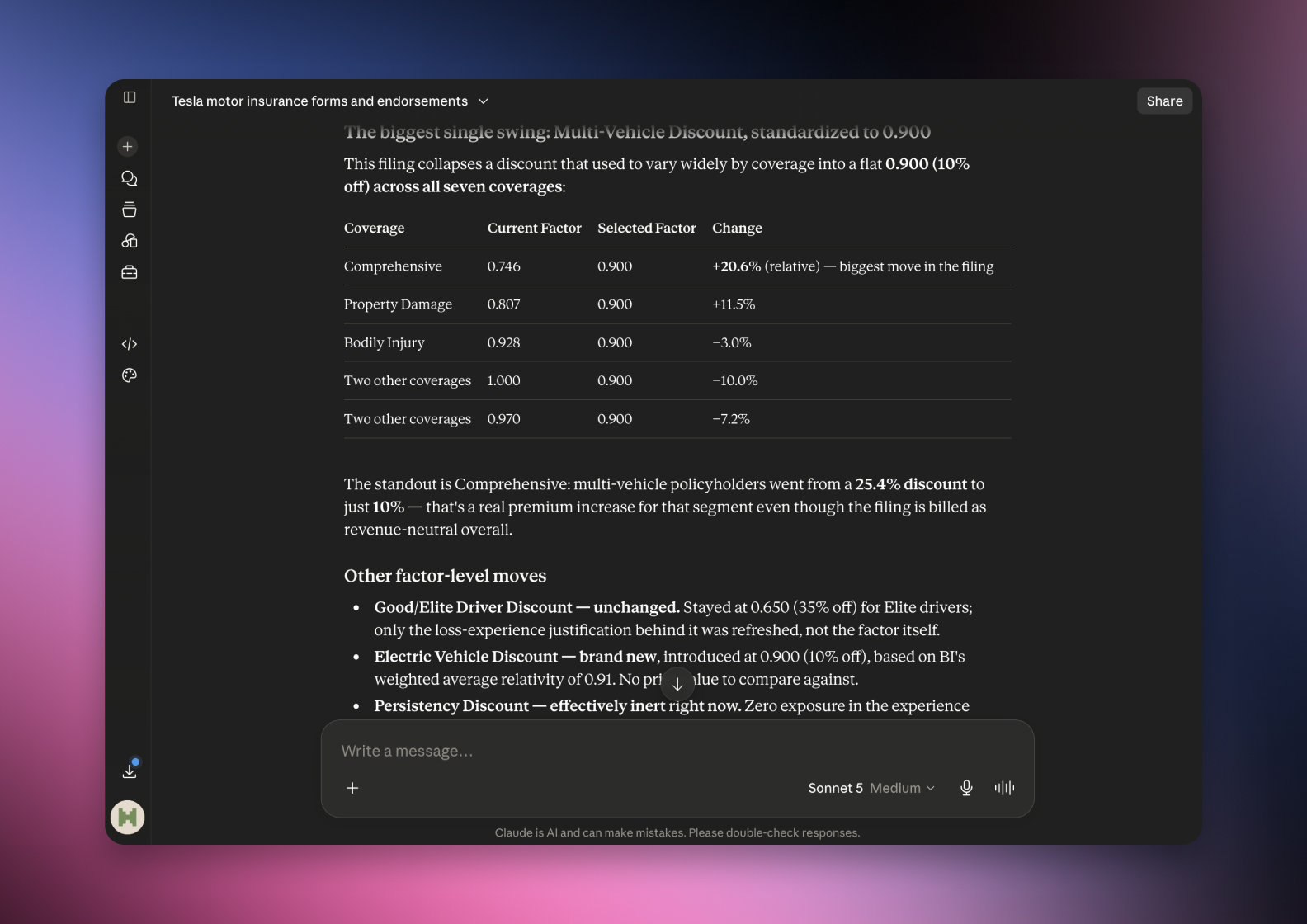

Connected via MCP to the AI you already use, Claude or ChatGPT, or through our dedicated platform, serff.ai makes searching and analysing SERFF filings effortless. A change to rating factors becomes a single question: ask which factors moved, by how much, or who is affected, and get a grounded, cited answer in seconds.
The manual way
Compare factor tables across versions cell by cell.
With serff.ai, just ask
“Which rating factors changed, and by how much?”
The manual way
Work out which customers a factor change affects.
With serff.ai, just ask
“Who is most affected by this factor change?”
The manual way
Read the rate pages to find a specific relativity.
With serff.ai, just ask
“What is the factor for this risk characteristic?”
The manual way
Check whether a new factor was introduced.
With serff.ai, just ask
“Were any new rating factors added in this filing?”
Every answer is cited back to the exact page of the source PDF and grounded only in filed values, with no invented numbers, so you can trust it the way this audience needs to. Research that took weeks takes a prompt.
No credit card required. Simply sign up and connect to Claude or ChatGPT or use Swallow’s SERFF.ai platform.
A premium usually starts from a base rate and is then adjusted by a chain of factors, each tied to a characteristic of the risk. The base rate sets the level; the factors set the spread between one customer and another.
The order in which these are applied is set by the rating algorithm.
Factors live in the rate/rule schedule of a rate filing, on the rate pages and in factor tables. The justification for a factor, its derivation from experience, sits in the actuarial memorandum and its exhibits.
The signal is in the deltas, not the absolute values. Compare the new factor table against the edition it replaces and look for cells that moved, levels that were added or removed, and any variable that is new to the filing. A small change to a widely applied factor can affect more customers than a large change to a rare one.
Read a factor change as a redistribution, not just an increase. When one relativity rises and another falls, the insurer is re-sorting risk, and the customers who move the most are often not the ones named in the headline rate change.
Factors decide who pays more and who pays less, so regulators review them for actuarial support and for fairness. Some variables are restricted or prohibited in some states, and a filing that leans on a contested factor often draws an objection letter.
Rating factors are the multipliers that turn one base rate into thousands of individual premiums. To read a filing, find which factors moved and by how much, and remember that a small change to a common factor can outweigh a large change to a rare one.
A rating factor is a multiplier tied to a risk characteristic, such as age or location, used to adjust a base rate up or down for a specific customer.
The base rate is the starting price for a coverage; rating factors are the adjustments applied to it for each characteristic of the risk being priced.
They appear on the rate pages and in factor tables in the rate/rule schedule, with their justification set out in the actuarial memorandum and exhibits.
No. Factors must be actuarially supported, and some variables are restricted or prohibited in certain states on fairness grounds.
Compare the new factor tables against the prior edition, looking for changed cells, added or removed levels, and any newly introduced variable.





 ChatGPT
 Claude
.png)
.png)
.png)
.png)