
Natural language search lets you describe what you're looking for in plain English rather than guessing the exact words a document uses. For insurance filing research, where the same concept can be worded differently across states and companies, that shift matters more than it might first appear.
This is what natural language search actually does differently from keyword search, and what it changes for anyone trying to find the right filing without knowing its exact wording in advance.
serff.ai is built to do that for you: it indexes millions of SERFF filings and lets you ask questions in plain English instead of opening documents one by one. You can connect it to the AI assistant you already use: Claude or ChatGPT, via the serff.ai MCP server, or work directly in the web platform.
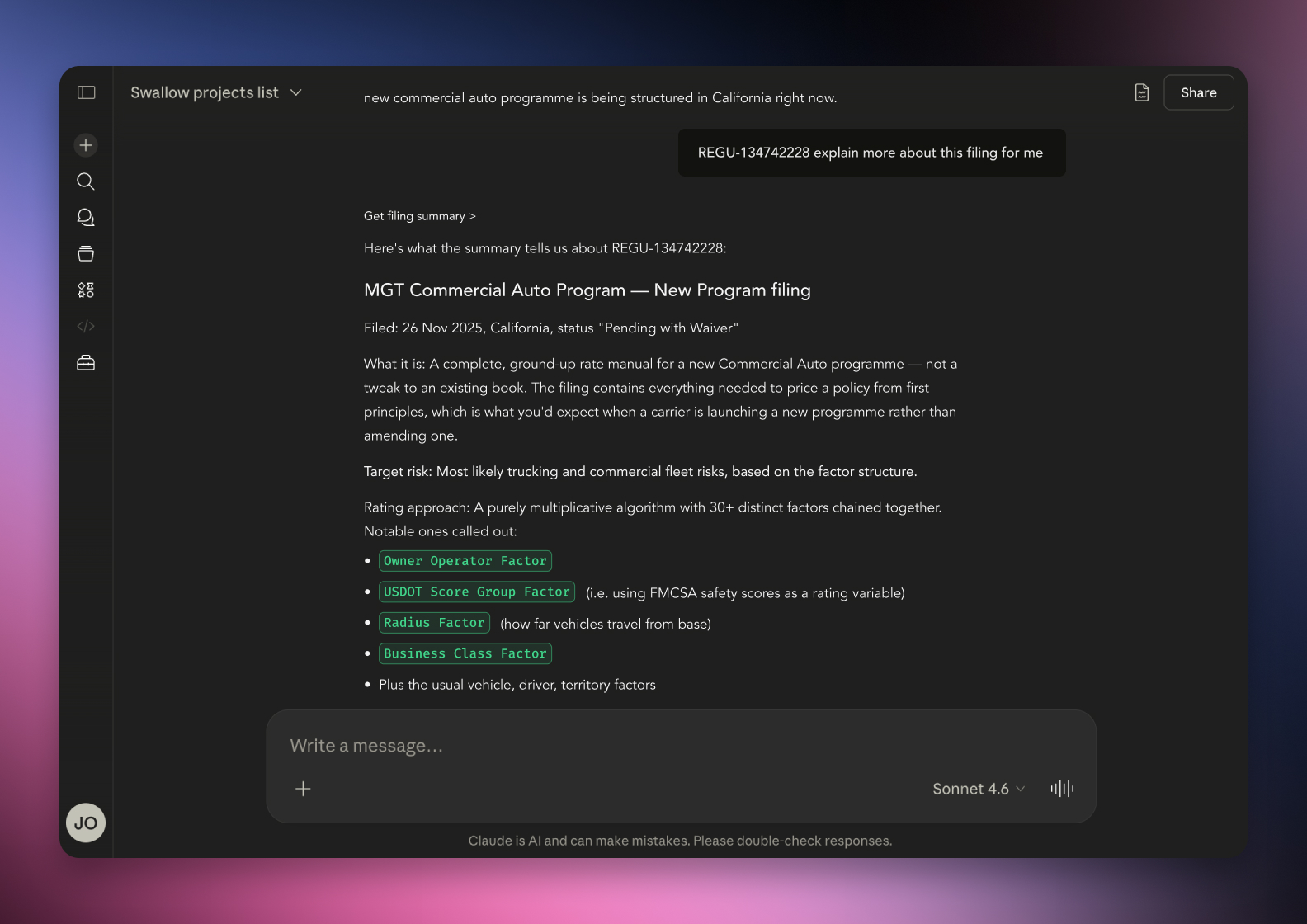

Connected via MCP to the AI you already use, Claude or ChatGPT, or through our dedicated platform, serff.ai makes searching and analysing SERFF filings effortless. Natural language search becomes a single question: describe what you're looking for however feels natural, and get filings that actually match the intent, cited to source.
The manual way
Guess the exact term a filing might use for your topic.
With serff.ai, just ask
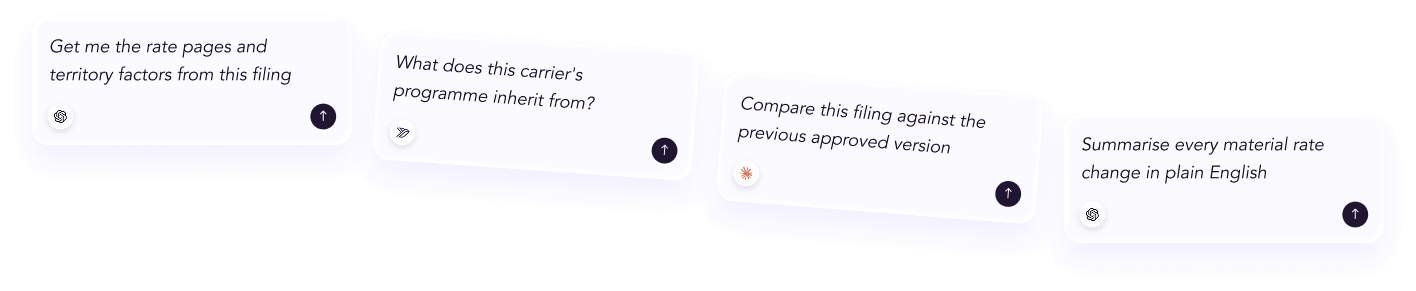
“Show me filings about usage-based insurance pricing.”
The manual way
Run several keyword variations hoping one hits.
With serff.ai, just ask
“Find every filing that discusses this, even if it uses different terminology.”
The manual way
Miss a relevant filing because of a wording mismatch.
With serff.ai, just ask
“Include filings that mean the same thing, even when they use different language.”
The manual way
Translate your actual question into search-friendly keywords.
With serff.ai, just ask
“Answer my question from the filings and show me the evidence.”
Every answer is cited back to the exact page of the source PDF and grounded only in filed values, with no invented numbers, so you can trust it the way this audience needs to. Research that took weeks takes a prompt.
No credit card required. Simply sign up and connect to Claude or ChatGPT or use Swallow’s SERFF.ai platform.
Keyword search matches exact text. If a filing describes a concept using a synonym or a different phrasing than your search term, it can be missed entirely, even when it is exactly what you need. That gap has always been the central limitation of traditional filing search.
Because terminology genuinely varies across states and insurers, natural language search closes a gap that used to require trying several keyword variations, or simply missing relevant filings entirely. It also lets you search with an actual question rather than translating that question into search-friendly terms first.
Ask your real question directly rather than trying to guess the ideal search phrase. Natural language search is designed to work with how you'd actually phrase the question, not a stripped-down keyword version of it.
Natural language search finds relevant material more flexibly, but the answer built from it still needs to be grounded in the actual source text to be trustworthy. Understanding why AI hallucinates is worth pairing with any use of natural language search, since flexibility in finding information doesn't remove the need to verify what was found.
A more flexible search can surface more results, including some that are only loosely related. Check that a result actually addresses your question rather than assuming relevance because it was returned.
Natural language search matches intent and meaning, not just exact words, which closes the gap that keyword search leaves when terminology varies across states and companies. It changes research from guessing the right search terms to simply asking the question, though grounding the resulting answer still matters.
It is search that matches what you're actually asking based on meaning and intent, rather than requiring exact keyword matches.
Keyword search matches exact text; natural language search understands synonyms, context and intent, so relevant results surface even with different wording.
The same concept can be worded differently across states and companies, which is exactly the gap keyword search struggles with and natural language search closes.
Yes, that's the core advantage. Natural language search is designed to work with how you'd naturally phrase a question.
No. It finds relevant material more flexibly, but any answer built from that material should still be grounded in and checked against the actual source.





 ChatGPT
 Claude
.png)
.png)
.png)
.png)